
Nu Holdings: Revolutionizing Banking in Latin America
A Deep Dive into the Digital Disruptor's Growth, Moats, and Future Potential - Nu Bank Stock Analysis 2025

Welcome to Compound & Fire, where we’re on a mission to build wealth the smart way, hunting for top-quality businesses that grow shareholder value over the long haul, paving the road to financial freedom and early retirement.
This community is free, but if you’re enjoying the deep dives and want to fuel more, you can treat me to a coffee on Buy Me a Coffee. Or actually, in this case buy Steven a coffee. A special thanks to Steven van der Burg, an invaluable member of our Compound & Fire community, for doing this amazing work on this deep dive. Give him a follow on X and join the conversation in our Global Quality Investing Discord App where you can find Steven and 500 other quality investing enthusiasts!
Introduction
My Quick Scan recently evaluated NU Holdings, a leading digital banking platform founded in Brazil in 2013 by David Vélez (Colombia), Cristina Junqueira (Brazil), and Adam Edward Wible (USA). The quick scan assigned an Investment Readiness Score of 90.3, signaling a company worthy of a detailed deep dive.
The company began by offering a no-fee credit card managed entirely via a mobile app, which was a disruptive response to Brazil’s fee-heavy, bureaucratic banking system. Over time, Nubank expanded into a comprehensive suite of financial services, including savings accounts, personal loans, insurance brokerage, investments, and even non-financial offerings like a travel booking platform (NuTravel) and a mobile phone service (NuCel).
The company went public on the NYSE in December 2021 at a valuation of USD 45 billion (IPO price USD 9 per share), making it one of the most valuable financial institutions in Latin America. Notably, Nubank raised this capital at the peak of a tech boom, fortifying its balance sheet ahead of a more challenging macroeconomic turn in 2022.
This deep dive article will cover Nu Holdings management, their culture, it’s product and services, business model, strategy and moats, competition, growth expectations and valuation and will include a buy-below price and the final score. Let us know whether you liked this extended deep dive!

Management
David Vélez – Co-Founder, CEO & Chairman (Age:41)
David Vélez Osorno is Nubank’s chief architect and leader. A Colombian by birth, Vélez had first-hand frustration with Latin American banking when he tried to open a bank account in Brazil, an experience of bureaucratic hurdles and high fees that inspired Nubank’s founding. Before starting Nubank in 2013, Vélez was a successful venture capitalist: he was a partner at Sequoia Capital (2011 – 2013) in charge of LatAm investments. He also worked in investment banking and growth equity at Goldman Sachs, Morgan Stanley, and General Atlantic. He holds a BS in Management Science & Engineering and an MBA from Stanford University, giving him both analytical and business skills.

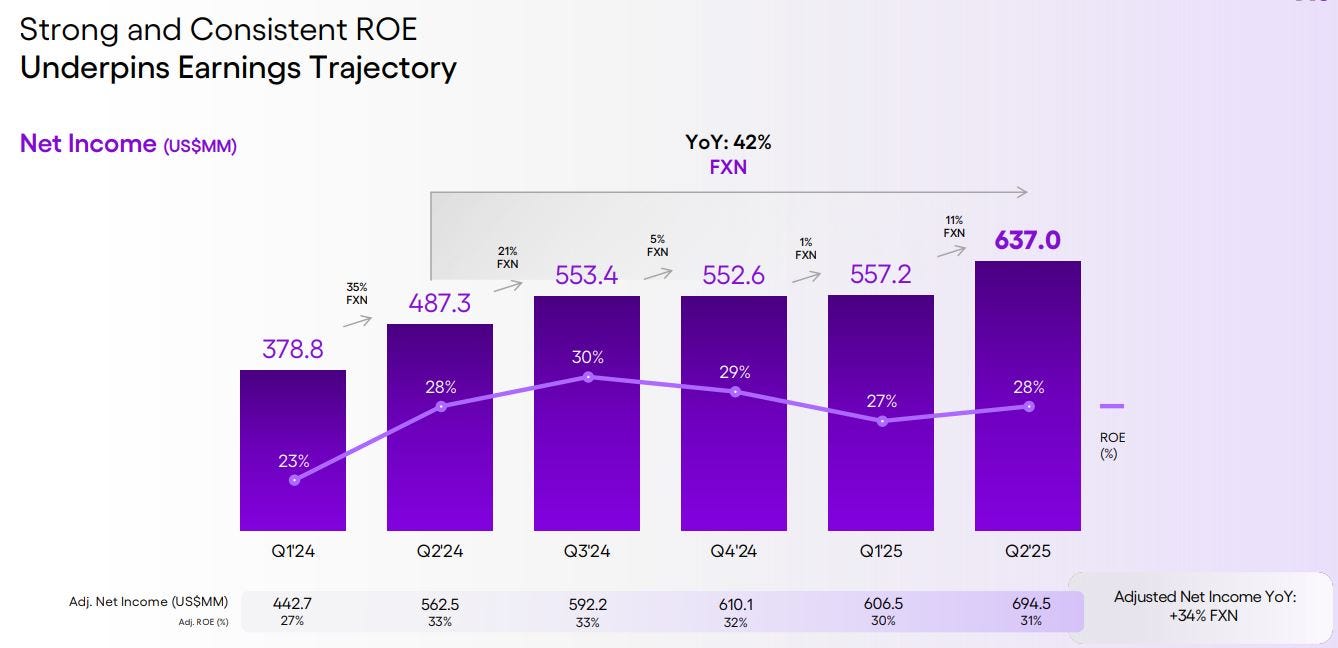
Source: 2Q25 Earnings Release
As Nubank’s CEO, Vélez is widely regarded as a visionary, customer-obsessed leader who grew the company from a small startup to a NYSE-listed banking giant in under a decade. He is known for championing Nubank’s fanatical focus on customer experience and its nonconformist, tech-driven culture. Vélez also serves as Chairman of the Board, cementing his influence over Nubank’s strategic direction.
He has skin in the game: Vélez is Nubank’s largest shareholder. As of the IPO, he owned 938 million shares, mostly Class B with 20× voting power, giving him 75% of voting rights and 19% of economic ownership.
Vélez’s continued leadership is viewed as a key asset. If he were to depart, it could be destabilizing. However, he’s relatively young and deeply committed to Nubank’s mission, so this risk seems low. Overall, Vélez’s mix of venture capital mindset, regional knowledge, and tech vision has been instrumental in Nubank’s rise. He has stated goals as bold as making Nubank ‘the most valuable bank in the world’ and maintaining the company’s culture at scale. Thus far, he has shown prudent decision-making and an ability to attract top talent to the team.
Cristina Junqueira – Co-Founder & Chief Growth Officer (Age 41)
Cristina Junqueira is Nubank’s prominent co-founder alongside Vélez. A Brazilian native, she worked at Itaú Unibanco in credit cards and consumer lending prior to Nubank. She has an engineering background and an MBA from Kellogg. At Nubank’s inception, Junqueira brought deep knowledge of Brazil’s banking products and customer pain points, having seen it from the inside at Itaú. She was instrumental in designing Nubank’s initial credit card product and customer support ethos. She famously insisted on no fine print or hidden fees. For many years, Junqueira was Nubank’s public face in Brazil and led its marketing and growth efforts.

In 2022, her role formalized as Chief Growth Officer (CGO) for the group. In this capacity, she is responsible for growth strategy and operations in new markets (Mexico, Colombia), as well as global marketing and communications. Essentially, she spearheads Nubank’s international expansion playbook and ensures the brand replicates its success outside Brazil.
Junqueira is also a champion of Nubank’s culture and diversity initiatives. She is one of the few female co-founders in fintech and has been recognized in Fortune’s Most Powerful Women International list. She holds a significant equity stake in Nubank as well, about USD 1.8 billion worth as of mid-2025, which amounts to roughly 3% of the company. This makes her one of Brazil’s wealthiest women on paper and aligns her interests with long-term success. Cristina is known to be very customer-centric and detail-oriented, often reviewing customer feedback and instilling Nubank’s fanatical customer love culture in new hires.
Having a co-founder lead growth signals how critical expansion is to Nubank, ensuring new markets getting the same DNA. Her experience at an incumbent bank also provides an insider perspective on how to outmaneuver them. As Brazil CEO until recently, she oversaw Nubank’s core market scaling. Livia Chanes took over the Brazil CEO role in 2024 so that Cristina can focus fully on growth dimensions. These include cross selling more products per customer and pushing into new geographies.
Guilherme Marques do Lago – Chief Financial Officer (Age 45)
Guilherme do Lago has been Nubank’s CFO since Feb 2021. He joined Nubank in 2019 as VP of Finance and was promoted to CFO two years later. Do Lago brings deep banking and finance experience: he spent 13 years at Credit Suisse (2006 - 2019) in various roles, including Managing Director in the investment banking division. He also had a stint at McKinsey & Co. as a consultant (2005 - 2006). He holds an engineering degree from USP and an MBA from Harvard. As CFO, do Lago oversees Nubank’s financial strategy, accounting, and investor relations.

Colleagues describe him as financially disciplined and detail-oriented, which is evidenced by Nubank’s solid financial disclosures and moves like early securitizations of loan portfolios to manage risk. In 2022, CFO do Lago and Vélez took decisive steps to improve profitability: for example, terminating a 2021 employee share award program (saving USD 70 million per year), and slowing hiring growth. This signals a focus on efficiency and shareholder value from the finance side.
Do Lago’s background at a major global bank likely helps Nubank in dealing with regulators, capital markets, he would have been key in the IPO process, and implementing robust financial controls.
In sum, as CFO he brings a conservative counterweight to Nubank’s rapid expansion, ensuring capital adequacy by holding double the required capital and prudent provisioning. He, along with the CEO, signed off on no near-term dividends and reinvestment of profits, indicating alignment with long-term growth.
Youssef Lahrech – President & Chief Operating Officer (Age 50)
Youssef Lahrech joined Nubank in 2020 as COO and was elevated to President in Aug 2022. He comes with nearly two decades at Capital One in North America. At Capital One (a pioneer in data-driven consumer credit), Lahrech held roles spanning product, analytics, risk, and technology, helping build card and lending businesses in the US and Canada. He has advanced degrees in Mathematics / Engineering from top French schools and MIT, giving him a strong quantitative and technical foundation.

At Nubank, Lahrech reports directly to the CEO and is responsible for day-to-day operations: he oversees product performance, platform reliability, marketing execution, and country operations, as well as corporate support functions. Essentially, while Vélez sets vision, Lahrech drives execution. His experience at Capital One likely informs Nubank’s credit underwriting and use of machine learning. Capital One was famous for its analytical rigor, which aligns with Nubank’s data-driven approach to extending credit to new segments.
Since taking on the President role, Lahrech also coordinates Nubank’s multi-country expansion and cross-functional integration. Insiders credit him with improving Nubank’s operational efficiency. He streamlined processes as Nubank scaled from startup to an 8,000+ employee company. Lahrech’s presence is also a signal to investors that Nubank has seasoned management beyond the founders, capable of running a large, regulated institution. He complements the team by having big-bank operational experience but also the adaptive mindset from Capital One’s innovative culture.
Henrique Camossa Fragelli – Chief Risk Officer (CRO)
A seasoned risk manager, CRO since 2018. He has global risk experience at HSBC London. Fragelli is responsible for all risk disciplines such as credit, market, liquidity, operational and AML. His leadership has been crucial in keeping Nubank’s credit losses relatively low and ensuring regulatory compliance as the company grew. He brings a conservative risk culture to balance Nubank’s rapid growth.
Jagpreet Duggal – Chief Product Officer (CPO)
Joined 2020, previously at Facebook and Google. He leads product strategy and development. Under his watch Nubank launched dozens of new features. His Silicon Valley experience reinforces Nubank’s tech/product excellence.
Thuan Pham – Chief Technology Officer (CTO)
Ex-CTO of Uber, joined Nubank in 2022. With Pham’s addition, Nubank gained one of the world’s top engineering leaders, ensuring its platform scales globally.
Livia Chanes – Brazil CEO (since Jan 2024)
Livia was promoted to handle day-to-day in Brazil. She’s ex-Itaú and ex-McKinsey and highly experienced in digital products. Her appointment allows Junqueira to focus on group growth, and brings specialized leadership to Nubank’s largest market.
Are incentives aligned?
Nubank’s approach to capital allocation has been characterized by aggressive reinvestment for growth, careful attention to maintaining a strong capital base, and gradually increasing focus on profitability metrics like Return On Equity (ROE).
Nubank has not paid any dividends and does not plan to in the near term. All earnings are plowed back into expanding the business, be it launching new products, marketing to acquire customers, or geographic expansion. Similarly, Nubank has not engaged in share buybacks; any excess capital is seen as fuel for growth rather than to be returned. Management explicitly states that given the high growth opportunities and high returns on invested capital internally, retaining earnings is the best use. This aligns with shareholder interests as I expect Nubank can continue to earn high ROE levels on reinvested funds.
Decent ROE
Early on, as a fintech, Nubank prioritized growth over immediate profitability along with venture backing to subsidize acquisition. However, as a public company, it has started demonstrating a strong focus on improving ROE and efficiency. In 2024 and 2025, Nubank delivered a 28% - 30% ROE, which is far above peers. Nubank’s capital adequacy is strong by roughly 2× regulatory minimum, but not grossly overcapitalized to depress ROE.
Yes, there is Stock-Based Compensation, but reasonable for a fintech
Like many tech firms, Nubank has used SBC to attract talent. This leads to dilution, which shareholders watch carefully. Nubank had relatively high SBC as a percentage of revenue and currently it hovers around 4.8%. Management has indicated SBC as a percent of revenue will come down as the company scales.
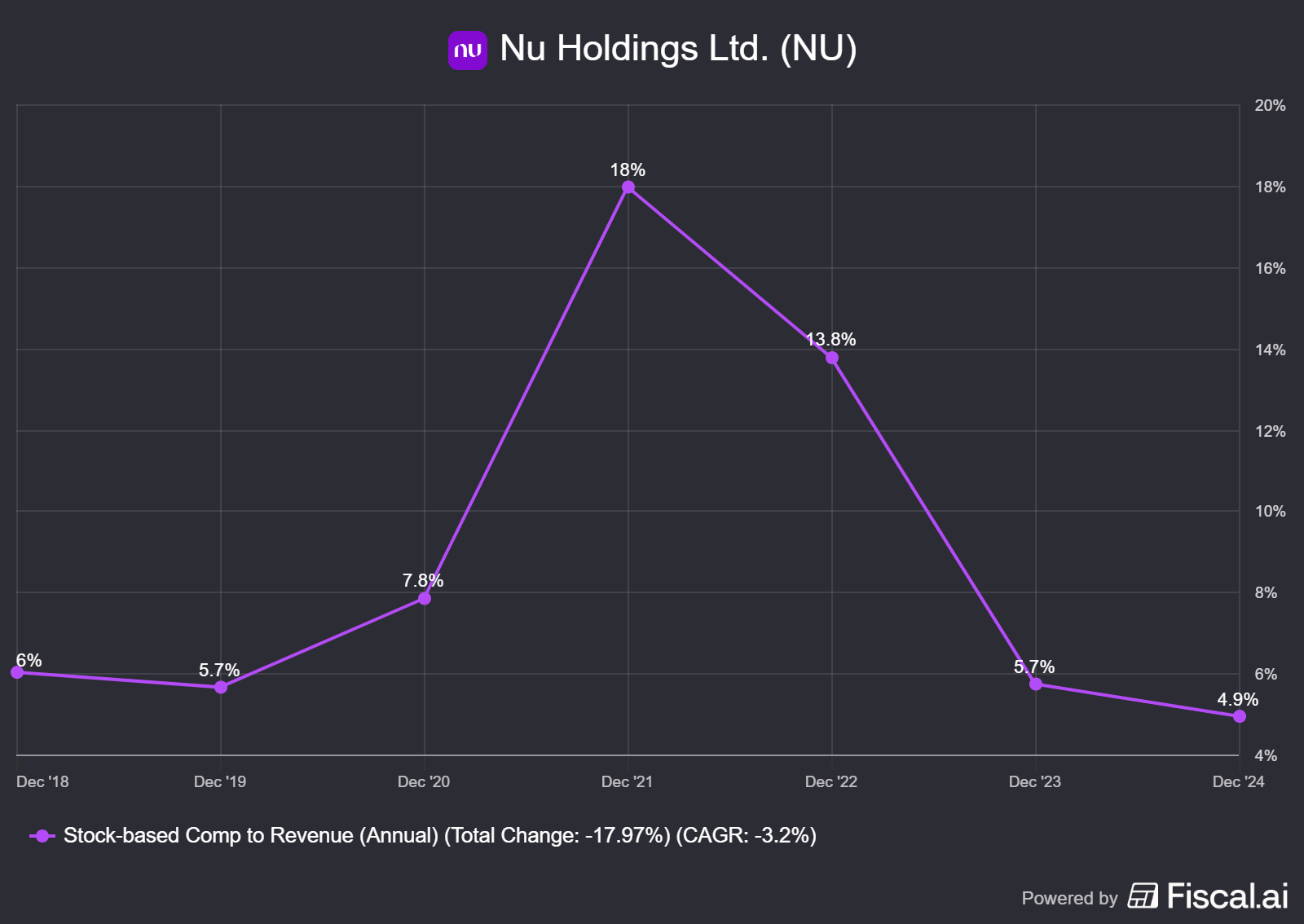
In 2022, Nubank took a notable step by canceling a large contingent share award program from 2021. CEO Vélez himself agreed to terminate that program early, forfeiting some of his own potential awards, to eliminate USD 70 million in annual expense and corresponding dilution. This was a shareholder-friendly move showing management’s willingness to contain dilution and improve per-share metrics.
Due to their SBC program, 76% of employees held shares or awards as of December 2021 (IPO), which is positive for shareholder alignment.
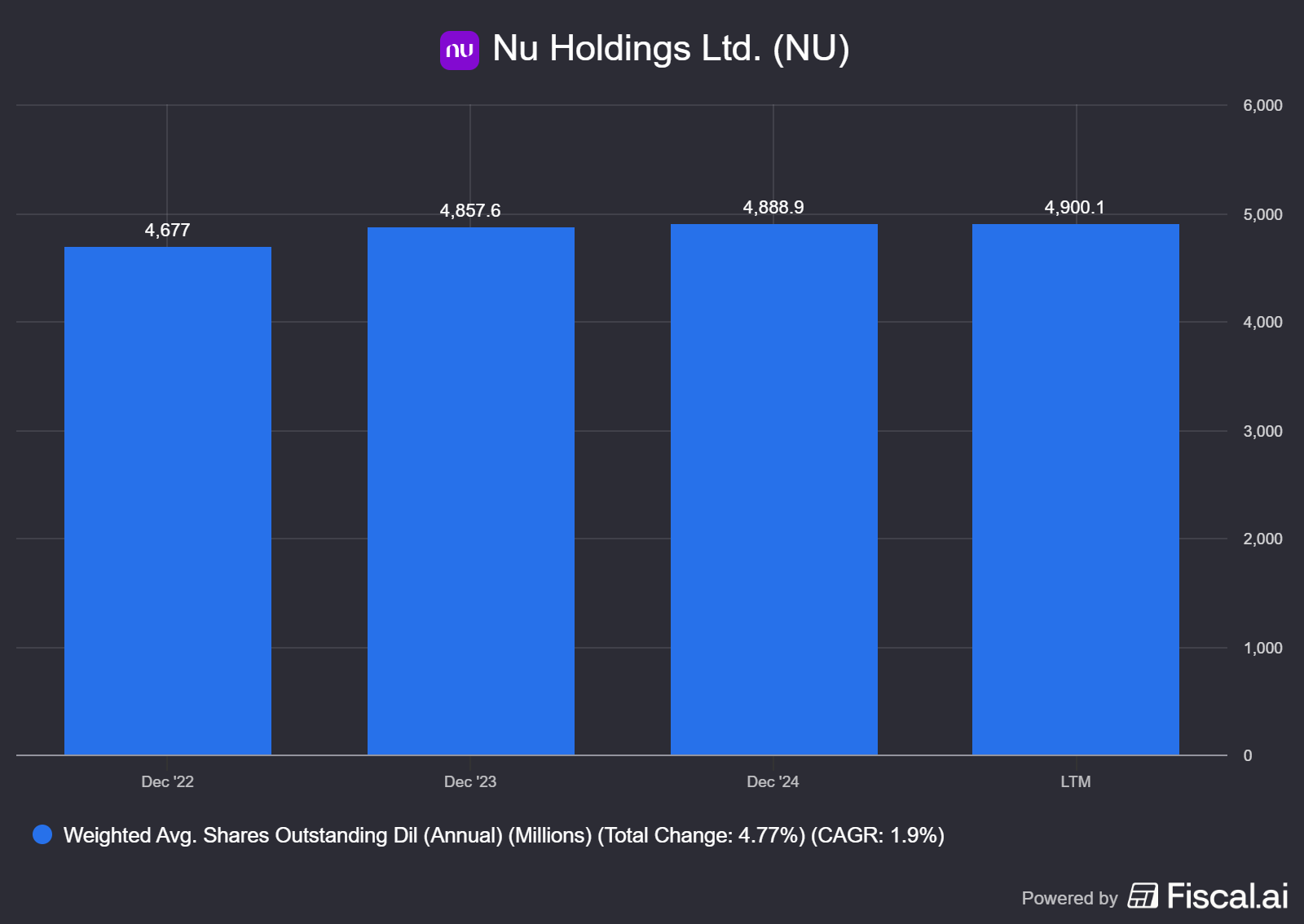
Nubank’s share count did increase post-IPO due to employee options / RSUs vesting, but at a measured pace. As of end-2024, Class A + Class B shares outstanding were ca. 4.9 billion, up only slightly from 4.7 billion at end-2022.
Use of IPO proceeds
Nubank raised $2.6 billion in its IPO in late 2021. Management essentially pre-funded a lot of growth with that money. They haven’t squandered it; rather, it allowed them to comply with higher capital needs for a growing loan book and to expand safely through the 2022 high-rate period without needing to raise costly debt or dilutive equity at lower valuations. This shows good timing and foresight in capital raising. They also secured additional credit lines of USD 650 million in 2022 as backup liquidity. So capital allocation has been prudent in terms of ensuring ample liquidity but not lazily sitting on cash, Nubank’s cash and investments are largely utilized to fund credit growth.
No value-destroying acquisitions - so far
Nubank has made some acquisitions (Easynvest in 2020 for investments, an engineering firm, etc.), but these have been strategic and relatively small. Easynvest was a partly stock deal of USD 70 million. Management hasn’t attempted any oversized, unrelated M&A that would risk capital. All moves like acquiring a minority stake in an Indian payments firm or small tech tuck-ins have been to augment capabilities. Nubank’s management seems inclined to grow mostly organically and only buy if it accelerates their roadmap. Easynvest gave them a brokerage license and 1.5 million clients instantly.
Is Management Transparent?
Nubank’s shareholder communications have been regarded as quite thorough for a young company. The 2022 report even had a ‘Dear shareholder’ letter by Vélez with candid reflections on the year. The annual letters provide detailed metrics like ARPAC, cost-to-serve, activity rate, primary bank NPS, etc., which many banks do not disclose. This level of transparency builds trust that management is not hiding issues.
Solid external reputation
Nubank has earned significant third-party recognition for its transparency and corporate reputation. It’s been named the #1 strongest brand in Brazil in 2023 and won dozens of awards including ones for customer service and innovation. Such accolades imply that not only customers but also industry observers see Nubank as a trustworthy, well-run company.
Culture
Nubank’s culture is a mission-driven blend of customer obsession, innovation, diversity, ownership, and efficiency, designed to empower both users and employees in Latin America’s financial landscape. Their customer-first ethos stands out and fights complexity to deliver "memorable customer experiences."
This culture has been instrumental in attracting top talent both locally and globally, growing to approximately 9,000 employees by 2023 (from 6,000 in 2021) while maintaining a high talent bar. The company has hired senior leaders from world-class firms, such as a former Uber CTO and ex-Facebook product managers, a rarity for a Latin American company, showcasing its ability to compete on a global stage.
Glassdoor reviews reinforce this, with a 4.4/5 overall rating and 91% of employees recommending Nubank, indicating strong employee satisfaction. Reviews frequently praise the mission-driven work and innovative leadership, which aligns with the founders’ emphasis on challenging the status quo through first-principles thinking.
Nubank’s culture encourages bold innovation, building a digitally-native, cloud-based platform with full ownership of its technology stack, enabling control over its destiny. Employees are empowered to act as "protagonists" in a low-ego, mistake-tolerant environment where learning is prioritized: "making mistakes and learning from them is actively encouraged."
The company’s commitment to diversity is another pillar, with the founders highlighting the importance of "strong and diverse teams" to drive creativity and problem-solving. Hiring the "best and most talented people regardless of their CV or pedigree" creates an inclusive workplace that attracts global talent, fostering a meritocratic culture where employees think and act like owners, not renters.
Nubank’s management consciously nurtures this culture, maintaining a relatively flat structure initially and empowering small, autonomous teams dubbed "mini startups." This structure encourages ownership and accountability, with zero tolerance for status symbols or ego, as the founders note: "there is no ego." Despite scaling rapidly, retention remains strong, with key executives staying, suggesting success in preserving this culture.
Are they able to adapt quickly?
Nubank’s culture of ‘challenge the status quo’ inherently means being adaptive. We saw adaptability in product pivots. When customers asked for a loyalty program, Nubank built NuRewards. When Pix emerged, Nubank integrated it deeply, even though it disrupts some card usage.
When the pandemic hit, Nubank quickly moved to remote work and still kept productivity high. The company’s quick expansions into new verticals shows willingness to pivot and experiment beyond core banking. Launching a mobile MVNO (NuCel) is non-traditional for a bank, but Nubank saw an opportunity to keep customers engaged in their app ecosystem with a telco offering. This cross-industry pivot indicates a fearless, agile culture set by management.
Do they have a healthy risk governance framework?
An important aspect of culture in a bank is risk management culture. Nubank’s management has instilled a modern, quantitative risk culture and simultaneously a cautious lending approach despite appearances. For example, they often started customers with low credit limits to learn behavior, then gradually increased. This is a cultural decision to prefer safe growth in credit vs. aggressive lending for short-term gains. Their CRO’s background and early hiring indicates they built robust risk frameworks early. By 2018 they had a CRO and risk team even while private. They maintain a culture where risk concerns can be raised. That shows a healthy balance in culture between growth ambition and decent risk oversight.
Products and Services
Nubank offers several products or services. What started with a credit card offering has been extended with a full platform of financial products, for both consumers and business owners (SME’s). Over time, customers tend to adopt more of Nubank’s financial products, further boosting their overall engagement and the revenue generated per customer. Let’s dive into all these different products, their key features, success to date and recent developments.
Nubank Credit Cards
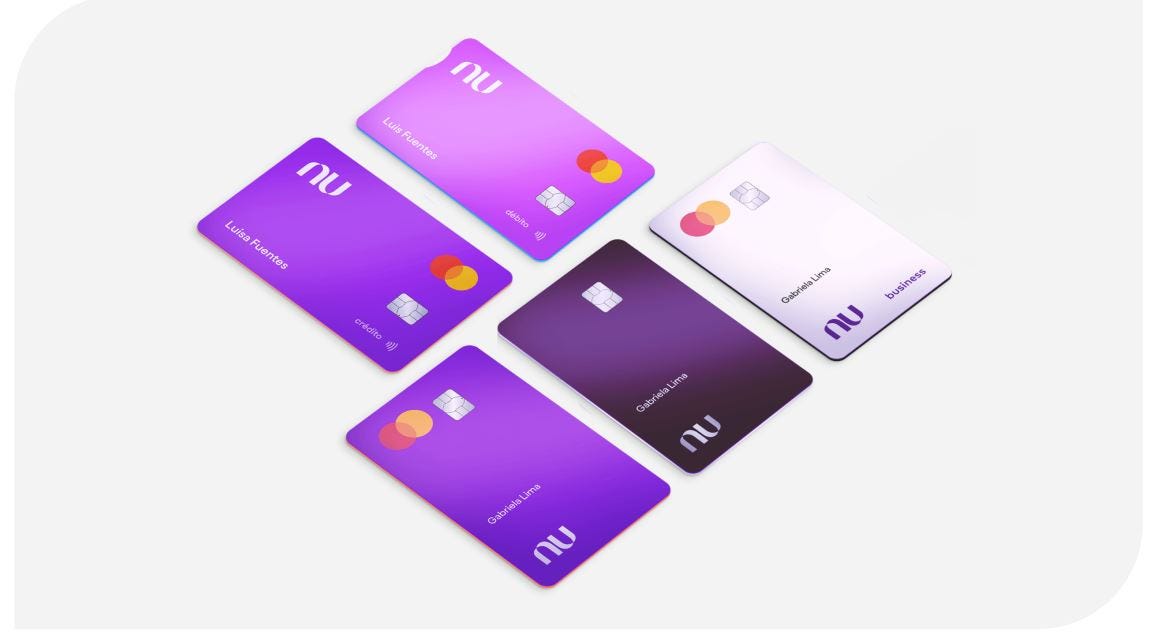
Nubank’s flagship product is its Nu credit card, a no-annual-fee Mastercard launched in Brazil in 2014. It functions as both a credit and prepaid card with a fully digital experience. Customers can apply and manage everything via the mobile app, including credit limit adjustments, blocking/unblocking the card, and bill payments.
Key Features
No annual fees or maintenance charges, breaking from traditional bank card fees.
Provides digital wallet integration by supporting Apple Pay, Google/Android Pay, and even WhatsApp payments (for the prepaid mode) for convenient contactless use.
Mastercard backing means global acceptance at over 150 million merchants worldwide.
The app offers granular control: real-time spend alerts, instant card locking / unlocking, due date management, and even disposable virtual card numbers for secure one-time purchases.
Unique options like installment discounts for early repayment and investment-backed credit limits, where customers can pledge investments to increase their credit line, enhance flexibility.
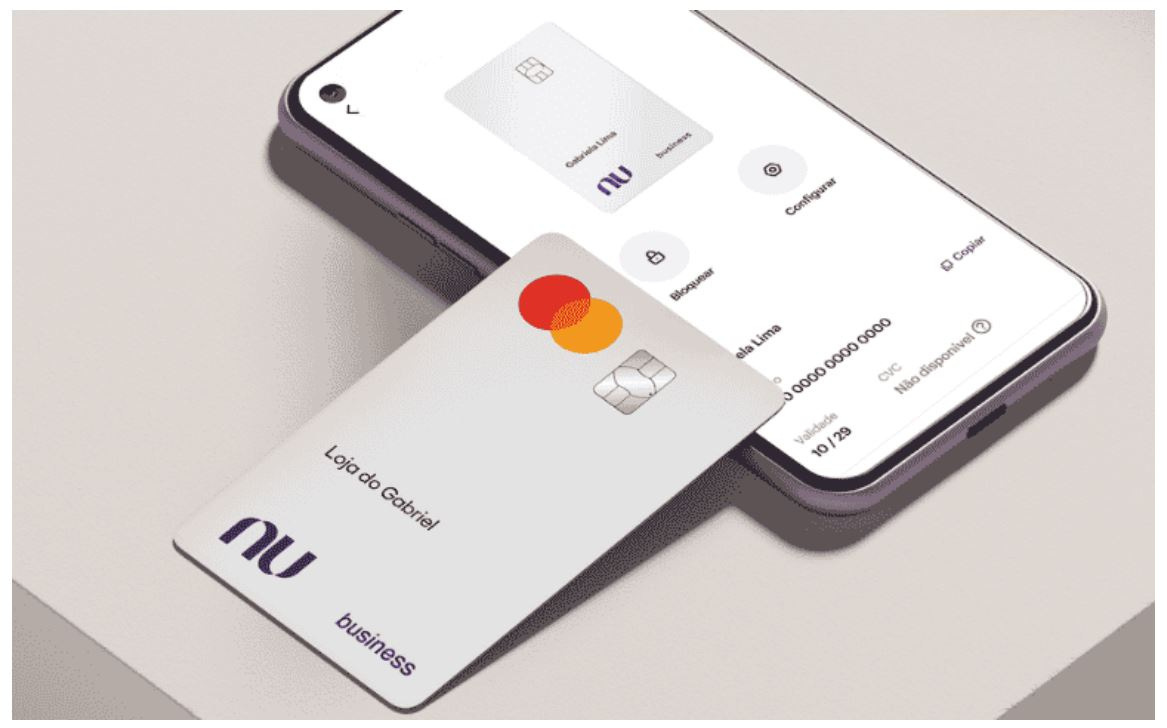
For small business owners, Nubank extended this model. Nu Business credit cards offer entrepreneurs the same no-fee, app-managed card benefits, with added ability to transfer limit between personal and business cards for flexibility.
Success to date
Nubank’s credit card pioneered a transparent, customer-friendly approach in Latin America. The absence of fees and the 100% digital onboarding were revolutionary in Brazil’s card market, providing many users their first-ever credit access. By 2024 Nubank reached over 60 million unique credit card customers in Brazil, about 34% of the 14+ population, indicating massive inclusion of first-time cardholders. It holds about 15% of total credit card purchase volume market share in 2024.
A similar impact is seen in Mexico: Nubank launched in 2019 and rapidly became the country’s leading card issuer by 2024 with 5.6 million Mexican card customers, 50% of whom had never had a credit card before Nu. It controls a 5% share of Mexican card purchase volumes by 2024.
This product’s success is measured not only in customer count but also engagement: Nubank cardholders show very high activity rates, which in turn drive fee income (interchange, interest) for the company.
Recent developments
Nubank has continuously enhanced its credit card offering. In recent years it introduced a suite of ‘transaction financing’ features that augment credit card functionality, for example, customers can split an existing purchase into installments after the fact (Purchase Financing), pay utility bills or rent via card and installment (Boleto Financing), or even send instant Pix transfers using their credit line (Pix Financing). These features, all manageable in-app with transparent simulations, effectively turn the credit card into a multi-purpose credit line, boosting interest-earning receivables and customer stickiness.
Nubank also rolled out contactless payment support and digital wallets integration early, and in 2023 it launched Nubank+ and Ultraviolet tiers which build loyalty through cashback and perks tied to card usage.
On the SME side, Nubank added the ability for business owners to request additional corporate cards and enabled Apple Tap-to-Pay on iPhones, turning phones into POS terminals for card acceptance.
Nubank Digital Accounts - NuConta and Cuenta Nu
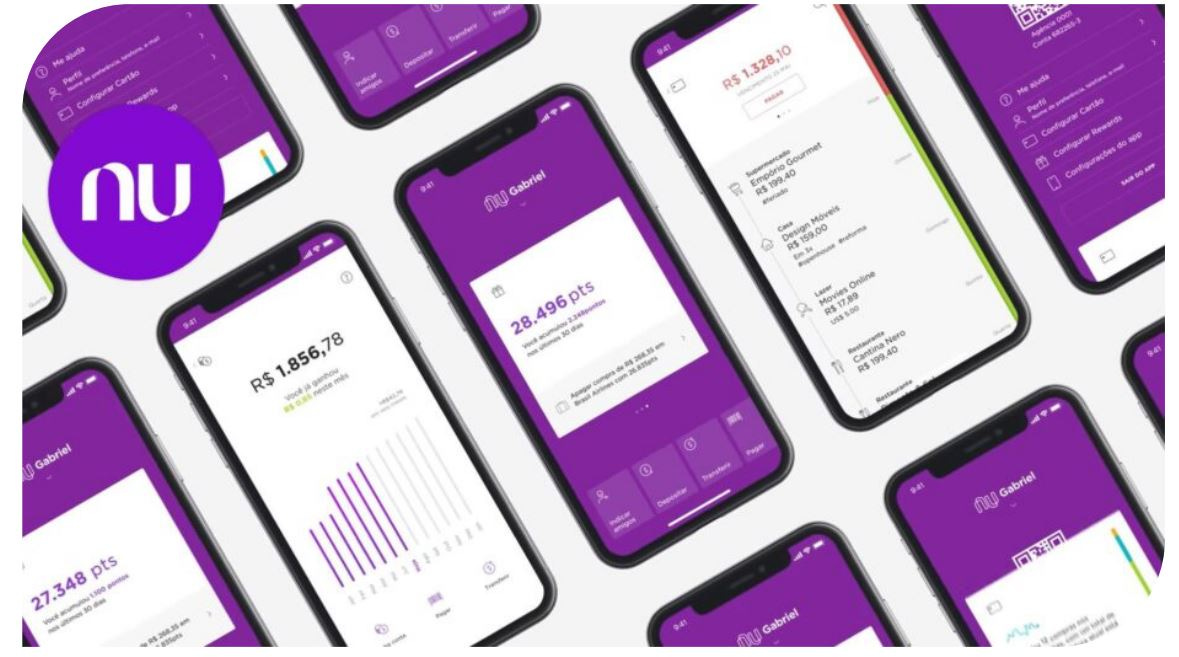
Nubank offers a fully digital bank account that serves as a checking and savings hybrid. In Brazil this began as the ‘NuConta’ in 2017, and in Mexico and Colombia it is called ‘Cuenta Nu’. The core functions include holding deposits, making transfers and payments, and earning daily interest on balances.
Key features
There are no monthly fees or minimum balance, a stark contrast to traditional banks’ checking accounts.
Idle balances are automatically invested in Brazilian government bonds or time deposits, yielding 100% of the Brazilian interbank rate (CDI) with instant liquidity. Similarly in Mexico, Cuenta Nu offers a very attractive savings APR (around 13% at launch, far above market averages).
Customers enjoy unlimited free peer-to-peer transfers and bill payments, including Pix instant payments in Brazil, at no charge.
A complimentary contactless debit card is provided for ATM withdrawals and purchases from the account balance.
The app includes a ‘Payments Assistant’ to organize recurring bills and reminders, ability to set aside money in ‘Reserves’ or sub-accounts for budgeting goals, and an option to lock funds as a time deposit for higher yield. Customers can also schedule automatic savings contributions to instill good habits.
Success to date
Nubank’s account stands out for its simplicity and generous terms. By eliminating fees and offering interest on all deposits, it attracted customers who were frustrated with legacy banks. The ease of opening an account digitally in minutes (using just an app and an ID) brought many unbanked or underbanked individuals into the financial system.
In Brazil, NuConta launched in 2017, rapidly scaling as a free alternative to bank accounts. By Q2 2025, Nubank Brazil had over 107 million customers, many of whom use the account, representing 60% of Brazil’s adult population. Deposits reached USD 36.6 billion by mid-2025, reflecting strong trust in Nubank as a primary bank.
In Mexico, Cuenta Nu was introduced publicly in May 2023 and saw explosive uptake, it reached 1 million accounts in its first month and helped propel Nu Mexico to 10 million customers by the end of 2024. The launch of Cuenta Nu was highly disruptive because it offered an 13% annual yield vs. <1% at incumbents, with 24/7 access and no minimums. By 18 months post-launch, Nu Mexico had USD 3.8 billion in deposits, indicating that a large share of Mexican users adopted the account product. The availability of ‘Cajitas’, money boxes; a savings goal feature, has been cited as a decisive factor for many Mexicans joining Nu.
Nu Colombia launched its savings account Cuenta Nu in mid-2024, and this immediately boosted customer growth; Colombia’s base nearly tripled to almost 3 million by early 2025 after the account launch.
The interoperability with each country’s payment infrastructure (Pix in Brazil, SPEI in Mexico, etc.) and the seamless integration with Nubank’s other products (one app for card, account, loans, etc.) provide a one-stop financial hub that is a key selling point.
Overall, Nubank’s accounts have been highly successful: internal data shows over 83% activity rate of customers and surveys in Brazil indicate a large portion of customers consider Nubank their primary financial account.
Recent developments
Nubank has also built a large physical cash network through partnerships, for example, in Mexico it partnered with OXXO stores (30,000+ locations) so that customers can deposit or withdraw cash to their digital accounts easily.
Other recent enhancements include remittances: in 2024, Nu Mexico launched a feature in collaboration with Wise, enabling customers to receive money from the U.S. via WhatsApp.
Nubank Brazil added ‘Locked Deposits’ options, allowing customers to lock a portion of funds for a higher yield. These locked funds can serve as collateral for credit products.
The account’s payment capabilities have also grown: Nubank was among the first to support Pix instant payments since its 2020 debut, and has added Pix keys, QR code payments, and even voice-initiated Pix via WhatsApp. All these updates keep Nubank’s account on par or ahead of competitors in features.
On the SME side, Nubank’s business account has seen new tools like ‘Meus Impostos MEI’ – an in-app tax module to generate and pay monthly tax forms for solo entrepreneurs, reducing bureaucracy for business owners.
A confirmed near-term development in Mexico; having secured a full banking license in April 2025, Nu plans to introduce payroll accounts and other enhanced deposit products. A payroll account would allow Mexican customers to have their salaries deposited directly into Nubank, likely with perks or interest incentives to capture paychecks from traditional banks.
Nubank Personal Lending – Unsecured and Secured
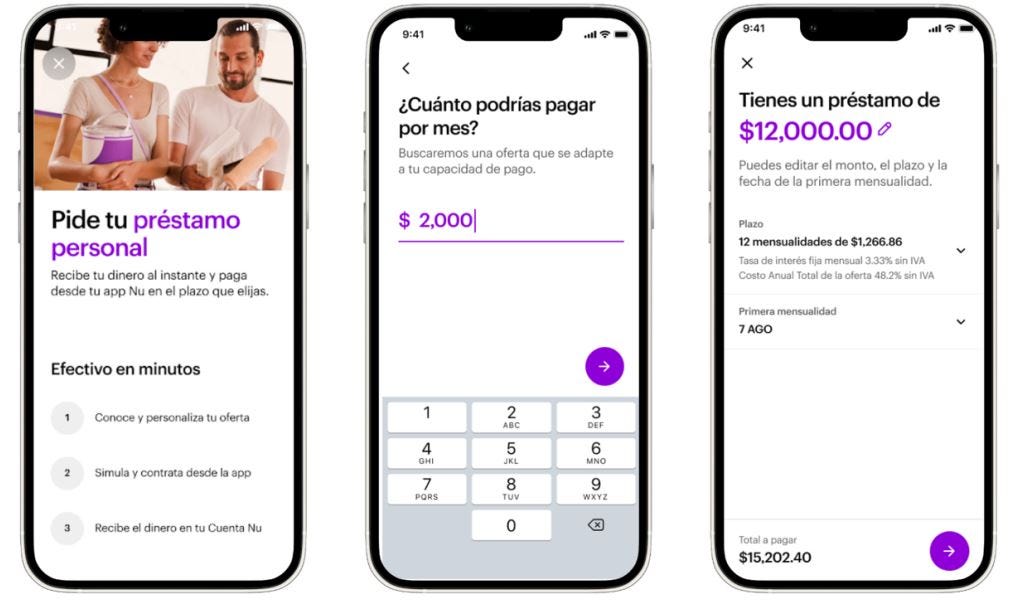
Nubank offers a range of lending solutions, from unsecured personal loans to new secured loan types, all delivered digitally. Personal Unsecured Loans are simple cash loans available to pre-approved Nubank customers through the app. Borrowers can simulate different loan amounts and terms, accept an offer instantly, and receive the money directly into their Nu account within seconds.
Key features
From simulation to approval to disbursement, everything happens in-app in real time. There’s no paperwork or branch visit, aligning with Nubank’s digital model.
The app provides transparent sliders to adjust loan amount and tenure and see the resulting interest and installment clearly. After taking a loan, customers can manage it easily. They can prepay installments or the full loan at any time through the app, often with a discount for early payoff.
In Brazil, Nubank’s personal loan interest rates are below market average for equivalent profiles, thanks to efficient underwriting and lower overhead. The terms are clearly disclosed with no hidden fees.
Loan funds are deposited instantly into the customer’s Nubank account, making access to cash seamless. Repayments can likewise be auto debited, simplifying the experience.
Beyond unsecured loans, Nubank has introduced Secured lending products in Brazil, split up in the following variants:
Investment-backed Loans: Launched in 2022, this allows customers to borrow against their own investments held with Nubank - such as fixed deposits or government bonds - as collateral. Because of the collateral, customers can get a larger credit line at a lower interest rate than an unsecured loan. Crucially, the borrower’s investments stay intact and continue earning, allowing them to handle short-term cash needs without liquidating assets.
Payroll-Deductible Loans ‘Consignado’: Introduced in 2023, this is a form of secured loan where repayment is guaranteed by automatic payroll deduction. Nubank partnered with Brazil’s largest public payroll systems, covering federal employees, military, and pensioners, to offer these loans, which carry very low interest rates. The automation removes the need for intermediaries or brokers.
FGTS-Backed Loans: Also launched in 2023, these loans let customers borrow against their FGTS - a Brazilian severance fund, annual withdrawal allowance. Essentially, Nubank advances the customer a lump sum, and the government’s FGTS fund repays Nubank annually from the customer’s accrued benefits. This gives people early access to money that is ‘theirs’ in a safe, low-rate manner.
Unique Selling Points
Nubank’s lending products emphasize ease, transparency, and inclusion. A major unique point is how accessible these loans are: because Nubank leverages its vast customer data and AI-driven underwriting, it often extends credit to users who might be overlooked by traditional banks.
In Mexico, for instance, personal loans, launched in 2023, are helping deepen customer relationships in a country where consumer credit is underpenetrated. Nubank’s unsecured loans have no requirement for guarantors or physical documents, removing barriers typical in Latin America.
The secured loans are innovative: the investment-backed loan is uncommon in the region and appeals to more affluent customers as a way to handle emergencies without sacrificing investments. The payroll and FGTS loans differentiate Nubank by entering segments traditionally dominated by public banks and niche lenders; Nubank’s value proposition here is a fully digital, no-hassle process and the lowest price in the market for many customers. By bringing its tech efficiency to secured loans, Nubank’s USP is simplifying what are otherwise bureaucratic products. Payroll loans usually involve lots of paperwork; Nubank makes it a few taps.
Success to date
Nubank’s unsecured personal loans launched in Brazil in 2019, and later in Mexico in 2023 and Colombia in 2024. Take-up has been strong: as of Q1 2025, Nubank’s total loan portfolio reached USD 24.1 billion, up 40% year-on-year.
The secured loans are newer but ramping up: Nubank acquired a 182 million dollar portfolio of third-party payroll loans in Q1 2025 to accelerate entry, and is already working with major government payroll systems, covering 60% of the addressable market.
Nubank SME & Business Banking – Nu Empresas
Nubank has built a strong suite of offerings for small and medium-sized enterprises (SMEs) under its ‘Nu Empresas’ (Nu Business) accounts. These business accounts function much like the personal accounts but tailored for entrepreneurs to manage company finances with ease.
Key features
Entrepreneurs. including sole proprietors (MEI), single-owner LLCs (EIRELI/LTDA), and companies with multiple partners can open a business account entirely via the app in minutes, provided the owners are Nubank individual customers. This 100% digital process was pioneering in Brazil’s business banking.
The business account has no maintenance fees or opening fees, saving businesses significant costs. Transactions like transfers are mostly free, including Pix for enterprises. Nubank was one of the first to waive Pix fees for business users.
Business customers get a debit card for expenses and can make unlimited free payments such as bill pay, employee transfers, taxes, etc.. For receiving money, Nubank provides multiple channels;
free Pix keys to accept instant payments of which 91% of business clients already use Pix to receive payments;
a payment link feature to generate payment URLs for clients;
NuTap, a software that allows merchants to accept card payments on their smartphone - no card reader device needed. Notably, Tap to Pay on iPhone was enabled in early 2024, making iPhones into card terminals with Nubank’s app.
Nubank’s business app includes extras like the calculation and payment of the monthly MEI tax within the app. There’s also a Bills / Payment Assistant to track due dates for the business’s recurring expenses, akin to the personal account feature. Business owners can easily separate personal vs. business finances, with distinct account interfaces under one login.
For credit, Nubank offers a Nu Empresas credit card with no annual fee and similar perks as the personal card. In 2021 Nubank began testing credit cards with businesses and saw enthusiastic uptake. A unique feature is that entrepreneurs can shift part of their personal card limit to their business card if needed, providing flexibility in credit allocation.
In late 2024, Nubank also launched Working Capital loans, its first dedicated SME loan product, offering tailored credit lines to support business cash flow needs.
Additionally, in 2023 it introduced ‘Nu Limite Garantido’ for businesses, allowing companies to increase their credit card limit by posting an investment as collateral.
Unique Selling Points
Nubank’s business banking USP is simplicity and cost savings for entrepreneurs. Traditionally, Brazilian SMEs faced tedious paperwork to open accounts and were often charged high fees for basic services. Nubank turned that on its head by offering a quick, no-bureaucracy signup and zero fees on the account. This directly addresses a ‘latent pain’ of entrepreneurs, as business owners want to focus on their business, not bank bureaucracy or abusive fees.
Another selling point is how feature-rich the Nu business account is despite being free: entrepreneurs get tools like tax payment and free Pix payments that would usually be add-ons elsewhere. The integration of NuTap at competitive transaction fees, Nubank’s merchant fees are 30% lower than typical, is a unique benefit that effectively adds payment acquiring to the account offering.
Nubank also leverages its large base of entrepreneur clients, 10 million of its individual customers are entrepreneurs, to cross-sell. 76% of business users are MEIs (sole proprietors) who likely were Nubank individual users first. The ecosystem allows business owners to seamlessly manage personal and business finances in one app, transferring between them as needed.
This led to high customer satisfaction Nubank’s business service achieved #1 NPS in SME banking in Brazil by H2 2022, indicating strong word-of-mouth.
Success to date
Nubank launched its business accounts around mid-2019, initially to sole proprietors upon heavy customer request. Growth has been remarkable: by June 2023 Nubank had 3 million business customers, up 60% in one year. By early 2024, this reached 4 million business customers. Nubank now likely has the largest SME customer base of any bank in Brazil. Moreover, internal surveys show 58% of active business customers use Nubank as their primary business account, meaning they have moved most of their financial activity to Nubank.
Nubank’s share of the SME market profit pool is still small; <1% of Brazil’s USD 11 billion SME credit profit pool as of 2024. On credit, Nubank’s SME credit card issuance has grown, and in October 2024 Nubank disclosed that 65% of its SME borrowers were getting their first-ever business loan through Nubank. Loan volumes to SMEs grew 150% after launching the Working Capital line. This indicates significant success in extending credit to underserved small businesses.
Nubank Investment - NuInvest
Nubank’s journey into investments began with its 2021 acquisition of Easynvest, an online broker, rebranded as NuInvest. Now, Nubank offers customers an array of investment products integrated into the app, aiming to make investing as easy as spending or saving.
Key features
Customers can invest in stocks, ETFs, mutual funds, Brazilian government bonds (Tesouro Direto), high-yield savings bonds (CDBs), and more – all through the Nubank app. The platform offers a wide portfolio of choices, catering to both conservative savers and more aggressive investors.
Nubank introduced zero-commission stock trading for Brazilian equities, a significant USP as many brokers charge fees. Most investment products have transparent pricing with no hidden management fees by Nubank.
The emphasis is on demystifying investing. The app provides clear, jargon-free information on each product and even personalized recommendations or nudges based on a customer’s profile. Educational content is woven in to help new investors. There is also portfolio tracking so users can monitor performance easily.
Importantly, Nubank integrated investing with banking, transfers between the Nu account and NuInvest are seamless, and some features overlap. Money in the main account is actually auto-invested in a money market by default. This means no complex account setup; a Nubank user can start investing literally with a few taps. The app’s design treats investing goals as an extension of saving.
Unique Selling Points
Nubank’s investment offerings are built around accessibility and integration. A key USP is that even very small investors are welcomed – you can start with as little as BRL 1 (USD 0.20) in certain products like government bonds or even crypto (via NuCrypto, discussed next). This lowers the bar for entry dramatically.
Another USP is contextual advice. Nubank’s platform can suggest products appropriate for the customer’s goals, for instance, suggesting a low-risk investment for an emergency fund caixinha. Unlike incumbent brokers that cater to financially savvy clients, Nubank targets the mass population; its study showed that a large portion of its users had never invested before. The bundling of bank and brokerage means instant funding of investments, no delays or complicated transfers, which is an advantage over standalone investment apps. Nubank also leverages its brand trust, as one of the world’s largest digital banks, customers feel comfortable trying investments on the same app they use for daily finances.
Finally, Nubank’s knack for community-building such as educational content, in-app news, and even gamified challenges sets it apart in making investing less intimidating. The Money Boxes concept is relatively unique among banks in Brazil and serves as a USP. It transforms saving into a goal-driven, even enjoyable experience, as opposed to just shuttling money into a generic account.
Success to date
After the Easynvest acquisition, NuInvest officially launched in 2021, and Nubank gradually integrated it by 2022 so that all customers could activate an ‘Investments’ tab in the app. The uptake has been impressive: by late 2023, Nubank reportedly had over 7 million active investing customers, making it one of the largest investment platforms in Brazil by users.
In Brazil, Nubank quickly became a top distributor of government bonds to individuals, reflecting how many users channel their savings via Nu. The Money Boxes feature was also successful – within months of launch, millions of caixinhas were created, and Nubank expanded it to SME customers in Dec 2023 due to demand.
By Q1 2025, Nubank’s investment revenue, largely commission fees, was still a small fraction of overall revenue but growing. The success is also qualitative: Nubank was named the #1 most innovative company in LatAm in 2023 by Fast Company, largely for its impact on financial inclusion in saving and investing.
Nubank Crypto - NuCrypto
NuCrypto is Nubank’s in-app crypto trading and wallet service, launched in 2022. It allows Nubank customers to buy, sell, and hold cryptocurrencies seamlessly through the Nubank interface.

Key features
Users can start investing in crypto with as little as BRL 1 (USD 0.20), making crypto accessible to virtually anyone. This is a stark difference from traditional exchanges that might have higher minimums.
NuCrypto supports trading in a variety of popular cryptocurrencies. Initially launching with Bitcoin (BTC) and Ethereum (ETH), it expanded to include at least 15 different tokens by 2024, such as Uniswap (UNI), Ripple (XRP), Solana (SOL), Stellar (XLM), Polygon (MATIC), Aave, Chainlink, Avalanche, Litecoin, Polkadot (DOT), and even stablecoins like USDC. This breadth allows users to diversify or explore different crypto projects within the same app.
Unlike some fintech crypto offerings that are closed ecosystems, NuCrypto provides a custodial crypto wallet for each user. Users can withdraw their crypto to an external wallet or deposit crypto from outside into their Nubank wallet. Nubank partnered with Fireblocks for secure custody of assets and to facilitate these transfers safely. This feature gives users more control and aligns with crypto norms of being able to move assets freely.
Customers can trade crypto anytime, including weekends, using their Nubank account balance. Because the Nubank account is linked, buying crypto is instant with a tap, and selling converts back to BRL in the account.
NuCrypto not only offers BRL-to-crypto trades but also introduced crypto-to-crypto swap pairs (e.g., BTC↔ETH, BTC↔USDC) with efficient pricing. To ensure good execution, Nubank sources liquidity from multiple providers and does FX conversion via a licensed partner to tap USD markets when needed. This means Nubank users get competitive 14 rates close to global market prices, an important detail in markets where local crypto liquidity can be thin.
Nubank applies its rigorous KYC processes to NuCrypto, meaning only verified Nubank customers can trade. This mitigates fraud risks and aligns with regulations. The user experience emphasizes security. To authorize a crypto transfer, the user must go through strong authentication.
Unique Selling Points
NuCrypto’s primary USP is that it democratized crypto investing for the average person. Many Latin Americans are curious about crypto but find traditional exchanges daunting or unsafe. With Nubank, a trusted brand, offering crypto in the same app as one’s bank, users gained confidence to try it. The integration means no need to create a separate exchange account, remember new passwords, or deal with unfamiliar interfaces.
Another USP is simplicity and educational framing: Nubank provides explainers and ‘price alert’ feature so users can follow market movements with custom notifications. This helps newbies engage without feeling lost.
By offering a range of coins, including a stablecoin (USDC), Nubank also positions itself as a potential platform for dollarized saving. Nubank found that 1 in 4 new NuCrypto investors chose to buy USDC, effectively using it as a digital dollar saving strategy.
Additionally, Nubank’s approach to compliance by registering the necessary approvals, working with licensed partners for FX and using a reputable custody solution as Fireblocks is a USP in terms of safety.
Success to date
Nubank announced crypto trading in May 2022, and by September 2022 it had rolled out to all Brazilian customers. The uptake was very strong: in about a year, Nubank became one of the largest retail crypto platforms in Brazil. The customer increase is impressive; from 1.3 million users in Q2 2023 to 6.6 million users in Q2 2025.
By July 2023, Nubank launched a pilot of NuCoin, a proprietary crypto token intended as a loyalty/rewards token for customers. NuCoin’s testing phase involved select customers and was aimed at creating engagement as users could earn NuCoins for certain activities.
Nubank also integrated crypto content in its marketing by means of educational blog posts, highlighting how easy it is to buy crypto with Nubank. By offering crypto, Nubank increased its ARPAC; crypto trading generates commissions or spread revenue. While still a small portion of overall revenue, it attracts a segment of customers who might otherwise use external platforms.
Nubank Insurance - NuSeguro
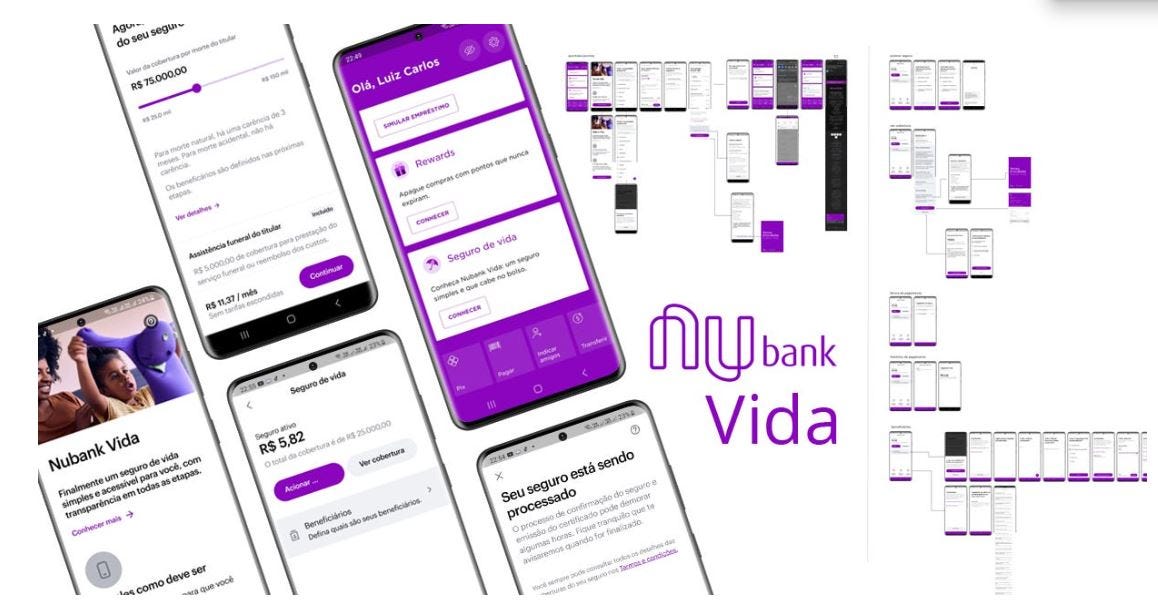
Nubank has entered the insurance market by offering a range of affordable, flexible insurance products through its app, under a unified Nu insurance platform - often in partnership with insurance underwriters. The initial product was Nu Vida (life insurance), and since then Nubank has expanded to cover other areas such as mobile phone insurance, and is exploring home, auto, and other protections.
Key features
From getting a quote to customizing coverage to filing claims, everything is done in-app. The process to purchase insurance is fast, simple, and paperless. For example, a user can get a life insurance quote by answering a few questions in the app and instantly see different coverage options.
Nubank’s policies are highly modular. Customers can choose coverage amounts and add-ons to fit their needs and budget. For instance, in life insurance, one can select different payout amounts, add riders for funeral assistance, etc., all with real-time premium updates. This personalization is designed to avoid overpaying for irrelevant coverage.
Nubank positions its insurance as low-cost and disruptive in pricing. Life insurance premiums start as low as 2 dollar per month for basic coverage. There are no surprise fees, and Nubank often forgoes some traditional broker commissions, passing savings to customers. It clearly shows what each level of coverage costs.
Nubank acts as a broker, partnering with established insurers like Chubb for life and phone insurance. This means policies are backed by major insurers but sold and managed through Nubank’s interface. Nubank earns brokerage revenue while the risk is on the partner, a capital-light model.
A critical part of insurance is claims. Nubank leverages its customer service infrastructure to provide 24/7 support and aims to make filing a claim as easy as a few taps, with minimal paperwork. The idea is to remove the notorious hassle from claims. Users can upload documents or photos in-app for a phone insurance claim and track status in real time.
Unique Selling Points
Nubank’s insurance USP is making insurance approachable and fair for a generation that is skeptical of insurers. By integrating insurance into the same app where users manage money, it’s easier to cross-sell at the right moment, like offering phone insurance when a user spends money to buy a phone. The affordability is a key USP: Nubank explicitly markets that for the price of a coffee, you can insure your phone or life, which is compelling in markets where insurance penetration is low.
Furthermore, flexibility is a key topic. Users can start or cancel coverage anytime without penalty via the app. This no-lock-in, no-bureaucracy approach contrasts with legacy insurers.
Nubank also benefits from its trust and transparency; customers who love Nubank for banking are likely to trust it to not mis-sell insurance, which addresses a traditional pain point of aggressive or confusing insurance sales.
Also, by covering new categories like pet insurance or device insurance, Nubank differentiates with a broad suite all accessible in one place. It’s essentially one of the first one-stop-shops for multiple insurance needs in a fintech app in LatAm.
Success to date
Nubank launched its first insurance product, life insurance, in late 2020 in Brazil. In the first year, it reportedly sold hundreds of thousands of policies, indicating strong uptake. By 2022, Nubank was also offering cell phone insurance and ‘Seguro Família’ (a funeral expense coverage) as add-ons. In 2024, Nubank expanded at least with to different insurance products: life, mobile, home and financial protection.
Nubank’s life insurance likely attracted many first-time insured individuals. They emphasize cases where young customers in their 20s took a life policy, historically a rarity in Brazil, showing Nubank’s reach. Also, because Chubb underwrites, claims have been being paid reliably, which helps build Nubank’s credibility in insurance.
The brokerage revenue from insurance is still a small slice. The insurance profit pool in Brazil is around 5 billion dollar and Nubank’s share is <1%, meaning there’s huge room to grow.
Nubank Other Products - NuPay, NuShop, NuTravel, NuCe
NuPay
NuPay is Nubank’s digital checkout / payment solution launched in 2022. It enables Nubank customers to pay online merchants directly via their Nubank app, with just a few clicks, without needing card details.

For customers, NuPay offers convenience and security. At partner e-commerce sites, instead of entering card info, a user can choose NuPay, approve the payment in their app, and it’s done – eliminating risk of card data theft. It’s a one-click purchase experience.
Customers can pay either using their account balance (debit) or their credit line, and importantly, NuPay allows installment payments up to 24x - even beyond the normal card limit. Nubank essentially extends additional credit for NuPay purchases, boosting customers’ purchasing power.
For merchants, NuPay promises higher conversion rates by simplifying checkout and lower fraud because user authentication is handled by Nubank, a trusted party. It settles to merchants quickly and can support recurring payments for subscription services.
NuPay integrates tightly with Nu’s app and NuShop; within the Nu app’s shopping section, purchases use NuPay by default for a seamless end-to-end experience.
Since launch, NuPay has onboarded many popular merchants, including some big retail chains and digital services in Brazil. Its unique proposition is that no sensitive card info is exchanged, and Nubank can approve transactions internally, leading to near-zero payment processing failure for Nubank users. This makes it a strong USP, especially as e-commerce continues to grow in Latin America.
NuShopping
NuShopping is Nubank’s integrated shopping portal in the app, where users can buy goods and services from partner merchants without leaving the Nubank ecosystem. It curates deals from top e-commerce players: for instance, products from Apple, retailers like Casas Bahia, travel bookings via Hopper, and gift cards via Epay are available.

Nubank negotiates special discounts or cashback for its users on this marketplace. For example, a user might get an extra 5% cashback for buying a phone through NuShopping versus going directly.
Users can complete the entire purchase in-app using NuPay, without needing to register on the merchant’s site or input delivery info repeatedly. Nubank essentially acts as the intermediary, streamlining the checkout.
From electronics to travel tickets, NuShopping aims to cover various needs. It keeps users engaged in the Nubank app even when they’re doing non-banking activities, increasing stickiness.
This marketplace also generates commission income for Nubank, adding to ARPAC.
NuShopping was rolled out around 2021 - 2022 and has expanded since. It taps into the trend of super-apps by embedding commerce into finance. The success is evidenced by high engagement; Nubank often mentions how its customers can shop for major brands inside the app with ease.
NuTravel
Launched in 2024, NuTravel is Nubank’s integrated travel booking service. It allows users to search and book flights, hotels, and other travel services directly in the Nubank app.

Nubank touts that bookings via NuTravel come with guaranteed best prices, likely achieved by partnering with travel aggregators or negotiating rates. This instills confidence that customers aren’t paying more for using a new platform.
In partnership with Wise, Nubank offers a multi-currency account alongside travel booking. Users can exchange BRL to USD, EUR, etc., at low rates and hold foreign currency for travel. This is linked to their Nubank account, making spending abroad easier.
With NuTravel, a customer can plan a trip end-to-end: buy airline tickets, book hotels, and handle forex, all in one app. Expenses can be paid with the Nubank card or account, and possibly in installments, taking advantage of Brazilian habit of installment travel purchases.
The synergy with Nubank’s financial products is strong: customers with Ultraviolet tier get extra travel benefits like lounge access, and presumably, those might integrate with NuTravel for a premium experience.
NuTravel includes innovative perks like offering a free international eSIM for roaming data in certain destinations. This addresses a common travel pain point (expensive roaming), adding value beyond financial services.
NuTravel’s launch indicates Nubank’s ambition to be more than a bank – to be a lifestyle platform for its customers. Early usage has likely been driven by Ultraviolet customers and savvy travelers, but over time it could challenge traditional travel agencies and FX services by convenience.
NuCel
In late 2023, Nubank took a bold step outside traditional finance by launching NuCel, a mobile virtual network operator (MVNO) service in partnership with telecom provider Claro. NuCel essentially offers Nubank-branded mobile phone plans.
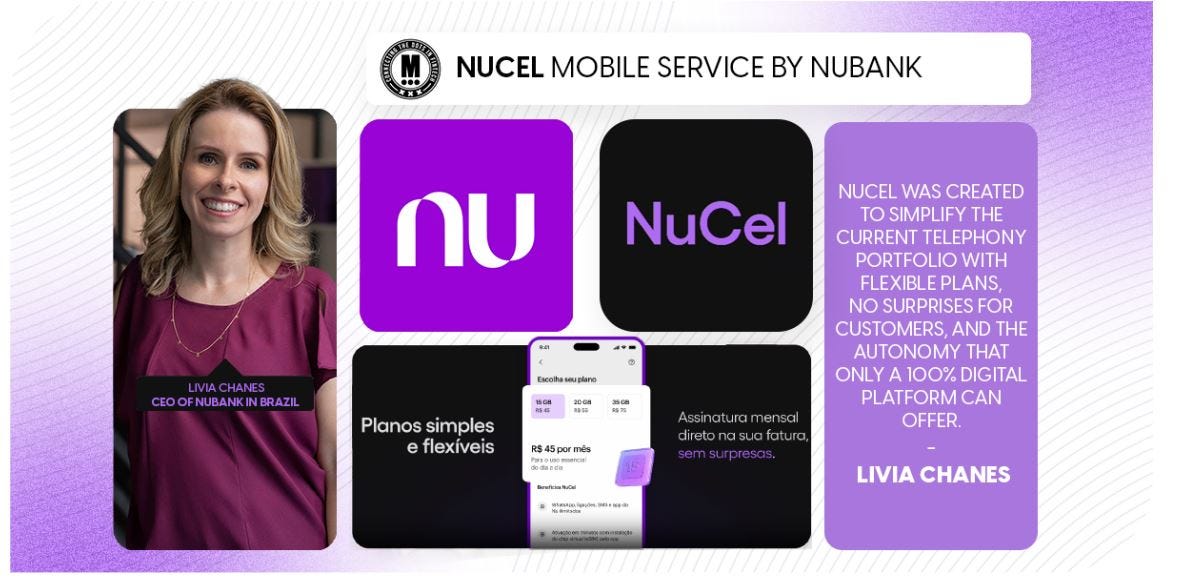
NuCel’s plan is designed with simplicity; unlimited calls (local and long-distance) and unlimited WhatsApp (including calls) are included. This mirrors Nubank’s style of removing hassle.
Unique to NuCel, customers get access to an exclusive savings box with 120% of CDI return on up to BRL 10,000 deposit, valid for one year. This means if a customer subscribes to NuCel, they can park up to BRL 10,000 in a special account earning 20% above the usual rate, effectively subsidizing their phone bill via extra interest. This is a clever cross-industry perk only Nubank could offer, blending telco and finance.
Nubank applies its DNA of transparency to mobile service. No hidden charges, easy plan management in-app, and Nubank’s highly rated customer support for any telco issues.
NuCel started with a limited rollout in late 2023 and will expand if successful. It’s quite innovative, very few fintechs globally have ventured into telecom, and Nubank’s approach of tying a high-yield savings incentive to it is novel.
What is their Business Model?
Nubank’s business model is fundamentally that of a digital-first bank with a freemium pricing strategy. Most of its products are offered with zero or minimal fees to the customer. For example, no annual fee on credit cards, no monthly fee on accounts, free transfers, etc.. This dramatically lowers the cost barrier for customers, particularly the previously unbanked or underbanked, to join Nubank. Instead of charging customers, Nubank monetizes primarily through interchange and interest spreads, essentially capturing revenue from the payments ecosystem and borrowers rather than via account fees. This model was initially ‘subsidized’ by venture capital and IPO funds while Nubank scaled; the bet was that high customer growth and engagement would eventually yield robust revenue per user through cross-sell and increased share of wallet.
Pricing structure – the counter-positioning advantage
Nubank’s revenue model relies on indirect monetization. Credit card interchange is paid by merchants while customers pay nothing for the card, but Nubank earns fee income whenever they spend. Similarly, interest on credit or late fees are only paid by those who borrow or miss payments, and Nubank’s personal loan interest rates are competitive with or lower than incumbents for comparable credit profiles.
Nubank also introduced opt-in paid services like the NuRewards subscription (for enhanced rewards) and has a tiered interest on deposits. Overall, the pricing strategy is to eliminate traditional fees such as account fees, card annuities, etc. – which incumbents relied on for profit – and replace that revenue by expanding volume such as transactions and loans and taking a slice of those flows. This was a classic disruptive play: incumbents couldn’t easily drop their fees without hurting their own P&L, giving Nubank a counter-positioning advantage.
Even as Nubank grows, it has maintained a customer-friendly pricing stance, for example paying above-market savings rates to depositors in 2022’s high-rate climate while still lowering its funding cost due to efficiency. Therefore, Nubank has pricing power afforded by its low-cost structure. It can offer better deposit rates or lower loan rates than peers and still profit, effectively undercutting competitors.
That leads to high dependence on Interest Income Revenue
Nubank generates revenue primarily from two main sources: fees and interest income. The revenue mix has shifted toward interest income. In 2020, fees and commissions made up almost 50% of revenue, but by 2024 interest income and fair value gains represented 83% of total revenue. This reflects Nubank’s rapid growth in its lending and credit card portfolios and the high interest rate environment in Brazil during 2022 - 2023.
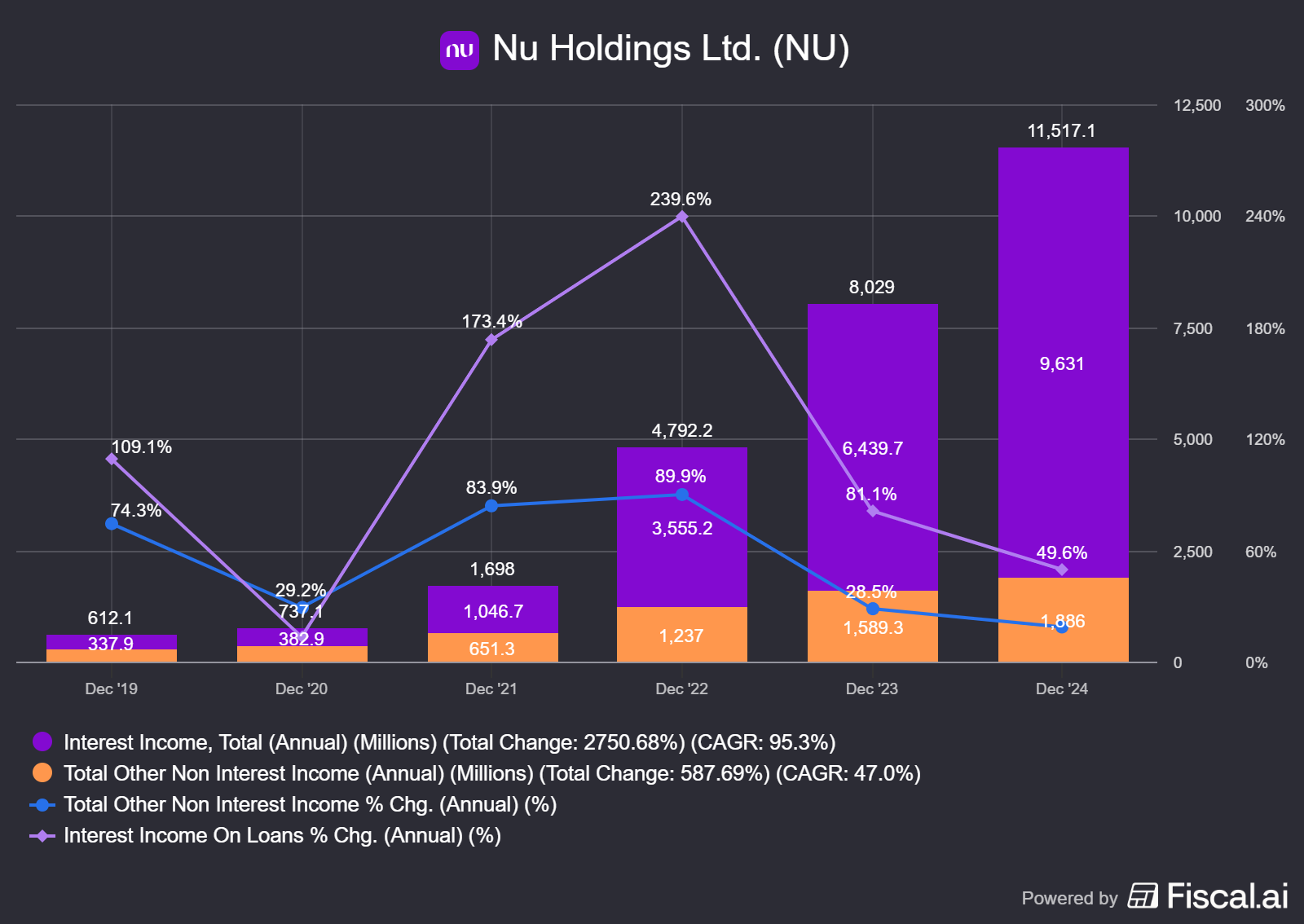
The expansion of interest share is evident: Nubank’s deposits are increasing heavily with YoY percentages of 48% between Q1 2024 and Q1 2025.

Nubank expects the revenue mix to re-balance longer term as newer fee-generating services such as NuShopping, NuInsurance and NuTravel scale up and as interchange volumes grow with customer spending. The company explicitly notes it anticipates credit card revenue concentration to decline over time with product and regional diversification.
Fee and Commission income
Nubank generates non-interest revenue mainly from interchange fees on card transactions, along with smaller fees from services like its premium subscription, insurance brokerage commissions, and other partnerships. Key drivers for fee income include cross-selling of services such as insurance or mobile phone top-ups through Nubank’s app. These fee drivers appear sustainable given Nubank’s expanding active customer base and engagement.
Net Interest Income – NII & NIM
Nubank’s interest income is derived from credit card revolving balances, personal loans, and interest on its investment of excess cash - primarily in government bonds. Interest income soared from 1.05 billion dollar in 2021 to 6.8 billion dollar in 2024.
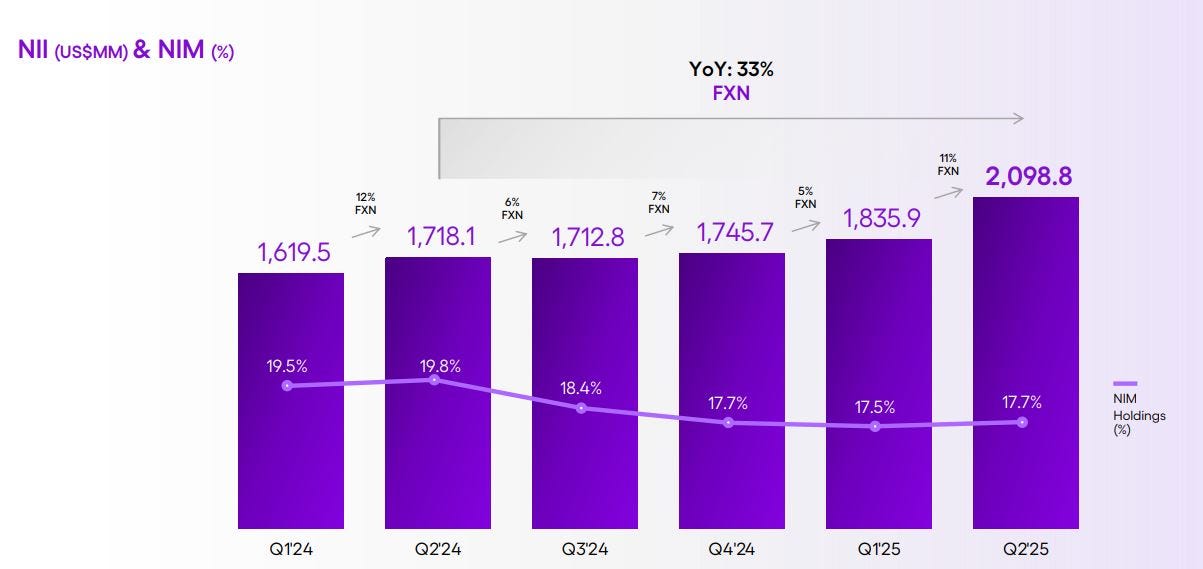
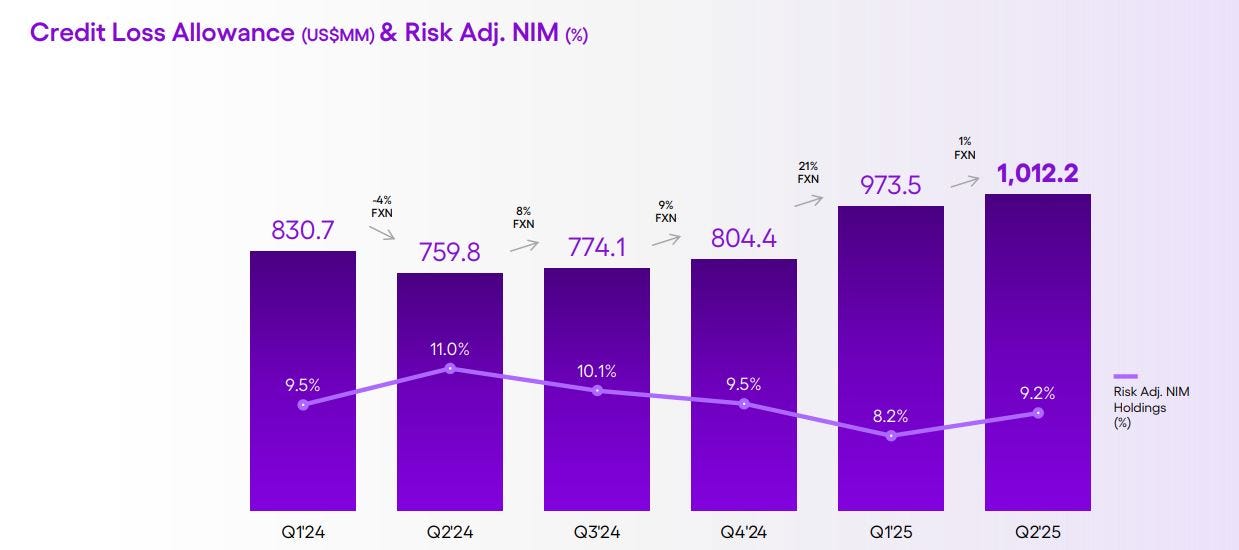
Nubank’s NIM is exceptionally high relative to traditional banks at ca. 17 - 18% versus high-single digits for major Brazilian incumbents, due to its focus on unsecured consumer lending and a low-cost funding base. Even risk-adjusted NIM (net interest minus credit losses) was ca. 9 - 10% in recent quarters, versus 5 - 6% range at incumbents.
Nubank’s outsized NIM comes from its product mix, credit card and consumer loans in Brazil often carry annual interest well above 50%, whereas its deposit costs are around 90% of CDI. Another factor is that Nubank historically held a lot of non-earning cash; as it deploys more cash into loans, reported NIM improves.
Such NIM levels underscore the profitability of its lending, though sustaining them will depend on credit performance and interest rate trends.
LTV - Lifetime Value
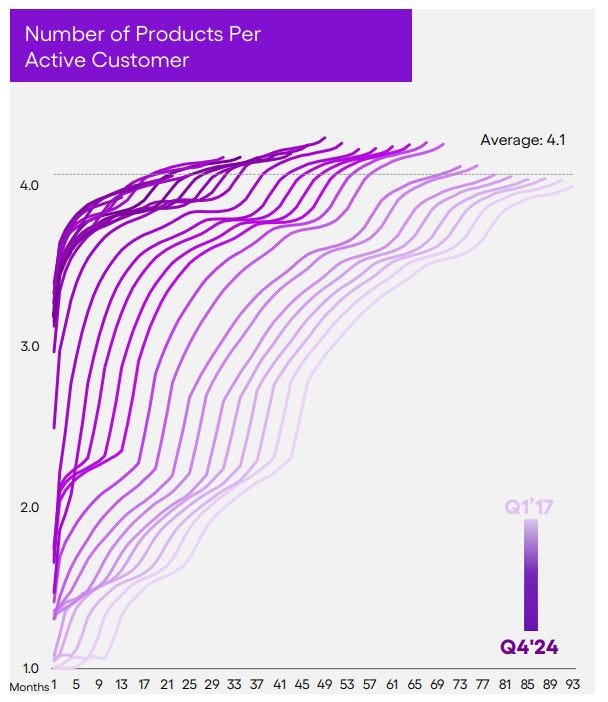
Nubank’s model is built on maximizing the lifetime value (LTV) of each customer through cross-selling and deepening engagement. The company’s data shows that the longer a customer stays, the more products they use and the more revenue they contribute. On average, an active Nubank customer used 4.1 different products in 2024, up from fewer in earlier years. Importantly, 61% of active customers now consider Nubank their primary financial institution, which correlates with higher balances and product uptake.
ARPAC - Average Revenue Per Active Customer
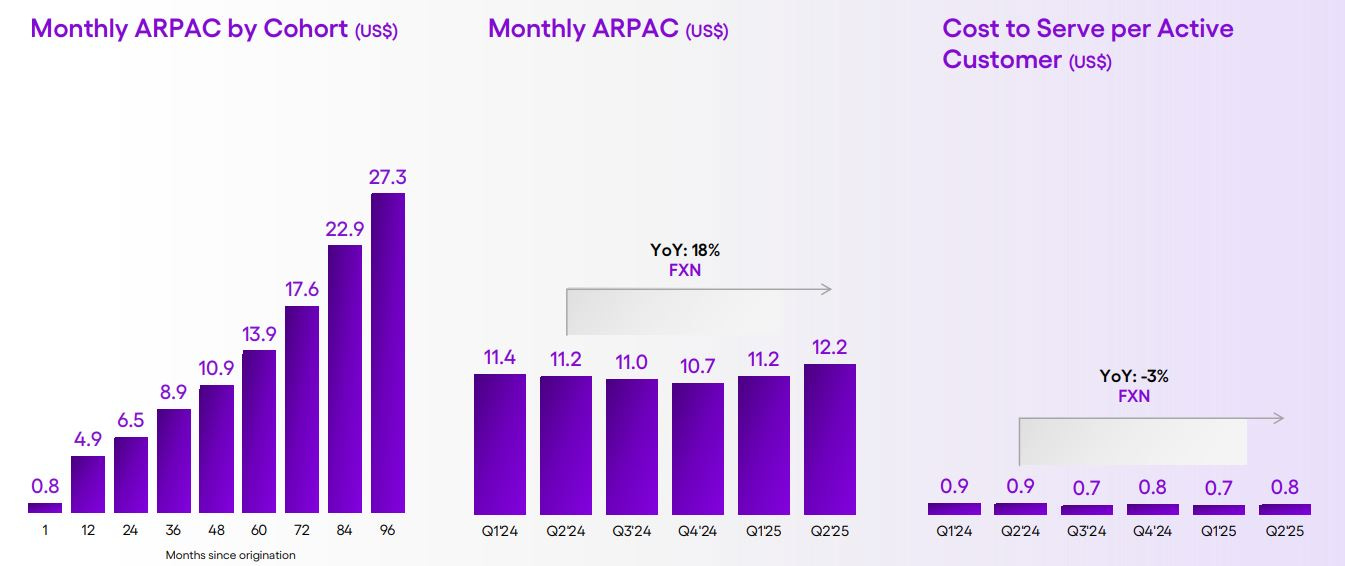
Monthly Average Revenue Per Active Customer (ARPAC) is a key metric used by Nubank to monitor the average monthly revenue generated by each active customer. Nubank’s monthly ARPAC grew from USD 4 in Q2 2021 to USD 12.2 in Q2 2025. As customers use their credit responsibly, Nubank increases their credit limits, which encourages higher spending and in turn drives greater revenue for the company. At the same time, customers become increasingly familiar with Nubank’s products and begin to spend more frequently on the platform. This deeper relationship often leads to the adoption of additional Nubank financial products; as customers engage with multiple products, the company sees a substantial boost in the revenue earned per user. Cohort analysis reveals that this pattern persists over time, with most customer cohorts ultimately surpassing a monthlyARPAC of USD 27 in their 8th year of activity.
Cost to Serve per Active Customer
The average cost to serve each customer remains stable at about USD 0.80 per month during the last years. This dynamic, rising ARPAC while cost per customer stays flat, showcases powerful operating leverage in Nubank’s model.
The company has effectively no marginal customer acquisition cost for referrals and very low marginal servicing cost (the app and cloud infrastructure scales cheaply), so each additional product or account a customer adopts contributes almost entirely to margin. Nubank highlighted that its cost to serve plus G&A per active customer is ca. 85% lower than incumbent banks’. Concretely, a traditional bank might spend more than $4 per customer per month on branches, staff, etc., while Nubank spends less than $1. This cost advantage allows Nubank to offer better pricing and still achieve profitability.
What are the main Unit Economics?
CAC vs LTV
With Customer Acquisition Cost (CAC) between $5 – 10 and annual revenue per active customer around $146 and growing, the payback period on customer acquisition is very short, just half a month(!) of ARPAC covers CAC. With average customer lifespan likely to be many years, and increasing product adoption, the LTV / CAC ratio is enormous, supporting aggressive growth without cash burn.
Margin per Customer
Monthly cost to serve of $0.8 and ARPAC $12.2 in Q2 2025 yields a gross margin per customer of $11.3 per month, or $135 per year, before operating expenses. Given operating expenses per customer continue to decline with scale, more of this gross profit flows to the bottom line each year.
Efficiency Gains
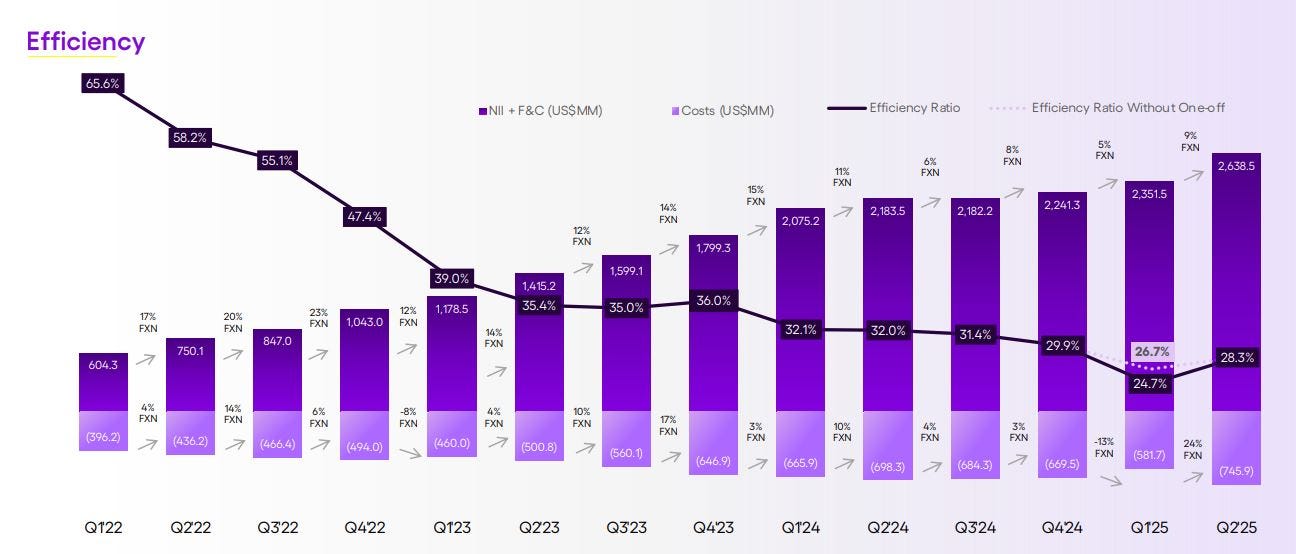
The efficiency ratio (cost / revenue) improved to about 28.3% by Q2 2025 on a banking basis excluding provisions. This trajectory shows that as Nubank scales, incremental revenue comes at high incremental margin. For example, revenue grew 67% in 2023, but operating expenses grew only ca. 30%.
Profitability
Nubank turned the corner on profitability by mid-2022. Currently, Nu bank has an impressive net profit margin of 17.4%. The high ROE of 28% is evidence of the strong per-unit profitability now that the business has reached scale. This profitability emerged much faster than typical fintechs. Nubank is already one of the most profitable banks in the world on an ROE basis, despite its young age.
Strategy and Moat
Nubank frames its entire operating model around four core principles that guide its culture, strategy, and execution. Together, they explain how the company scaled rapidly, disrupted incumbents, and built one of the most efficient and customer-loved banking platforms in the world, and will continue to do in the future.
Mission Driven Culture
Nubank was founded with a clear mission: fight complexity and empower people. This mission is woven into its organizational culture. Every team is expected to ask how their work advances financial inclusion and improves lives. The company actively recruits and retains employees who resonate with its purpose, creating a sense of ownership and alignment across the organization. This principle also drives Nubank’s long-term orientation: prioritizing sustainable customer trust and financial inclusion over short-term profit maximization. The result is a culture where mission comes before bureaucracy, and decisions are filtered through the lens of impact on customers and society.Extraordinary Customer Experience
Nubank strives to deliver financial services that people actually love using, a radical concept in Latin America’s historically unfriendly banking sector. Products are designed to be simple, transparent, and free of hidden fees, directly addressing the frustrations customers had with incumbents. The app provides real-time control, intuitive interfaces, and fast onboarding. Customer service emphasizes empathy, speed, and effectiveness, helping Nubank achieve a Net Promoter Score (NPS) near 90, far higher than traditional banks. This focus on extraordinary experiences has turned customers into promoters, fueling Nubank’s viral, low-cost growth.Advanced Technology
Nubank operates as a technology company with a banking license, not the other way around. It built its core systems in-house, using cloud-native infrastructure that scales seamlessly to tens of millions of users. Proprietary platforms allow rapid product launches, high reliability, and low operating costs. The company invests heavily in engineering and product talent globally, often through acquisitions of specialized firms such as Cognitect, Plataformatec and Hyperplane AI. This technology-first principle ensures Nubank remains more agile, efficient, and innovative than incumbents tied to legacy systems.Proprietary Data Science
Data is embedded in every function of Nubank, turning its massive customer base into a competitive advantage. AI and machine learning models assess thin-file or first-time borrowers, enabling financial inclusion while controlling risk. In addition, Nubank focusses heavily on fraud detection by real-time monitoring systems to flag behavioral patterns anomalies instantly. Data driven insights tailor credit limits, product offers, and app experiences to each user. Finally, by forecasting models Nubank optimizes collections, marketing spend, and resource allocation.
With 120 million customers generating billions of monthly transactions, their proprietary data models compound over time, reinforcing its risk-adjusted profitability and product adoption.
Moats
NU Holdings (Nubank) has built a competitive position in Latin America's digital banking sector through a combination of technological innovation, customer-centric execution, and scale. However, its moats are tested against both traditional incumbents and emerging fintech/neobank rivals.
Switching Costs (Rank: 3)
Switching costs for Nubank are moderate, creating some stickiness through ecosystem integration and habit formation. In retail banking, costs are low on paper, customers face no fees or contracts to leave, and many in Latin America use multiple providers. However, Nubank builds "soft" barriers as users bundle services: salary deposits in NuConta, savings in investments, and bills paid via the app. The longer customers engage, the more entwined Nubank becomes with their finances, with ARPAC rising over time due to increased product usage.
For example, shifting all activities (e.g., credit cards, loans, payments) to a competitor requires effort, new setups, and trust-building. Compared to peers like Banco Inter (with higher complaint rates), Nubank's seamless experience amplifies this moat. Still, it's not insurmountable, dissatisfied users could migrate gradually, and it strengthens primarily against incumbents rather than agile fintechs.Cost Advantage (Rank: 4)
Nubank enjoys significant cost advantages driven by its scale economies and efficient digital model. With over 123 million users across Brazil, Mexico, and Colombia by mid-2025, Nubank is the largest digital bank outside Asia. This massive customer base allows it to spread fixed costs thinly, achieving an average cost per customer of USD 0.8 and an efficiency ratio of 28.3%, far below the 40-50% at traditional banks with branch networks. Nubank's branchless, cloud-based platform contrasts with incumbents' high overheads, enabling lower operational costs.
Among neobank competitors, Nubank's scale remains unmatched in Latin America. For instance, Brazil's Banco Inter has about 33 million customers (one-third of Nubank's), while others like PagBank or C6 Bank lag further. In Mexico, Nubank's 7+ million customers outpace local startups like Albo or Klar, providing cross-selling synergies that smaller rivals lack. Nubank shares these economies with customers via low/no fees, saving users $11 billion in 2023, fostering loyalty. However, this advantage is mainly against incumbents; as fintech peers grow, the gap may narrow, though Nubank's first-mover lead sustains it for now.Regulatory Barriers (Rank: 3)
Regulatory barriers provide Nubank a moderate moat, favoring established players like it over smaller entrants. Navigating Latin America's complex financial regulations (e.g., obtaining banking licenses) impedes newcomers, as seen in Nubank's full licenses in Brazil and Mexico, with Colombia in progress. These are not exclusive but require significant compliance expertise and capital, which Nubank has built through scale and execution.
Regulations generally benefit incumbents and scaled institutions, presenting hurdles for smaller fintechs aiming for market share. For Nubank, this bolsters its position, especially in secured lending like payroll loans. However, competitors like Mercado Pago also hold licenses, so this isn't a unique cornered resource. Against pure startups, it's stronger, but as neobanks mature, the barrier may weaken, though Nubank's track record in multi-country expansion (e.g., rapid Mexican growth) gives it an edge.Brand Power (Rank: 4)
Brand power is one of Nubank's strongest moats, built on its identity as a customer-friendly disruptor. From its purple "Roxinho" card becoming a status symbol in Brazil, Nubank has cultivated emotional loyalty. It ranked as Brazil's Strongest Brand in 2022-2023, outpacing heritage names, and is among the top 10 "most loved" brands. NPS around 90 (three times incumbents') drives 80% word-of-mouth acquisition, lowering costs.
This "cool factor" appeals to younger users, often compared to Amazon or Starbucks in devotion. Surveys show Nubank as "more customer-obsessed than Amazon." Among neobanks, it stands out, Banco Inter lacks the same emotional pull. However, this stems partly from first-mover status; as competitors mature, branding may dilute slightly, but Nubank's consistent delivery (e.g., no-fee products) sustains it.Intellectual Property (Rank: 4)
Nubank's intellectual property moat is strong, rooted in proprietary processes and technology like its NuX credit engine. This AI-driven system analyzes customer behavior and alternative data for dynamic underwriting, enabling Nubank to lend to underbanked segments with lower defaults than peers. Competitors lacking similar data/experience may incur higher losses replicating this reach.
Nubank's cloud-native infrastructure allows rapid updates and scalability, with 100% in-house development fueling agility. Customer service processes, blending AI self-service with "Xpeers" agents, achieve 94% first-call resolution within 45 seconds, hard to emulate. Product innovation, like transaction financing (e.g., Pix Financing), stems from these refined algorithms. While not patented in a traditional sense, this "process power" creates a moving target: systems improve daily with more data. Against fintech peers like Banco Inter (less optimized), it's a differentiator; incumbents struggle to match the tech sophistication. Over time, this could strengthen as Nubank refines further.Network Effects (Rank: 2)
Network effects are limited but present indirectly through data and community. Direct effects (e.g., user-to-user value) are minimal in banking, but Nubank's referral flywheel—happy users recruiting via word-of-mouth—creates organic growth, with NPS fueling low acquisition costs.
A stronger indirect effect comes from data: more users generate richer insights for better underwriting and products, attracting more customers in a virtuous loop. For instance, refined risk models from 123 million users enable inclusive lending. However, this isn't classic network economies like platforms (e.g., Mercado Pago's e-commerce ties). Peers like PagSeguro have stronger merchant networks. Overall, it's modest and may not widen significantly against scaled competitors.
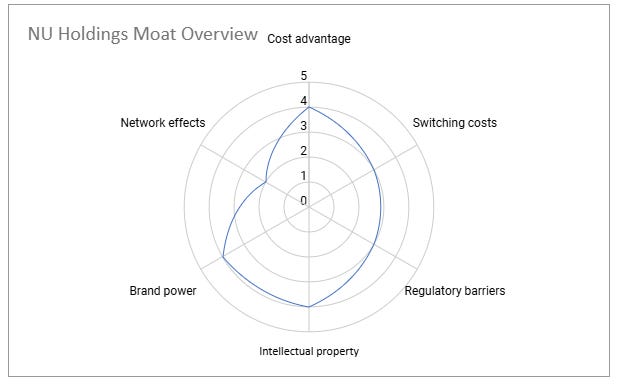
Nubank's overall moat is solid (average ~3.3/5) against incumbents but less assured long-term against fintechs. Strengths in cost, IP, and brand provide durability, but scaling rivals could challenge sustainability in 10 years. Focus on process innovation and ecosystem depth will be key.
Competition – mix between Incumbents and Fintech
Direct competitors to Nubank include incumbent banks and neobanks offering similar retail banking products (credit cards, payment accounts, consumer loans). These players directly approach the same customers and deposits, from Itaú and Bradesco in Brazil to BBVA in Mexico and Bancolombia in Colombia, as well as digital-only peers like Inter, Stori, or Nequi that mirror Nubank’s app-based model.
Indirect competitors include fintech and non-bank entities that fulfill specific financial needs, potentially siphoning off parts of Nubank’s business. These can be categorized in:
Payment-focused apps and wallets: Pix in Brazil, Oxxo’s Spin in Mexico, RappiPay in Colombia
Merchant credit providers e.g. Mercado Pago or store cards
Specialty lenders/fintechs that offer substitutes for bank credit (such as BNPL providers and micro-lenders). These don’t offer a full banking suite but compete in niches like payments or point-of-sale financing.
Substitute providers can also be considered, notably the informal or cash economy that still serves many underbanked consumers in Latin America. For instance, reliance on cash services like convenience-store payment vouchers in Mexico or informal lenders is effectively a substitute for formal banking for some consumers – and part of Nubank’s mission is to convert these users into banking clients.
Brazil
Nubank’s home market of Brazil features both powerful incumbent banks and agile fintech challengers. The “Big Five” traditional banks long dominated retail banking with vast branch networks and full-service offerings. These incumbents are direct competitors in products like credit cards and consumer loans, although they historically focused on more affluent and corporate segments:
Itaú Unibanco
Bradesco
Banco do Brasil
Caixa Econômica
Santander Brasil
Alongside them, a wave of neobanks and fintechs has emerged as direct competitors to Nubank’s digital model. All of them offer app-based accounts and credit cards with low fees similar to Nubank.
Key digital-first rivals include: Banco Inter, a former mid-tier bank turned into a fully digital lender, C6 Bank, Neon and Will Bank.
Payment focused fintechs are indirect competitors, such as Mercado Pago, PicPay and PagSeguro/PagBank.
They offer substitute services like e-wallets, payment processing, and merchant credit. Nubank also faces competition from store-based lenders (e.g. Banco PAN targeting low-income borrowers) and the rapid adoption of Pix (the Central Bank’s instant payment system), which, while not a single competitor, has become an alternative to card transactions for millions of Brazilians.
Nubank has rapidly grown its share in Brazil’s key product segments, although incumbent banks still command a majority of financial assets. In the credit card market, Nubank’s ascent has been striking – it is now the #2 issuer by volume of credit card loans, holding about 12.9% of market share as of March 2024. Itaú Unibanco remains the leader with ~24.3% share of card purchase volume, while Bradesco is close to Nubank at 12.5%. By number of cards issued, Nubank has become one of the top issuers in Brazil.
In deposit accounts and customer base, Nubank’s scale is similarly impressive: by serving 107 million people in Brazil, it is almost double as big as Brazil’s largest traditional bank, Itaú, who serves an estimated 55 - 60 million customers globally. However, when measured by financial volumes (like total deposits or loans), Nubank’s share is more modest: it holds 36.6 billion in deposits (as of Q2 2025), which is a single-digit percentage of Brazil’s banking system deposits since the top five banks collectively hold hundreds of billions in assets.
In personal lending, Nubank’s loan book - 27.3 billion dollar in credit portfolio in Q2 2025 - remains smaller than incumbents’, though it is expanding fast (40% YoY). Segments where competitors dominate include mortgages and auto loans. Nubank does not (yet) offer home or car loans, leaving traditional banks like Caixa and Banco do Brasil to dominate those categories. Likewise, high-net-worth wealth management and large corporate banking are outside Nubank’s focus and remain the focus of incumbents. Nonetheless, within unsecured consumer credit and daily banking transactions, Nubank has captured significant share.
The top ten banks (including Nubank) still account for over 80%+ of credit card balances in Brazil, indicating a competitive but concentrated market. Nubank’s positioning is that of the largest digital bank in Brazil by customers, and a top-three player in key retail products like credit cards, where incumbents are still leading in total assets and in certain product niches.
Mexico
In Mexico, Nubank competes against a concentrated banking sector led by a few large incumbents and a growing cadre of fintech entrants. The primary competitors are the top five traditional banks: BBVA México, Citibanamex, Banorte, Santander México and HSBC México.
They collectively account for roughly 75% of credit card issuance and an estimated 82% of debit accounts. BBVA is the market leader with over 10.7 million credit cards issued, followed by 45 Citibanamex with approximately 9.2 million. These banks are direct competitors across retail products (accounts, cards, personal loans), though they typically serve a broad clientele via branch and digital channels.
Nubank also faces emerging fintech banks as direct rivals:
Stori, a credit-card-focused fintech, has over 3 million customers and targets underbanked consumers similar to Nubank’s strategy.
Albo and Klar offer digital accounts and cards with zero fees, positioning themselves as alternative banking platforms for younger users.
Ualá, an Argentine fintech unicorn, has expanded into Mexico (acquiring a banking license) and reached about 1.5 million users, also competing for digitally savvy, underserved consumers.
Indirect competitors and substitutes in Mexico include store-based lenders like: Banco Azteca (retail chain Elektra’s bank) and BanCoppel (store credit cards to lower-income segments, currently 3.7 million cards).
Additionally, Oxxo’s “Spin by Oxxo” wallet and Mercado Pago are non-bank platforms enabling payments, deposits, and remittances, thereby substituting some functions of a bank account.
Nubank’s market share in Mexico is growing quickly but remains relatively small compared to entrenched incumbents. In the credit card segment, Nubank has become one of the top new issuers since many of their customers hold its credit card. Still, the market is led by BBVA and Citibanamex: BBVA is the #1 with 10.76 million active credit cards (about 29% of all 37.1 million cards in Mexico), and Citibanamex has approx. 9.2 million cards (24% share). Santander (3.95 million), Banorte (2.56 million), and others follow. Nubank’s card count is not listed among these top issuers as of 2025, implying its share by card numbers is likely in the single digits. Nonetheless, Nubank’s entry has been notable – it has been one of the top 3 issuers of new cards by net additions in recent years.
In deposits and payments, Nubank only recently obtained a full banking license (2023) to offer savings accounts. Thus, its share of deposits or payments is still emerging. The Mexican retail banking market is highly consolidated: the top 5 banks account for approx. 82% of debit accounts. Nubank’s positioning, therefore, is as a fast-growing challenger nibbling at the margins of an oligopoly. It has likely captured a significant portion of new-to-bank customers (younger or previously unbanked individuals) rather than stealing large numbers of existing high-value clients from incumbents.
Segments where competitors still dominate include consumer loans (personal loans are led by banks like Banorte and by department store financiers like Bancoppel), mortgages (dominated by banks and government lenders), and payments (Oxxo’s cash network and big banks’ own apps still handle the bulk of payments).
Colombia
In Colombia, Nubank is a newer entrant and faces a banking sector led by a few large local banks and tech-forward fintechs. The primary competitors are the established banks such as:
Bancolombia
Grupo Aval (e.g. Banco de Bogotá)
Davivienda
BBVA Colombia
Bancolombia, the largest bank, holds roughly 20–27% of the market by assets and loans, giving it a strong incumbent advantage in scale and trust. These banks are direct competitors in retail products (savings accounts, credit cards, personal loans), though they traditionally operate via extensive branch networks and a full range of services (from mortgages to corporate loans).
Nubank’s direct fintech rivals in Colombia include:
Nequi - a digital wallet spun off by Bancolombia
Daviplata - Davivienda’s mobile wallet
Movii - an independent e-wallet
Lulo Bank - a new fully digital bank launched by Colombian financiers
Another key competitor is RappiPay, the fintech platform of delivery app Rappi, which partnered with banks to issue a Rappi credit card and now offers accounts and payments; it had about 870 thousand credit cards in Mexico and is also active in Colombia.
Additionally, Argentina’s Ualá has entered Colombia with a license as a finance company, adding to the competitive mix of digital banks.
Indirect competition comes from Colombia’s robust cash and remittance networks. For example, cash deposit partnerships like Efecty and Visa enabling digital cash-in at thousands of locations - which represent substitutes to formal bank accounts for many consumers.
The overall consumer credit market in Colombia is led by Bancolombia and other traditional banks. For context, Bancolombia alone holds about 27% of Colombia’s banking loans and deposits, and around 20%+ of banking assets. Thus, Nubank’s share of total banking assets or deposits in Colombia is still negligible as it only recently began offering a savings account called ‘Cuenta Nu’
The 4 major fintech competitors
Inter / Banco Inter
Inter is a Brazilian-born “financial super app” that evolved from a mid-sized bank into a digital powerhouse. It offers a full suite of services: free digital checking accounts, credit cards, personal and payroll loans, investments and brokerage, insurance, and even a built-in e-commerce marketplace, all within one platform. This vertical integration (banking + investing + marketplace) is a key differentiator. Inter’s model centers on bundling financial and lifestyle products to increase convenience and cross-sell. This broad offering, combined with a low-fee, app-based delivery, directly targets the pain points of traditional banks (high fees and poor service).

Inter represents a major threat to Nubank due to its comprehensive product range (e.g. it even issues mortgages and dollar accounts, which Nubank has yet to fully offer) and its growing scale as one of Brazil’s largest digital banks. Moreover, Inter’s banking lineage (founded in 1994) gives it deep credit experience, allowing it to compete in lending markets with a diversified portfolio (e.g. secured loans) that can attract customers away from Nubank.
In summary, Inter’s “one-stop-shop” super-app strategy and aggressive expansion (including international forays) position it as a formidable competitor vying for many of the same customers as Nubank.
Inter - Strengths
Inter’s most notable strength is its breadth of services and cross-selling ability. It can legitimately offer a customer everything – a salary account, a credit card, a personal loan, a mortgage, stock trading, insurance, a shopping marketplace, and even US-dollar banking – inside one app. This all-in-one model creates a convenience moat; customers have less need to leave the Inter ecosystem.
Inter also has a lower cost of funding than many competitors: its large deposit base has a cost of funds of ca. 90% of Brazil’s interbank rate, which is very low. It enables them to offer loans at competitive rates while still earning margin.
Additionally, Inter benefits from credit experience and risk management honed over two decades as a bank. Unlike Nubank (a newer entrant in lending), Inter has been underwriting credit since the 1990s and offers secured lending products; this know-how may translate to better credit quality or a more diversified loan book.
Inter’s customer profile is also somewhat more affluent on average – about 85% of Inter’s clients were already banked and came for better service/fees, meaning Inter attracts financially active users who may take up investments and larger loans (driving ARPU). Furthermore, Inter’s organic growth engine remains strong – it added over 4 million active clients in 2024 without astronomical marketing spend, thanks to referrals and ecosystem effects.
Finally, Inter’s moves abroad by expanding in the US and into Latin American markets indirectly could future-proof it by accessing new profit pools. Its Nasdaq listing gave it capital and credibility for such expansion.
Inter - Weaknesses
Despite its broad offerings, Inter’s customer engagement rate of 57% active trails Nu Holdings. This suggests many Inter customers use it as a secondary account or for limited purposes. Nubank, with its simpler product line, has managed to make itself the primary account for a larger share of its users.
Inter’s challenge is to activate its millions of low-engagement users in more products – a task Nubank has excelled at. Also, Inter’s market share in key profit areas is still relatively small: only ca. 1 - 2% in lending and investments. It will take time for Inter to significantly dent the big incumbents in these areas.
Inter’s rapid growth has come with higher costs; its operating expenses, while efficient for a bank, are not as ultra-lean as Nubank’s. Inter’s ROE at ca. 12% is only half of Nubank’s ca. 25%, indicating it hasn’t yet achieved the same profitability per unit of equity. Additionally, as a former traditional bank, Inter might carry some legacy baggage – e.g. it had to merge older systems into its new platform. Nubank, built from scratch on modern infrastructure, might iterate faster at times.
Lastly, in terms of branding, while Inter’s brand is strong, it’s perhaps less iconic among youth than Nubank’s purple brand.
PicPay
PicPay is a Brazilian fintech that started as a mobile payments and digital wallet app and has rapidly morphed into a full digital banking ecosystem. It began by offering peer-to-peer transfers, QR code payments, and social-media-like features for splitting bills. This viral payment focus helped PicPay amass tens of millions of users, especially among younger demographics.
In recent years, PicPay expanded into broader financial services: it now provides digital accounts with a debit card, credit cards, personal loans, investments, insurance, and even a crypto exchange, all accessible in-app. PicPay’s business model relies on driving frequent engagement by daily payments and then monetizing via interchange fees, lending interest, and cross-selling new products.
It has become a serious challenger to Nubank by leveraging its huge payments user base to cross-sell banking products. With over 60 million users, PicPay is now Brazil’s seventh-largest bank by customers. Its recent moves, such as integrating an AI assistant for payments (one of the world’s largest deployments of OpenAI tech, serving 6+ million users via WhatsApp), launching a crypto trading platform, and achieving profitability, underscore why it’s a significant threat. In essence, PicPay is turning its ubiquity in everyday payments into a springboard for a broader fintech offensive, directly encroaching on Nubank’s territory with a low-cost, high-tech approach to digital banking.
PicPay - Strengths
PicPay’s foremost strength is its massive user base and engagement in payments. With over 60 million users and ca. 40 million of them active, PicPay has achieved near-ubiquity among Brazilian digital wallet users. It is often the app consumers use for splitting restaurant bills, paying friends, or scanning a QR code to pay a merchant. This entrenched position in daily payments gives PicPay a network effect and troves of transaction data to leverage for other financial products.
PicPay has also proven highly innovative and agile. It was an early adopter of Pix P2P transfers, and then quickly expanded into areas like crypto by launching a crypto exchange in-app and AI by embedding an AI assistant to facilitate payments and answer customer queries. PicPay received the Best Digital Bank award in 2024, beating Nubank and Inter in a public vote. This resonates with customers who see PicPay as a cutting-edge platform.
Another strength is PicPay’s low-cost customer acquisition and social virality – it grew initially through referrals and social sharing of its payment app. Now that it’s profitable, that growth came essentially “pre-paid” without massive marketing outlays.
Additionally, PicPay’s new revenue streams such as credit and marketplace services are scaling very fast, which could imply a higher revenue per user trajectory – its ARPAC, while below Nubank’s, is growing rapidly. PicPay’s backing by the J&F group - one of Brazil’s largest conglomerates - is also a strength. It has access to funding and an ecosystem of partner companies.
Finally, PicPay’s customer satisfaction seems to be on the rise; its CEO highlighted high NPS and cross-selling success in 2024. All combined, PicPay’s combination of scale, innovation velocity, and improving financial performance makes it a strong contender.
PicPay - Weaknesses
One weakness is that PicPay, until recently, lacked a banking license of its own – it operates as a payments institution and relies on partner banks for certain services like deposits which are held via a partner. This could mean less control over its funding costs or product set versus Nubank which has its own banking license. However, PicPay has applied for an independent license to strengthen this area.
Another challenge is credit risk management at scale – PicPay’s loan book explosion (18x in one year) hasn’t been tested through a full credit cycle. Nubank, with a few more years in lending, has already navigated some difficult credit conditions in 2020 and 2021 and built substantial risk modeling capability. PicPay will need to ensure its credit losses don’t erode its newfound profits.
Moreover, PicPay’s user base, while huge, includes many low-value or intermittent users - people who downloaded the app for a cashback once. Converting these into fully active, high-value customers is an ongoing battle. Only ca. 65% of its registered users are active in a given quarter.
PicPay faces fierce competition in its core arena. WhatsApp launched its own payments in Brazil, and banks’ apps now also do free Pix transfers. This means PicPay must keep innovating to differentiate.
Finally, PicPay’s geographic concentration is a risk. It is 100% Brazil-focused. Any Brazilian regulatory change would hit PicPay fully, whereas Nubank has a broader footprint.
Mercado Pago
Mercado Pago is the fintech arm of e-commerce giant MercadoLibre and has grown into Latin America’s largest digital payments platform, now rapidly expanding into banking services. Initially created to facilitate online purchases on MercadoLibre, it has since developed into a PayPal-like ecosystem spanning multiple countries (Brazil, Mexico, Argentina, and more). Mercado Pago’s core business is payment processing: it enables online checkout on e-commerce sites, offers mobile point-of-sale (mPOS) card readers for in-person merchants, and powers QR code payments, capturing a huge volume of transactions on and off MercadoLibre’s marketplace.
Building on this foundation, Mercado Pago now offers digital wallets and accounts to consumers (holding balances that can be invested in money-market funds), credit products (consumer credit lines, installment financing, and merchant loans), insurance distribution, and of course credit cards. It has issued millions of its own credit cards, seeing that portfolio increase by 118% in 2024.
Mercado Pago represents a multifaceted threat to Nubank: it not only has regional scale with 61 million monthly active fintech users across Latin America, but it also enjoys synergies with MercadoLibre’s ecosystem. They use e-commerce data to underwrite loans and funneling marketplace sellers and buyers into its financial services. Its ambition is explicit: Mercado Pago aims to become ‘the largest digital bank in Latin America’. With strong brand trust, a wide product suite, and deep pockets from MercadoLibre’s profits, Mercado Pago is a formidable competitor on a regional scale.
MercadoPago - Strengths
Mercado Pago’s biggest strength is the power of the MercadoLibre ecosystem. It can acquire and engage users at a scale Nubank cannot match outside of Brazil. For instance, every MercadoLibre shopper or seller (over 100 million annual buyers region-wide) inevitably interacts with Mercado Pago. This built-in user funnel means Mercado Pago spends less on marketing for user acquisition and can grow alongside the secular boom in e-commerce and digitalization.
Mercado Pago also enjoys unparalleled scale and regional diversification among fintechs: its 197 million dollar total payment volume in 2024 and presence in 18 countries give it revenue streams beyond any single market. This scale yields economies of scale in technology, risk distribution by diversifying credit risk across countries, and partnerships since global brands happily partner with Mercado Pago for payments.
Another key strength is their rich data pool. Mercado Pago can leverage shopping data to underwrite loans and offer targeted financial products, e.g. offering a working capital loan to a business right after it has a spike in sales, or giving a consumer a credit line based on their purchase history. Nubank and others lack this deep commerce integration.
In terms of product depth, Mercado Pago has become very bank-like: it offers interest-bearing accounts, debit/credit cards, investment options, insurance, and an array of payment services – often with competitive pricing. It topped up these services with unique offerings like crypto trading and a USD stablecoin, showing adaptability to customer needs in high inflation markets.
Another strength is Mercado Pago’s brand trust and customer satisfaction, especially in certain countries. By Q4 2024, its NPS in Brazil and Mexico hit record highs, reflecting that users increasingly trust Mercado Pago for their financial needs. In markets like Argentina, Mercado Pago is arguably the most trusted fintech brand due to years of delivering stable services amid economic turmoil. Additionally, Mercado Pago’s financial clout - backed by a profitable parent - lets it invest heavily. It also has the resources to weather losses in certain products (like credit) to gain market share.
MercadoPago - Weaknesses
One potential weakness is that Mercado Pago is part of the larger company MercadoLibre, which means its strategic focus is not 100% on financial services. Nubank, PicPay, Inter – these live or die by their banking offerings, Also, Mercado Pago’s user base in Brazil overlaps with Nubank’s but doesn’t fully substitute for a bank account – many use Mercado Pago for certain transactions but still rely on a bank (or Nubank) for others like salary deposits or larger loans. Nubank, being a licensed bank, can directly capture those primary relationships more easily. Mercado Pago in Brazil still operates under a payments license, which imposes some limits like not offering overdraft or certain types of regulated deposits directly.
Another weakness is credit risk and funding: Mercado Pago’s push into lending is relatively new and its funding largely comes from MercadoLibre’s corporate funding or reinvested profits, not a traditional deposit base. Except in Brazil where it collects Pagos in accounts, and in Argentina where it effectively captures deposits via money market funds. This could mean higher funding costs than a bank like Nubank which has tens of billions in customer deposits. While Mercado Pago is addressing this by encouraging users to keep money in its app, Nubank still has a larger, stickier deposit base.
Additionally, Mercado Pago faces intense competition in each local market: e.g., in Brazil from Nubank, PicPay, PagBank; in Mexico from fintechs like Oxxo’s Spin or Nubank Mexico; in Chile / Colombia from local wallets. Managing competitive battles on multiple fronts can be challenging – Nubank for now mainly battles in Brazil, plus building up in Mexico and Colombia.
PagSeguro / PagBank
PagSeguro, through its PagBank platform, is a Brazilian fintech that started by disrupting the merchant acquiring business and has since evolved into a broad digital banking player. Its initial rise came from providing inexpensive card payment devices and processing to micro- and small merchants traditionally ignored by big banks. PagSeguro’s model enabled millions of street vendors, shop owners, and entrepreneurs to accept card payments via its mobile POS devices, taking a cut of each transaction.
On top of this acquiring business, PagSeguro launched PagBank, a digital account for both merchants and consumers to hold and transfer money. Today PagBank offers a comprehensive suite: free digital checking accounts, prepaid and credit cards, personal and business loans (with a focus on collateralized credit like merchant receivables), investments and mutual funds, insurance, and bill payments – effectively a full financial ecosystem for individuals and SMEs.
PagSeguro/PagBank is a serious Nubank competitor because it combines a large customer base, over 33 million users, including 6+ million merchants, with profitable operations and an entrenched presence among Brazil’s merchants. Its competitive threat comes from its scale in payments, PagSeguro runs Brazil’s largest payment acceptance network by number of merchants, and its strategy of converting those merchants (and their customers) into PagBank banking clients. Because PagBank can offer integrated solutions (“one-stop” banking plus payment acquiring), it has a distribution and data advantage in the merchant segment that Nubank is only beginning to address. Furthermore, PagSeguro is well-capitalized and profitable, enabling it to aggressively market and price its services (e.g. paying higher deposit yields or offering low-rate secured loans) to challenge Nubank.
PagSeguro / PagBank – Strengths
PagSeguro’s strengths lie in its profitable business model, merchant ecosystem, and disciplined operation. PagSeguro has been profitable for years and delivered a record net profit in 2024. This profitability allows PagBank to invest in growth while also rewarding shareholders, reflecting a sustainable model.
PagSeguro’s merchant acquisition network is a major moat: it has physical reach through its POS devices in small shops across Brazil, giving it brand recognition and an on-the-ground salesforce like presence that purely digital players lack. It is essentially the ‘banks for the unbanked merchants’, and those relationships are sticky – a barber or food cart vendor who relies on PagSeguro for payments is likely to use PagBank for their own banking needs.
Also, PagSeguro’s risk management is very strong – it deliberately keeps credit risk low (mostly collateralized loans), which means its earnings are resilient even in downturns. During Brazil’s high interest period, PagBank’s NPL remained at ca. 2% when many lenders saw rising delinquencies.
Another strength is scale in payments – PagSeguro still grew total payment volume 16% in Q1 2025 despite a slower economy. PagBank’s brand and distribution via UOL (Universe Online) can also be seen as a strength: being part of UOL (a popular internet portal in Brazil) provides it a marketing channel and trust mark, especially for online merchants and consumers who recognize UOL’s legacy.
Additionally, PagSeguro’s management has shown financial discipline – evidenced by the share buybacks and maintaining stable costs. In essence, PagSeguro’s advantage is being a scaled, entrenched incumbent in the SME segment with a proven ability to make money in fintech, which is a combination few others have.
PagSeguro / PagBank – Weaknesses
One weakness for PagBank is its customer mix and brand perception. Historically, PagSeguro is known as a merchant payments provider, not a trendy consumer bank. While it has ca. 33 million users, many of these were onboarded initially as merchants or as secondary accounts. It may lack the “cool factor” or youth appeal that Nubank or PicPay have – for example, PagBank hasn’t achieved the same social media buzz or customer love that Nubank’s brand enjoys. Nubank regularly tops customer satisfaction rankings and has extremely high NPS, whereas PagBank’s NPS is not widely touted. PagBank also have fewer daily-active retail users relative to its total - 17.7 million customers of 33 million were actively engaged as of Q1 2025.
Another vulnerability is competition on the acquiring side: The merchant acquiring/payment processing business in Brazil is highly competitive with thin margins – Cielo, Rede, Getnet, Stone, and Mercado Pago are all vying for merchants. PagSeguro’s growth in that area has moderated - payment revenue +14% in 2024 vs +60% for PagBank’s banking revenue. If competition intensifies, say incumbents drop fees or Pix payments reduce the need for card machines, PagSeguro’s core fee revenue could be pressured.
Pix is both an opportunity and threat for PagSeguro: while PagBank supports Pix for merchants, widespread Pix adoption can reduce card swipe volume (and thus MDR fees) over time, unless PagSeguro finds alternative monetization.
Additionally, unlike Nubank which has a single clear focus on consumers (and now some small business accounts), PagSeguro must juggle serving two segments: merchants and retail consumers.
On the technology front, PagSeguro’s legacy as a payment processor means it might not have been as cloud-native or modular initially as Nubank – although it has modernized a lot.
Finally, PagBank’s expansion beyond Brazil is basically nil – it is heavily exposed to the Brazilian economy. While Nubank and Mercado Pago are expanding regionally, PagSeguro has not. This means PagSeguro’s growth prospects rely on Brazil alone, which could be a constraint if the domestic market saturates or if Nubank and others eat into its share.
Nubank – Strengths vs. Competitors
Nubank itself holds several advantages in this competitive landscape. It has sheer scale in Brazil, giving it a cost advantage by spreading fixed tech costs over >100 million customers and a strong network effect - Nubank customers often refer friends and family, fueling organic growth.
Nubank benefits from their unit economics edge – its highly automated platform yields a cost-to-serve near 0.80 dollar per customer monthly, much lower than traditional banks and lower than most fintech peers. This means Nubank can offer better pricing without sacrificing profitability, pressuring competitors who have higher cost bases.
Nubank’s brand is arguably the strongest – it’s viewed as a revolution in banking, yielding industry-high NPS and deep customer loyalty. As of end-2024, Nubank had the fewest customer complaints per customer among major institutions in Brazil, reflecting its superior customer experience and service, which is a critical strength.
Moreover, Nubank’s product simplicity by offering one core app for all services, a unified user experience, has helped it achieve an 83% activity rate. Customers consistently use Nubank as their primary account.
Nubank’s credit underwriting experience, while shorter than incumbents, is now proven at scale; it navigated Brazil’s pandemic-era recession and high inflation period while still growing and turning profitable. This gives some confidence in its risk management relative to newer entrants. Lastly, Nubank’s international expansion into Mexico and Colombia, though in early stages, provides upside that competitors like Inter, PicPay, PagSeguro (which are Brazil-bound) don’t yet have – Nubank could become a rare pan-regional neobank, leveraging learnings from Brazil to quickly scale abroad.
Nubank – Weaknesses vs. Competitors
Nubank’s very success paints a target on it – all four competitors are explicitly trying to capture areas where Nubank is strong. For instance, Nubank’s dominance in credit cards is being attacked by PicPay (with rewards-laden cards) and Mercado Pago (with commerce-linked cards). Nubank’s low fees and spreads are being matched or beaten in some cases - PicPay and PagBank often offer slightly higher savings rates or cashback on purchases to entice Nubank users.
A key Nubank vulnerability is that it has fewer merchant services – unlike Mercado Pago or PagSeguro, Nubank’s ecosystem doesn’t directly serve merchants - aside from a small SME account product launched in 2022. This means Nubank is absent in the merchant acquiring / payment space, ceding that entire relationship and revenue source to competitors. As those competitors (PagBank, Mercado Pago) deepen ties with merchants, they could cross-sell merchant-related individuals (employees, suppliers) and encroach on Nubank’s retail base from that angle.
Another potential weakness is over-reliance on Brazil: while Nubank is expanding internationally, ca. 90% of its business is still Brazil. Mercado Pago and potentially Inter (with US operations) have a slightly broader base. Any Brazilian regulatory shifts could impact Nubank heavily.
Nubank’s hyper-growth strategy also means it must keep innovating to maintain engagement; as its user base matures, ARPAC growth might slow unless new products are introduced. Competitors have in some cases out-innovated Nubank in niche areas like PicPay’s social features and Mercado Pago’s crypto offerings.
Finally, Nubank’s credit portfolio is largely unsecured; if Brazil’s economy turns or unemployment rises, Nubank could face higher credit losses relative to a competitor like PagBank with secured loans. Competitors might seize on any Nubank stumble in credit performance to market themselves as safer or more stable. Essentially, Nubank’s vulnerabilities are the flip side of its strengths – its size and singular focus on retail banking mean that any service shortcomings are amplified, and its lack of diversification into certain verticals (such as merchant acquiring and limited stockbroking within app) can be avenues competitors use to pull customers away.
Nubank is still the largest digital bank in Latin America on customer level
Nubank remains the largest digital bank in Latin America by customer count – as of Q2 2025 it reached 123 million customers across Brazil, Mexico, and Colombia, with over 100 million in Brazil alone. This equates to ~60% of Brazil’s adult population. Competitors have also grown rapidly, eroding Nubank’s early lead in certain segments.
Inter serves 36 million customers in Q4 2024 with 20.6 million considered active (57% active customers) – a impressive increase from ca. 8 million users in 2019. Inter’s client base roughly doubled in the past two years, and it now ranks among the top neobanks in Brazil by users.
PicPay has 60.2 million registered accounts as of end-2024, of which about 39 million are active quarterly users, making it the 7th largest bank in Brazil by customers. PicPay’s user base surged by double digits annually, thanks to its viral adoption for Pix and P2P payments.
Mercado Pago had over 61 million monthly active users on its fintech platform in Q4 2024. Notably, Mercado Pago’s active user count grew ca. 35% YoY in 2024, signaling successful expansion in markets where Nubank is still nascent like Mexico.
PagSeguro reported 33.2 million customers by Q4 2024 (up 2.1 million in 2024), of which nearly 18 million are active users who treat PagBank as a primary account. This places PagBank’s user base on par with or above many mid-tier banks.
So, while Nubank is still the single largest player, each rival has amassed a substantial user base. Mercado Pago is the biggest competitor since their user counts are in the same order of magnitude as Nubank’s active customers (especially in Brazil).
Competition geographically
Nubank’s operations are concentrated in Brazil - over 85% of its customers – with growing footholds in Mexico (12 million customers) and Colombia (3.7 customers). Among competitors, Mercado Pago has the broadest geographic footprint. It is strong in Brazil, the market leader in fintech in Argentina and a close leader in Mexico’s digital wallet space. This gives Mercado Pago a market share edge in Spanish-speaking LATAM where Nubank has more limited reach.
Inter and PagSeguro so far remain almost entirely Brazil-focused, though Inter has begun offering cross-border services and plans for the U.S. and recently Argentina. PicPay is also focused on Brazil only – its vast user base is Brazilian.
In Mexico, Nubank’s main fintech competitor is Mercado Pago - along with local players like Klar or Albo which are outside of this deep dive.
Nubank leads in Brazil’s fintech customer share by a sizable margin, but in other LATAM markets like Mexico and Argentina, Mercado Pago is the incumbent digital finance leader.
Is Mercado Pago the biggest competitor?
Mercado Pago’s expansion piggybacks on MercadoLibre’s dominance: every MercadoLibre e-commerce user automatically becomes a Mercado Pago user for payments. In the recent period they have been deepening its fintech ecosystem and expanding its banking offerings across Latin America in high pace. All these MercadoLibre customers can be targeted effectively with the new banking offerings. Therefore, they grew credit offerings in scale, both in credit cards and consumer lending. The company invested in improved credit scoring models, leveraging machine learning and its rich commerce data. Mercado Pago explicitly views credit cards and digital accounts as critical to becoming the biggest digital bank in the region.
How fast can Mercado Pago monetize all above? Nubank has a first mover advantage in Brazil and people love the brand. Are there enough competitive advantages for customers to switch from Nubank towards Mercado Pago as main bank? Or will they use some products of Mercado Pago by using their app as a second tool? And how will Mercado Pago disrupt the growth of Nubank in Mexico and Colombia where Nubank does not have a first mover advantage?
To understand this, we have to understand the cultural differences of both companies.
Nubank's culture has changed drastically in the past four years, from pre-IPO to post-IPO. Nubank used to be a very agile but completely unstructured company with multiple teams that included multidisciplinary people from product, tech, customer excellence, UX, FP&A, and more.
Fast forward to now, Nubank has a very solid operating model, senior management and fast decision models. Recently David has eliminated many C-level or VP-level roles to be closer to execution, following the horizontal organization model of Revolut.
In addition, Nubank has an absolute obsession for their customers which might be the main differentiator against other companies. If Nubank has to lose money or not make as much money as they could in the short to mid-term to provide the customer with the best value proposition and win the market, they always do that.
Mercado Pago’s culture is significantly different. A former director described that during his 4 years of work, there was a reorganization every 6 months as Mercado Pago evolved from a payment supplier to a fully-fledged digital bank. For years, Mercado Credit was disconnected from Mercado Pago and teams from Mercado Pago had to negotiate with Credit to secure additional lines. Currently, they integrated credit, risk underwriting and fraud prevention within Pago.
However, they were not able to create an efficient culture. According to the former director they are ‘very bureaucratic’. Decision processes regarding the launch of new products takes over 6 months since many people must provide input in very long and extensive meetings. Even tough Mercado Pago is aware of the situation they have not been able to solve the issue. In addition, he scores the customer orientation at Pago quite low.
How big of a threat is Mercado Pago in Brazil?
Mercado Pago identified the credit card as the key battleground in the digital banking sector. When users adopt a credit card, they show a high probability to become either primary or secondary customers, leading to increasing lifetime value. Recognizing this, Mercado Pago prioritized its underwriting capabilities. Initially, it relied on conventional credit bureau data, mirroring legacy banks, and did not employ alternative data or advanced modeling like Nubank’s machine learning-based systems. In 2023, Mercado Pago pivoted, hiring data scientists and architects to develop proprietary models that could harness varied data streams for risk assessment.
The credit card business of Mercado Pago in Brazil is expanding rapidly, yet it did not catch up with Nubank’s underwriting dominance. Nubank’s approach has allowed it to grow across diverse socioeconomic groups while keeping non-performing loans steady during aggressive expansion. In addition, he mentioned another reason why Nubank is still leading in Brazil:
Nubank currently has two strong competitive advantages. First, the brand equity they've built over the past 10 years. Everyone knows Nubank cares for the customer, won't try to rip you off, and doesn't have hidden fees. If you need customer support, they'll be there in five seconds with a human to talk to you. This has given them strong brand equity. The second advantage is their superior underwriting models, developed over a decade.’’ - Former Director at Mercado Libre and Nubank
Once Nubank lost his first mover advantage and Mercado Pago caught up on their underwriting one might consider a situation where Mercado Pago could increase market share due to their platform leverage. I consider this as a significant risk for the Brazilian market.
What about Mexico?
Nubank lacks established brand recognition and underwriting advantages in Mexico. Replicating its successful Brazilian approach isn't straightforward. It requires a learning period, including initial financial losses to fine-tune its models and features before scaling up. While Nubank possesses the necessary technology and methodology, it does not yet have the localized competitive strengths that underpin its success in Brazil.
Conversely, Mercado Pago gains substantial leverage from its integration with Mercado Libre’s expansive Mexican marketplace. This gives it immediate access to a large and valuable customer base, as well as unique data to accelerate scaling. Currently, Mercado Pago’s underwriting capabilities in Mexico are nearly at par with Nubank’s according to the former director. Both firms started employing advanced modeling techniques around the same time, but Mercado Pago’s access to extensive marketplace data is a meaningful advantage. This positions Mercado Pago favorably to capture market leadership in Mexico.
Recent quarterly disclosures reveal that Mercado Pago has significantly increased provisions for non-performing loans in Mexico. They demonstrate a willingness to invest aggressively and absorb early losses to refine its risk models and expand quickly.
Therefore, I do expect that Mercado Pago will continue to grow more rapidly compared to Nubank in Mexico.
Conclusion Competition
Mercado Pago is the main competitor. Nubank will leverage its first mover advantage in Brazil for the short till mid-term, but will face significant competition in Mexico and Colombia due to Mercado’s marketplace advantages. Nubank and Mercado are head-to-head in underwriting technology in both countries.
Financials – How healthy is NuBank?
Revenue
Nubank’s revenues have grown explosively from 2020 through 2025, driven primarily by interest income on loans and credit card balances. Total revenue expanded from about $737 million in 2020 to $1.7 billion in 2021 (+130% YoY), to $4.8 billion in 2022 (+182% YoY), to $8.0 billionin 2023 (+68% YoY), reaching $11.5 billion in 2024 (almost 50% YoY).
The revenue mix has shifted heavily toward interest income. In 2020, fees and commissions (mainly interchange fees on card transactions) made up almost 50% of revenue, but by 2024 interest income and fair value gains represented 83.6% of total revenue. This reflects Nubank’s rapid growth in its lending and credit card portfolios and the high interest rate environment in Brazil during 2022 – 2023.
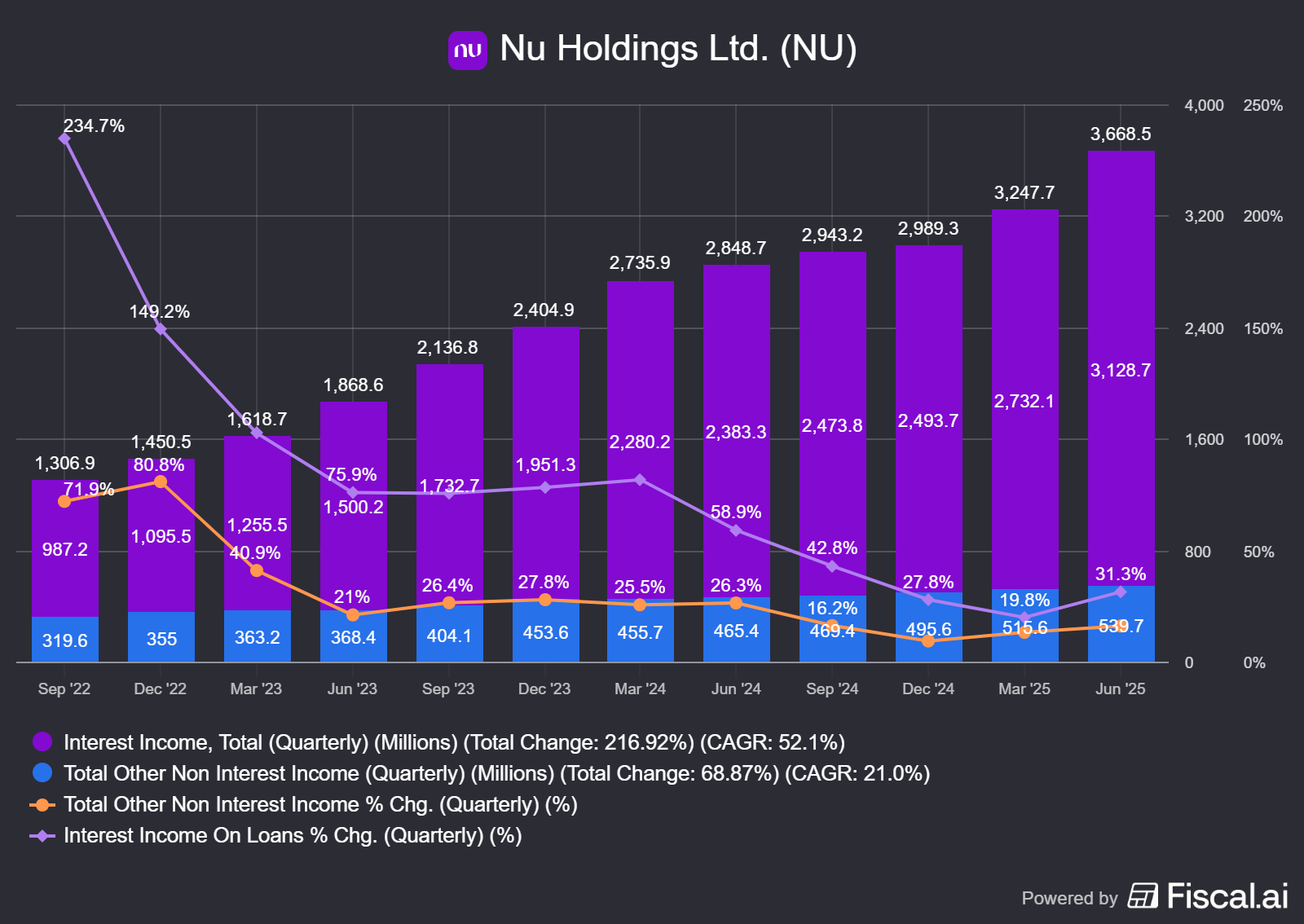
Gross Margin and Operating Leverage
Nubank’s cost of revenue (interest expense, transaction costs, and credit loss provisions) has grown with its business, but operating leverage is improving, especially during the last 3 years. In 2022, these cost of services surged, compressing gross margins. Gross profit margin fell from 43% in 2021 to 35% in 2022 By 2023, however, gross profit margin rebounded to 43.5%.
Operating leverage is clearly present. Revenues increased from 1.16 billion dollar in Q2 2022 to 3.67 billion dollar in Q2 2025, representing a 47% CAGR during these 3 years.
Gross margin increased from 0.4B dollar in Q2 2022 to 1.6 billion dollar in Q2 2025, representing a 62% CAGR during these 3 years.
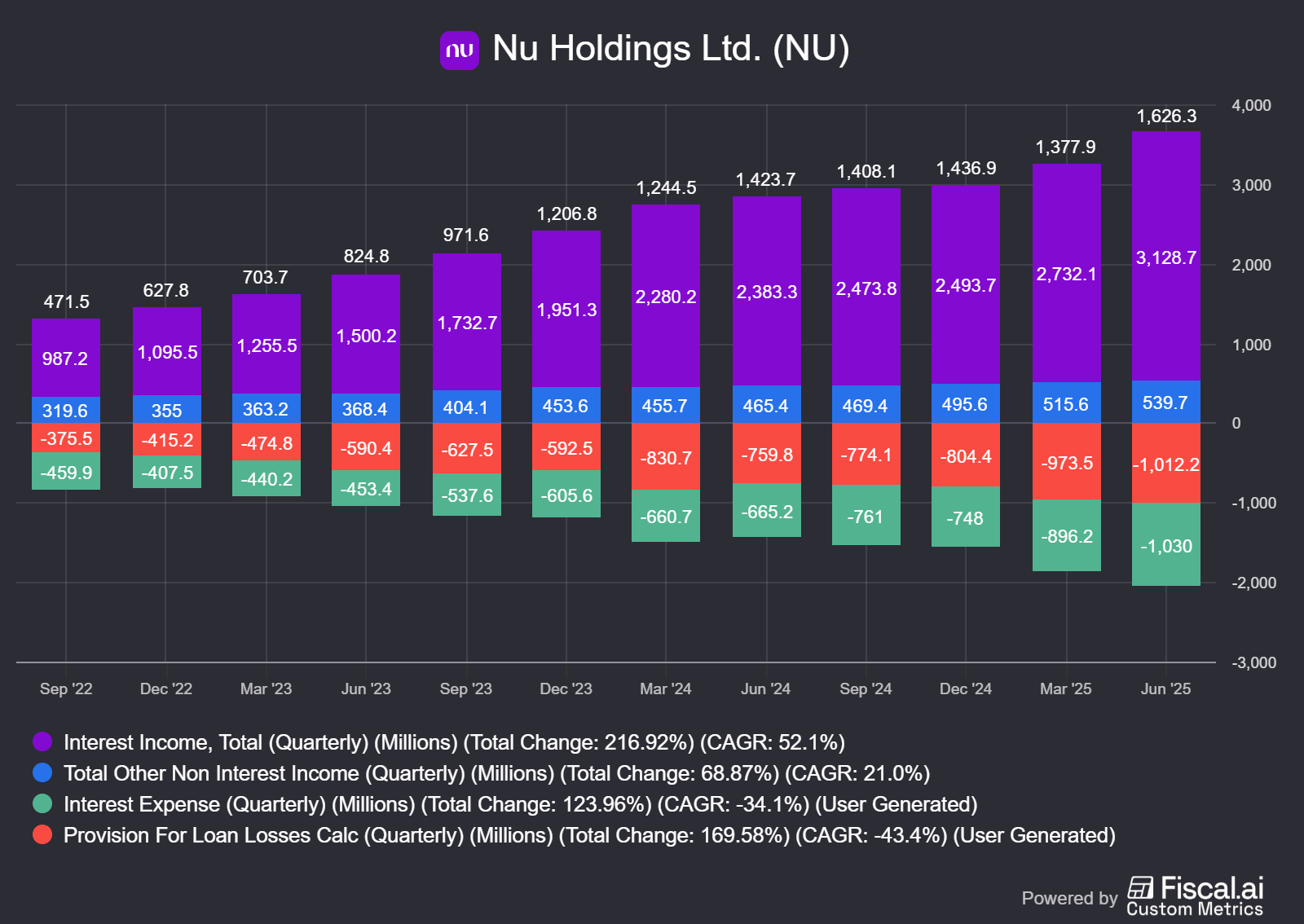
Profitability Ratio’s
NIM - Net Interest Margin
As discussed, Nubank’s NIM reached around 17 - 18% by 2024. This metric - net interest income / average interest-earning assets - is exceptionally high. For context, large Brazilian banks typically report NIM in the mid-single-digits - Itau’s NIM on loans was 8 - 9% in recent years.
Nubank’s outsized NIM stems from its product mix – credit card and consumer loans in Brazil often carry annual interest well above 50%, whereas its deposit costs, while tied to CDI, are lower (around 90% of CDI). Another factor is that Nubank historically held a lot of non-earning cash (which dilutes NIM if included in denominator); as it deploys more cash into loans, reported NIM improves. Impressively, Nubank’s risk-adjusted NIM, which is the NIM after deducting credit losses as a % of earning assets, was 9.2% in Q2 2025, up from 8 - 9% a year before. This means even after credit costs, Nubank earns 9% on its loan book, which is healthy and suggests that pricing adequately covers losses. In comparison, traditional banks might have risk-adjusted NIMs in the 5 - 6% range (with lower NIM but also lower loss rates).
Nubank’s NIM trend: it expanded through 2022 as interest rates rose (CDI increase boosted interest income on float and it repriced lending). We should expect NIM to normalize downward if Brazil’s rates fall or as Nubank enters more secured lending (which has lower yield but also lower cost). Nonetheless, current NIM levels indicate strong core profitability of lending operations.
Return on Equity
Nubank’s ROE has quickly risen to match or exceed legacy banks. After negative ROE in 2020 – 2022 due to net losses and high equity base post-IPO, Nubank delivered 17% ROE in 2023, 29% in Q4 2024 and 28% in Q2 2025. This is an extraordinary turnaround – a 28% ROE is on par with the most profitable banks globally and well above the 17 - 20% ROEs Brazilian banks like Itaú or Bradesco have had in recent years. It shows that Nubank is starting to leverage its equity efficiently. However, sustaining ROE at 28% may be challenging as the bank continues to grow its capital base and expands into new countries. A former director of Nubank mentioned that Brazil’s ROE is around 60%. Nubank’s reported ROE is being dragged down due to Mexico and Colombia and he expects that both countries will never reach Brazil levels, meaning a lower future ROE when international expansion increases.
Asset Quality Ratio
Nubank’s asset quality, while inherently more volatile (consumer unsecured lending), has been managed reasonably.
NPL Ratio
The key metric is loans 90+ days past due. As of end-2024, 90+ day NPL was 7.0%, increasing from 3.5% in Q1 2022. The increase in 2023 was expected due to credit stress in the economy. By Q2 2025, 90+ NPL decreased a bit back into 6.6%.
Nubank’s business model targets underbanked populations who often lack deep credit histories and have higher inherent credit risk. As Nubank rapidly expanded its lending to these segments, the probability of defaults increased - especially in periods of economic volatility. In addition, rising interest rates, inflation, and subdued GDP growth in Brazil and Latin America led to tighter consumer budgets and higher credit stress. These conditions resulted in more customers unable to meet payment obligations. Nubank also intentionally adjusted its credit models, such as providing higher credit limits and broadening its portfolio, which led to a front-loading of expected credit losses; this caused a temporary rise in NPL metrics while provisions were recognized before corresponding revenue growth could offset them. Anyhow an important metric to follow in the next quarters.
We also look at the total delinquency ratio including earlier stage: 15 - 90 day NPL hovers between 3.7% and 5% since Q1 2022. Nubank’s strategy has been to closely monitor early delinquencies (15 - 90 day) as a leading indicator. They took action in mid-2022 when that metric rose, tightening credit criteria, and saw an improvement by Q4 2022 when 15 - 90 NPL dropped 50 bps. This proactive stance is positive. They also slowed the expansion of certain higher-risk products until more performance data is gathered.
Nubank’s reported NPLs are a bit higher than large bank averages – for instance, Itaú’s NPL 90+ day for individuals was around 5.8% in 2023. However, Nubank’s customer base skews to underserved segments, so some higher NPL is expected.
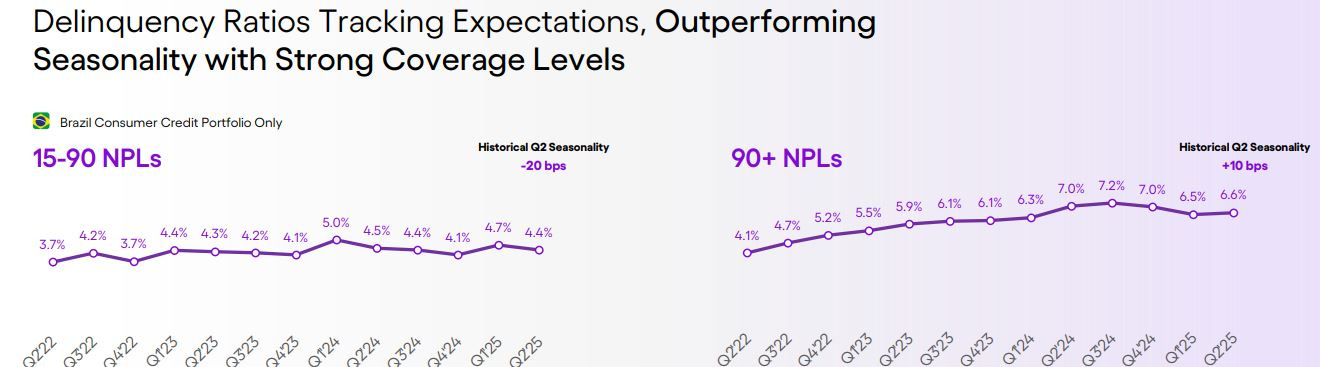
Liquidity Ratio
LDR - Loans-to-Deposits
Nubank’s LDR is conservative. It grew from 25% in Q1 2022 to 43% in Q2 2025. This is far more liquid than typical banks that loan out a much higher proportion of deposits. Nubank intentionally runs a low LDR as a new bank to ensure liquidity. This low LDR underscores a surplus liquidity position. Nubank’s deposit franchise growth has outpaced its credit expansion. It has intentionally taken a measured approach to deploying funds into loans, prioritizing credit quality over rapid loan growth. Over time one might expect LDR to trend up toward industry norms (ca. 80%). This gives Nubank an excellent liquidity coverage.
Although Nubank doesn’t disclose LCR (Liquidity Coverage Ratio) explicitly, one can surmise it easily exceeds 100%. LCR requires banks to hold sufficient high-quality liquid assets (HQLA) to cover 30-day outflows. Nubank’s large balances at central bank and government bonds are HQLA, and its likely 30-day outflows would be well covered by these assets. NSFR (Net Stable Funding Ratio) also should be high given a large equity and stable deposit base relative to assets.
Additionally, Nubank’s parent had $7.8B in cash and equivalents at end-2023 (implied by assets minus loans and other uses) and has access to central bank liquidity if needed. So, by any liquidity metric, Nubank is very well cushioned.
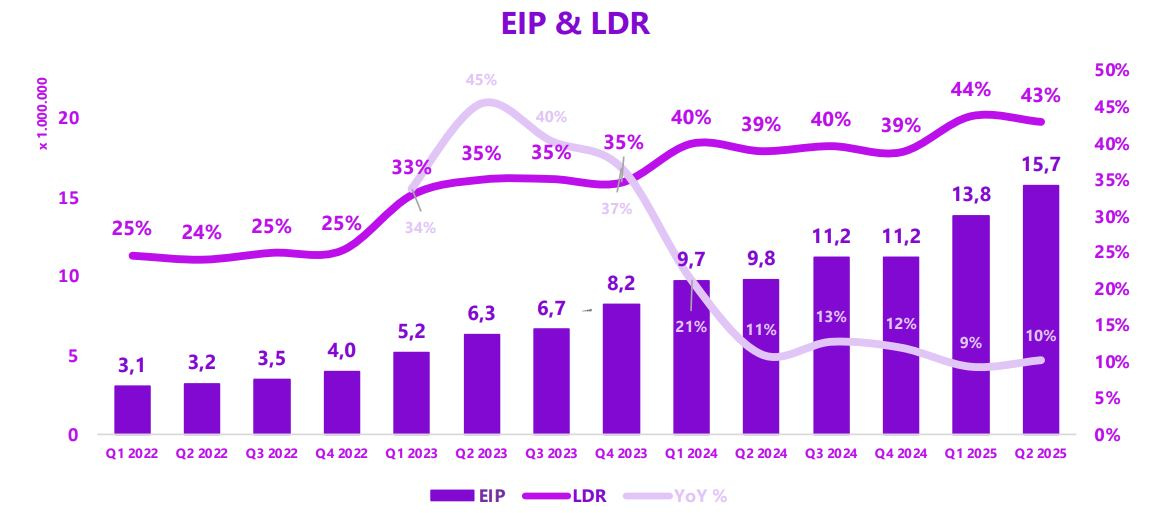
Capital Adequacy Ratio
CET1 - Common Equity Tier 1 Ratio
Though exact CET1 is not published in the annual report excerpt, S&P cited a Basel Index (Total Capital Ratio) of 20.2% for Nubank’s Brazil bank in Q2 2023. CET1 would be nearly that since almost all of Nubank’s capital is common equity. This is more than double the regulatory requirement which is ca. 8.75% in Brazil plus any buffers. It indicates a very strong capital buffer.
Even as Nubank’s loan book grows rapidly, risk-weighted assets (RWA) growth is funded by retained earnings. Notably, Brazil’s Central Bank allowed Nubank to use the ASA (Alternative Standardized Approach) for operational risk starting end of 2023, which reduces RWAs. We can infer CET1 ratio likely stayed in high teens through 2024, even after strong loan growth.
Regulatory Compliance
Nubank appears to be in full compliance with all local capital and solvency requirements. In Brazil, new banks often have higher initial capital thresholds; Nubank met and exceeded those, to the point one such additional requirement was lifted in 2022. In Mexico and Colombia, Nubank’s operations are currently less significant, but Mexico’s regulator (CNBV) has a capital requirement (CAP indicator) which Nubank’s Mexican entity likely meets easily (especially after it gets a full banking license and injects capital). There’s no sign of any capital-related regulatory concerns.
Efficiency Ratio
This is a standout metric for Nubank. At IPO, many wondered if a fintech could achieve better efficiency than incumbents. Nubank has proven it can: from 65% in Q1 2022 to 28.3% in Q2 2025. Large Latin banks usually have efficiency ratios in the 40 - 50% range, like Itaú around 44%. Nubank’s app-based model yields far lower overhead: operational costs are 85% lower than incumbents’ on a per-customer basis. That translates to an efficiency ratio 15 percentage points better than the best incumbents. This efficiency ratio includes all operating expenses; if we included credit costs, the “cost-to-income including provisions” would be higher, but even then Nubank’s robust revenue growth keeps it competitive.
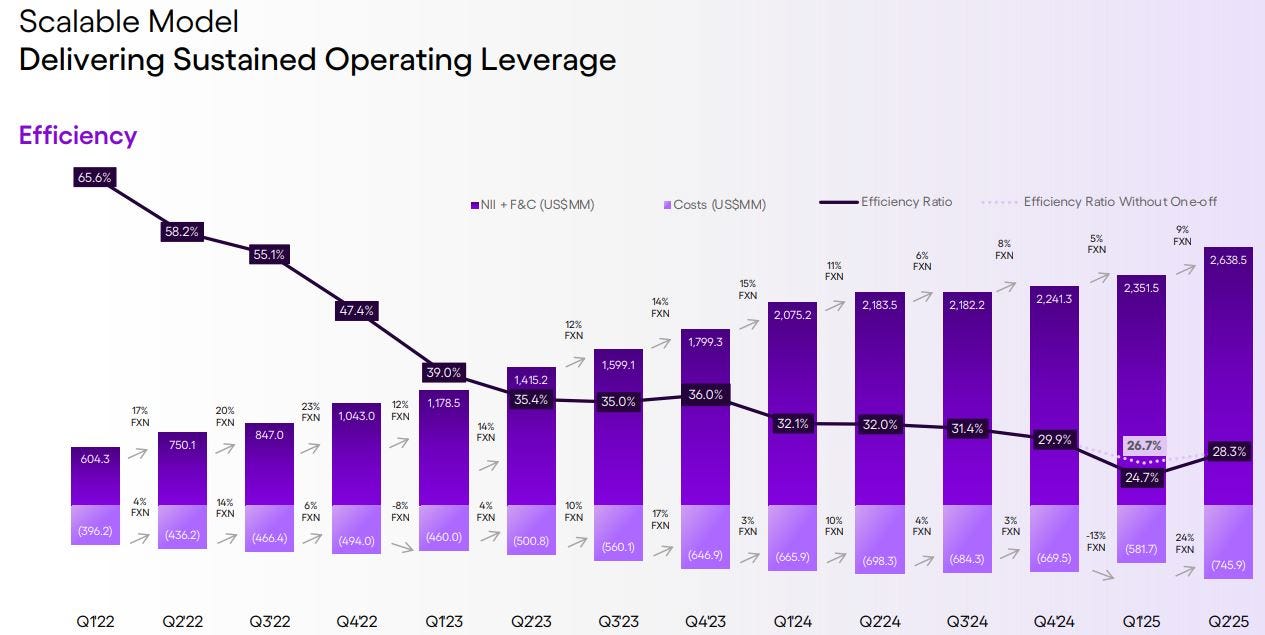
Sanity checks on the Financial Statements
NU Holdings does not have complex special purpose entities or securitization vehicles holding assets off-books (beyond the small past securitization which was consolidated or repaid).
The main off-balance-sheet exposure is unused credit card limits. Nubank doesn’t disclose the total card limits granted, but given 55 million active credit customers, even if average unused line was USD 200, that’s USD 11 billion potential exposure. However, not all those commitments will be drawn simultaneously, and Nubank can manage limits dynamically. Still, in a stress scenario, customers might draw down lines. Nubank’s strong liquidity could handle a surge in loan demand to an extent, but it is something to manage. The Central Bank likely monitors credit line utilization as part of risk.
Legal provisions are small (tens of millions). No big litigation like US class actions or regulatory fines have been noted. Nubank operates in a regulated space, so regulatory compliance is important, e.g., an operational risk event (like a tech failure or data breach) could cause off-balance costs (remediation, fines), but there’s nothing known that suggests a material hidden liability here.
There’s no evidence of suspicious related-party deals. The company is founder-led, but significant transactions appear to be at market terms (e.g., no unusual loans to executives, no off-load of bad assets to affiliates, etc.). The prospectus and 20-F would list related parties, mostly minor.
Nubank might provide guarantees for its subsidiaries (like Nu Mexico) in obtaining local funding, but that’d be reflected in notes if significant. None have been flagged.
Nubank’s financial reporting is quite detailed for a young company. Nubank’s management commentary has generally been candid about challenges - they openly discussed the higher delinquency in 2022 and actions taken. Additionally, management regularly highlights not just successes but also areas of caution, for instance noting that new customer growth in Mexico / Colombia temporarily lowers overall activity rate, or that they intentionally throttled some credit growth to monitor quality.
In conclusion on quality: no significant red flags emerged in Nubank’s financial reporting. If anything, the accounting is slightly conservative in areas like credit risk and transparent about one-offs.
Conclusion on the financial position of Nubank
Nubank’s financial statements from 2020 to 2025 shows a company that has rapidly scaled from a fintech startup into one of Latin America’s largest and most profitable banks. The income statements show extraordinary revenue growth with a 5-year CAGR well above 50%, accompanied by a dramatic turnaround in profitability – from net losses of USD 165 million in 2021 to nearly USD 2 billion in net income for 2024. Key profitability drivers have been the explosive expansion of net interest income, stemming from Nubank’s growing loan and credit card portfolio, and a relentless improvement in operating efficiency. Nubank’s cost-to-income ratio dropped below 30%, making it significantly more efficient than incumbent banks, which often operate at 45 - 50% efficiency ratios. As a result, return on equity has surged to 28 - 30% by 2024 – an exceptional level that outstrips most peers.
Under the hood, Nubank’s balance sheet is strong and liquid. It has built a large, low-cost deposit base of USD 36.6 billion by mid-2025, primarily from millions of retail customers, which funds its lending. The bank maintains a prudent liquidity buffer – even at end-2024, less than half of deposits were lent out, resulting in a LDR around 40%. This leaves Nubank with ample liquidity to meet withdrawals or support further loan growth.
Asset quality is managed actively: while NPL ratios rose in 2022 and 2023 amid economic stress, they have stabilized a bit around 6.6% for 90+ day NPL. Capitalization is strong with CET1/Tier1 capital around 20%, providing a sizable cushion above regulatory requirements.
So, Nubank’s financial health appears solid. It is profitable, well-capitalized, and highly liquid, with credit risk largely under control through substantial provisioning and high risk-adjusted margins. The balance sheet is solid, the income generation is robust, and the strategic direction (digital, low-cost, customer-centric) aligns with where banking is heading. The company’s rapid growth does introduce certain risks, chiefly credit quality and regulatory scrutiny, which require careful management. However, Nubank has so far demonstrated prudent risk management and maintained a healthy excess capital as a buffer.
Main Growth Drivers – A summary
Customer base expansion
First one is obvious; Nubank continues to add customers at a rapid pace, although with some tapering as it scales. Even after surpassing 100 million users in 2024, growth remains strong in Mexico and Colombia. A larger active customer base directly fuels higher revenue potential through more loans, transactions, and product cross-sell.
In Mexico, the bank just obtained a full banking license, enabling deposit accounts and new products. Management sees international units accelerating a proven flywheel model in these markets, with unit economics already surpassing those of Brazil at the same stage.
Global expansion is their third act of the ‘three act strategy’, in which they ‘lay the foundation for global expansion, positioning Nubank as a multi-country, multi-regional technology company’. Nubank announced that by the end of 2025 it will unveil its next international market outside Latin America, although the specific country has not yet been disclosed.
Rising monetization
ARPAC is climbing steadily as Nubank rolls out new products and matures its relationships. ARPAC exceeded $12.2 per month in Q2 2025 – while 8+ year customers show a potential of $27 per month. Importantly, around 60% of Nubank’s active customers now use it as their primary bank, which drives higher engagement and product usage. As customers age with the platform and adopt credit cards, loans, insurance, and investments, their value to Nubank increases. This ‘win in principality’ strategy is lifting ARPAC and hence forward revenue.
Product diversification
Nubank is rapidly growing new revenue streams beyond its initial no-fee credit card. It launched personal loans, payroll-linked loans, secured loans against investments, insurance (auto and life), and integrated a full investment brokerage (NuInvest). In addition, in 2023 Nubank introduced collateralized lending products such as payroll loans for public employees, doubling loan originations in one year. It also expanded insurance to 1+ million active policies by end-2023. These new products are expected to contribute meaningfully going forward.
Operational efficiency
Nubank’s cost structure provides significant operating leverage for future earnings growth. The average cost to serve an active customer is only $0.80 per month and has held around that level, reflecting an 85% lower cost than incumbents thanks to its digital model. Meanwhile, revenue per customer is rising, so cost-to-income ratios are improving dramatically. Nubank’s efficiency ratio fell to 28,3% in Q2 2025 (from 55% in 2022), making it one of the most efficient companies in Latin America in terms of overhead. This world-class efficiency means a greater portion of incremental revenue drops to the bottom line. As long as Nubank continues to scale users and ARPAC faster than operating costs, it will deliver outsized earnings growth. Management explicitly focuses on “scaling efficiently, with discipline” to grow profits alongside the customer base.
Top Line Growth – 2 stage approach
According to Nu, Active Customers, ARPAC and Cost to Serve determine the future earnings power of Nu. This makes sense; all product upsell is covered in the ARPAC ratio, while the TAM is partly covered by active customers and the product upsell. So, for the top line growth analysis, we will focus on Active Customer and ARPAC development.
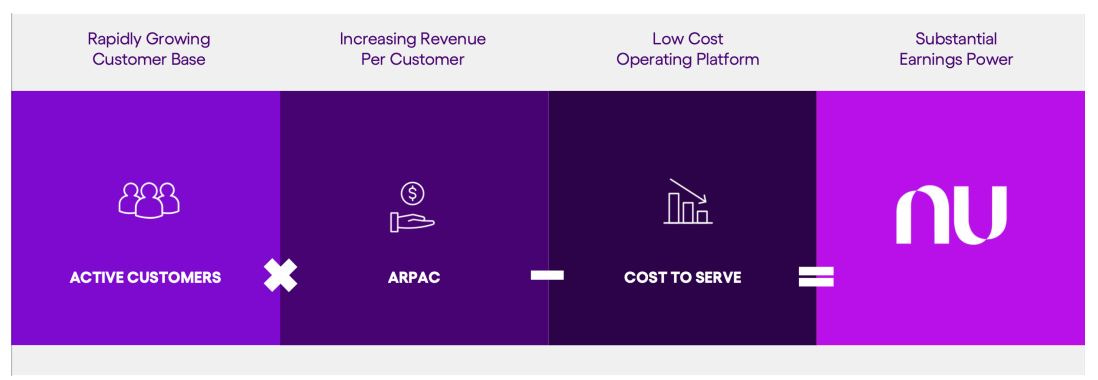
Active Customers
The growth of total customers has been impressive in the past years, especially in Brazil. In addition, customers are quite sticky and active, resulting in an activity ratio of 83%. But there is one major concern; over 60% of adults in Brazil is a customer of Nu. Makes one wonder how sustainable this growth will be for the future.
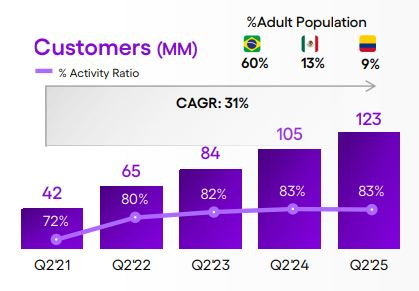
Brazil
Currently Nu Brazil has ca. 107 million customers and the YoY growth is already declining for quarters; from 31% YoY in Q1 2023 to 12% YoY in Q2 2025. I have continued this decline in growth until 2034, assuming that serving 75% of Brazilian adults will be the ceiling of growth. This results in maximum 134 million Brazilian customers in Q4 2034, including corresponding YoY growth rates and serving Brazilian adults % per quarter.

Mexico
In Q2 2025, Nu Mexico has ca. 12 million customers, which represents 13% of the adults of Mexico. YoY growth is jumping all over the place; from 33% YoY in Q2 2023 to 117% YoY in Q2 2024, back to 54% YoY in Q2 2025. I expect YoY growth to decline back to double digit figures until 2030, after it will continue to grow with single digit growth figures, ending up with a maximum of 35 million Mexican customers and a Mexican adult rate of 38%. This is quite conservative in my opinion.
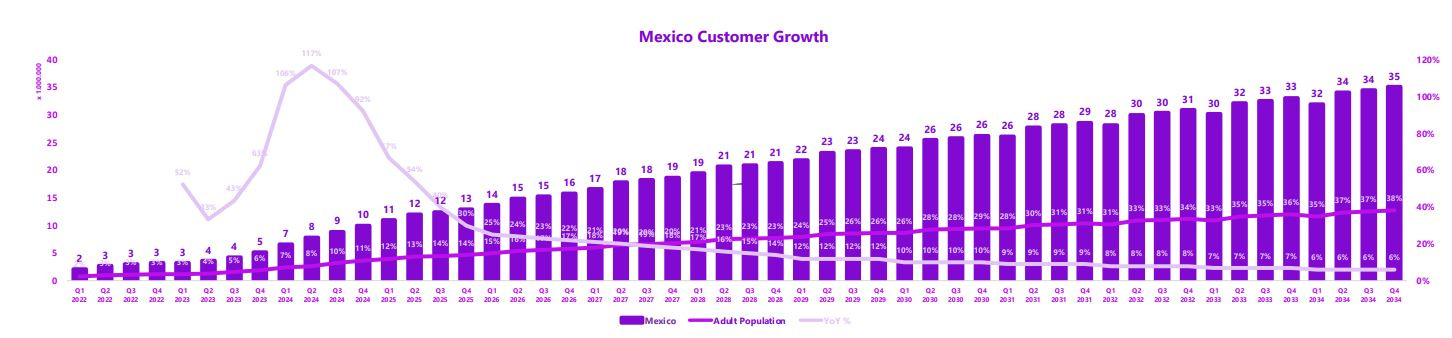
Colombia
Nu Colombia has ca. 4 million customers, which represents 9% of the adults of Colombia. YoY growth is jumping all over the place as well; from 201% YoY in Q1 2023 to 42% YoY in Q1 2024, back to 85% YoY in Q2 2025. I expect YoY growth to decline back to double digit figures until 2031, after it will continue to grow with single digit growth figures, ending up with a maximum of 15 million Colombian customers and a Colombian adult rate of 41%. This is quite reasonable in my opinion.
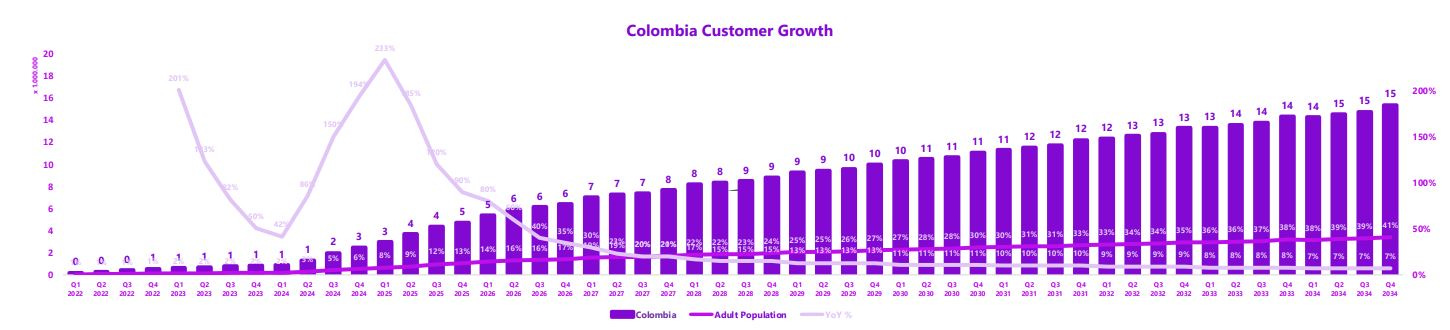
How many of them are Active?
The Active Costumers ratio has been quite stable over the past few quarters. From 78% in Q1 2022 to 82% in Q3 2022, after which it maintained around a level of ca. 83%.
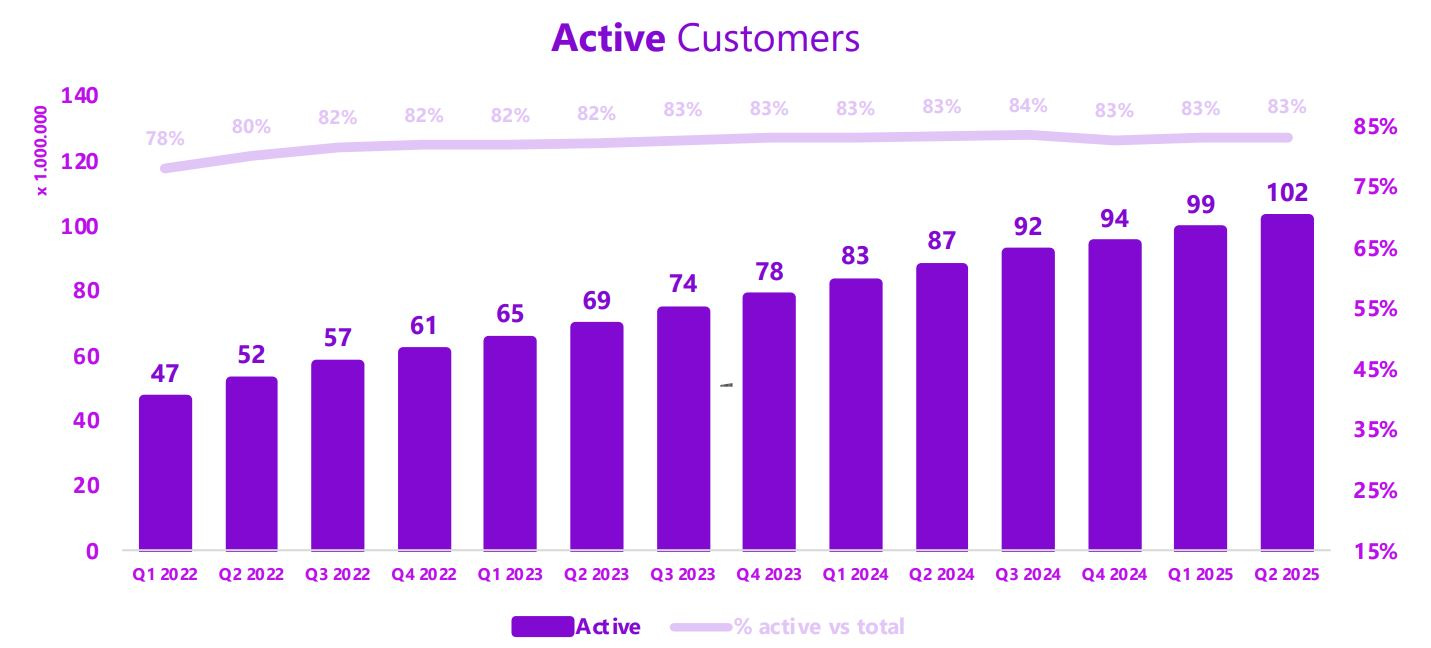
Therefore, I maintain an 83% Active Customer ratio until 2034.
So, what can we expect until 2034 when it comes to Average Active Customer growth?
Before I share the overview, one remark; I have created an Average Active Customer overview, since the ARPAC ratio is a monthly ratio. The Active Customers on quarter level are averaged to a yearly level. No huge impact, but just to make things more fair.
Based on the following parameters;
a maximum adult share of 75% in Brazil, 37% in Mexico and 39% in Columbia,
an 83% Active Customer Ratio
I end up with ca. 182 million total customers and ca. 150 million active total customers in 2034.
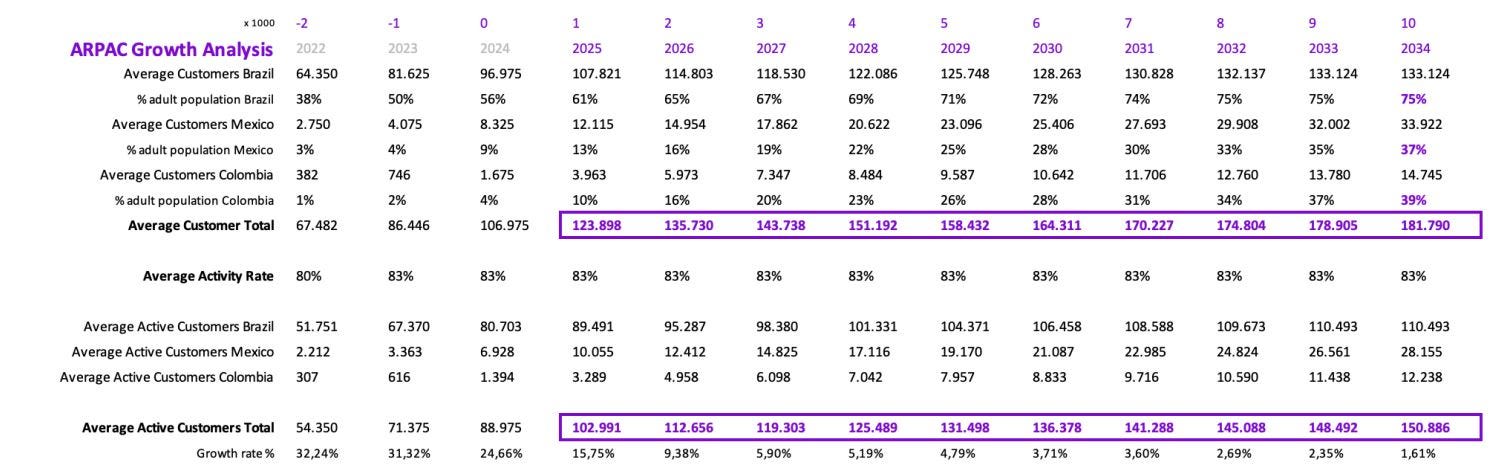
ARPAC
The ARPAC ratio is one of the most important ratios of Nu to monitor. It distills all revenue elements, product lines and corresponding growth perspectives, growing LDR ratio etc, down to one important ratio; how much dollar revenue collects Nu per active customer per month? Combine this with the previous Active Customer numbers and we can predict revenue growth for the foreseeable future.
Due to their growing product portfolio the ARPAC ratio is growing with attractive rates as well. From $6.7 per Active Customer per month in Q1 2022 to $12.2 in Q2 2025.
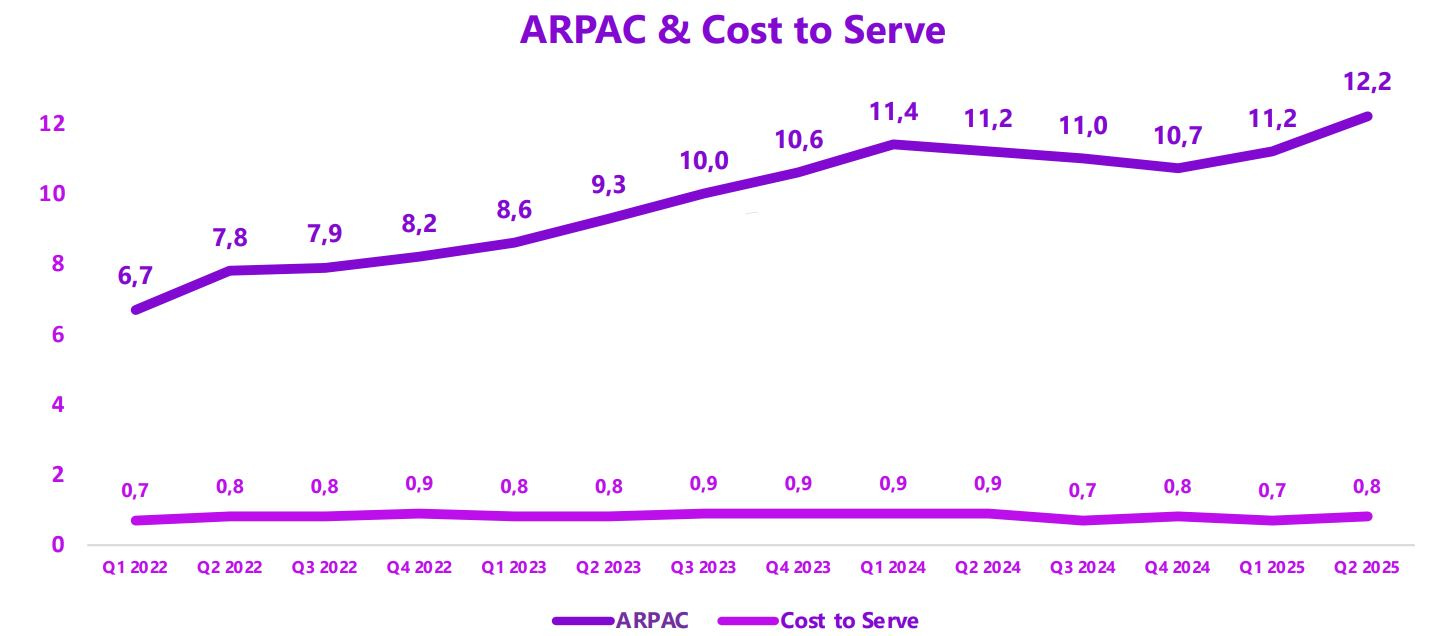
This ratio will continue to grow in the future, for at least 3 reasons:
Nu will continue launching new product lines.
Customers spend significantly more money per month in year 8 compared to year 1. After 12 months the ARPAC ratio is around 4.9 dollar per month, while this increases to 27.3 in year 8.
Incumbent banks in Latin America have an average ARPAC of ca. $43. They charge higher fees compared to Nu, but Nu should be able to launch more products compared to the incumbents.
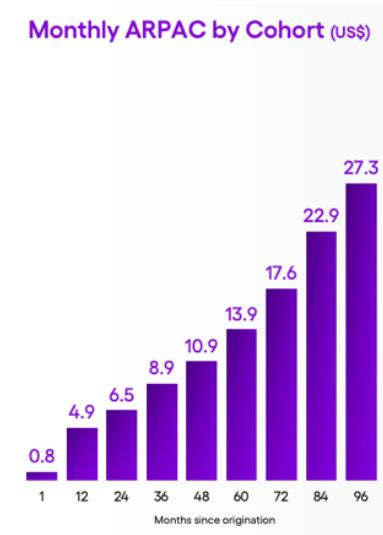
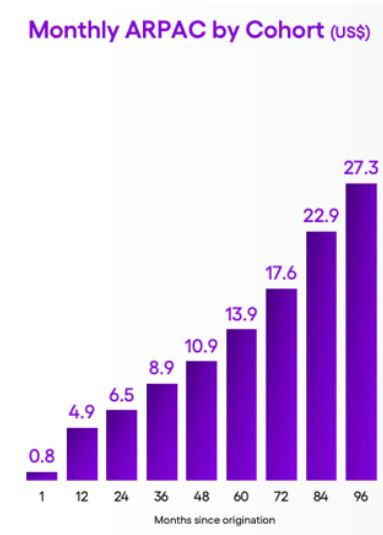
For now, I will let the ARPAC increase in a conservative manner to $25.5 dollar per month in 2034. This is around the current 27.3 dollar per month achieved by 8+ years customers but based on the current product portfolio. Nubank will extend their product portfolio significantly in the coming years, so the expected 25.5 ARPAC metric is considered to be conservative.

Over 46 billion revenue in 2034
Multiplying the expected Average Active Customers and the expected ARPAC results in over $46B revenue in 2034:
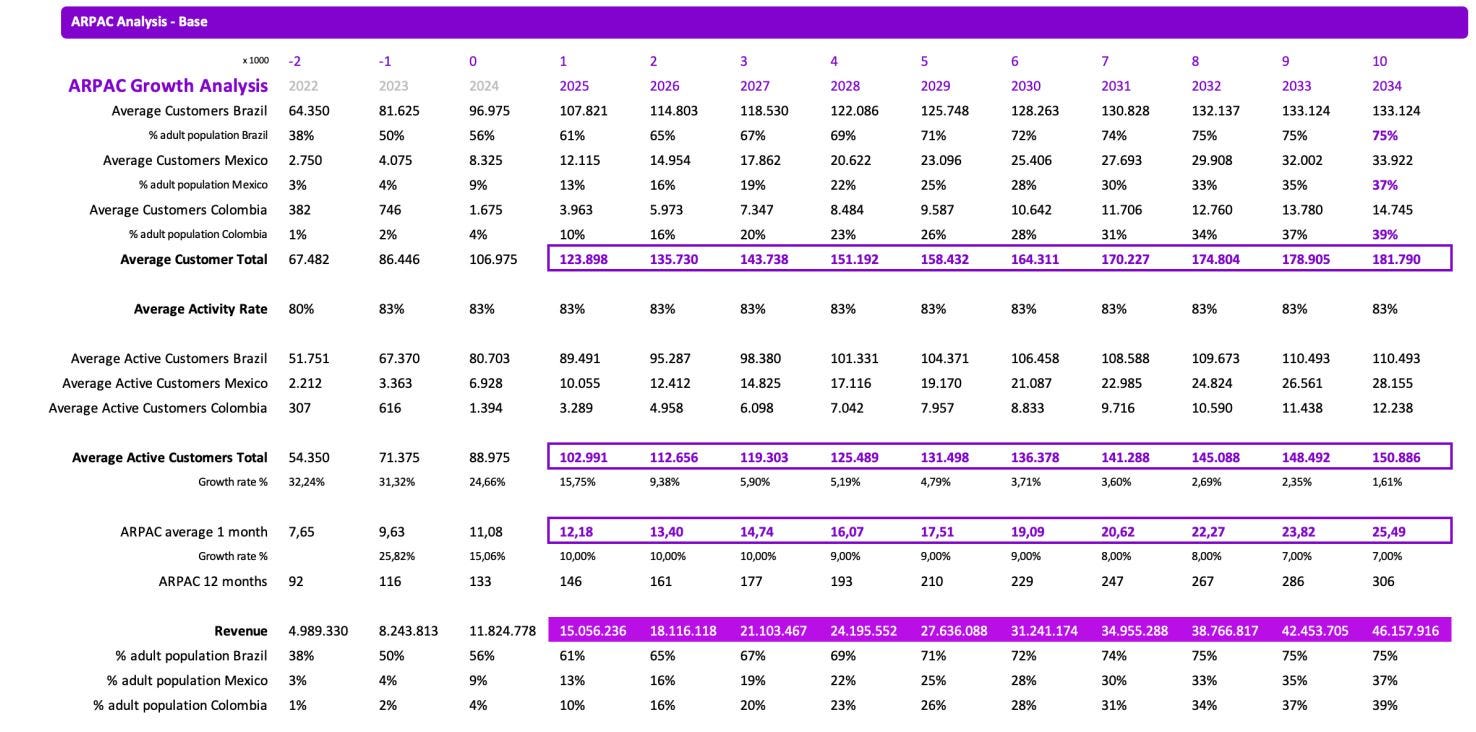
How feasible is this?
I did not include:
Expansion to other countries, although this is one of management’s key growth factors.
I have been conservative in:
Adult shares in Mexico and Colombia. Nubank does not have the same first mover disruptive advantage as it has in Brazil, since more neobanks or fintechs are already active in Mexico and Colombia.
ARPAC ratio of $25.5 in 2034. This is around the current $25.9 per month achieved by 9+ years customers, but based on the current product portfolio. Nubank will extend their product portfolio significantly in the coming years, so the expected $25.5 ARPAC metric is considered to be conservative. In addition, incumbents do have significantly higher ratios of $43 per active customer per month. Especially due to the increasing product portfolio and attractive and easy platform I believe that most of the upsell would be found in a higher increaser of ARPAC.
I have been reasonable in:
Adult share in Brazil, although this might be slightly higher than a 75% ceiling.
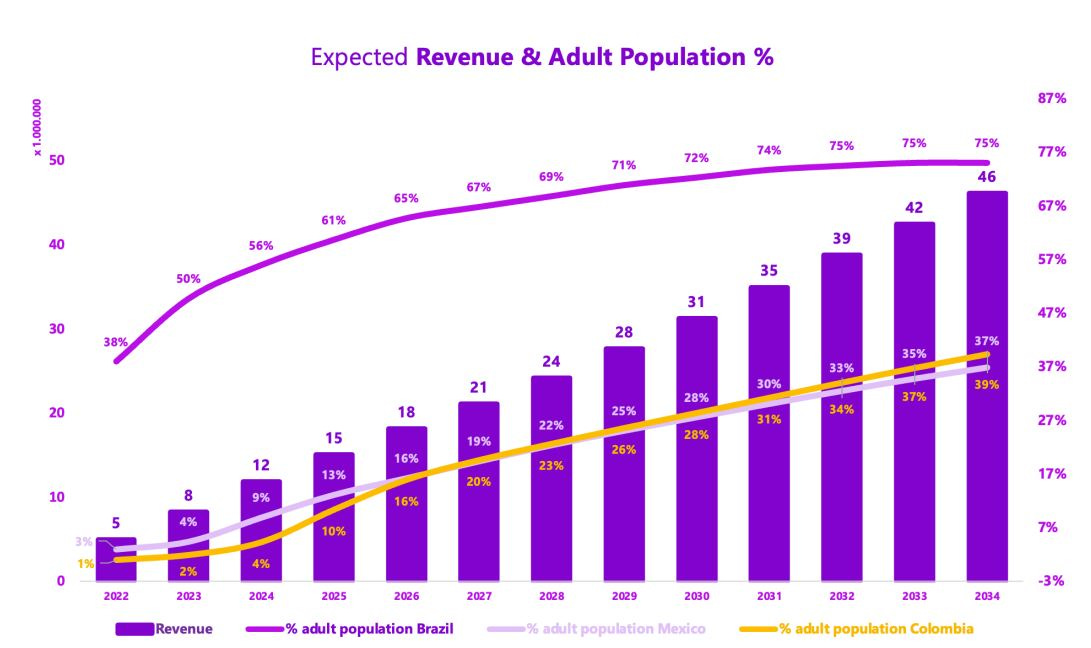
Valuation
Reverse DCF - What Growth is Priced In?
Starting with known data points and working backwards to assess market expectations and judge whether these expectations are realistic.
I start by working backward with a Reverse DCF, using known data to uncover the market’s growth expectations and test their realism. With a 10% discount rate and a 2.5% perpetuity growth rate, the model reveals NU Holdings must grow its income by 11.3% annually over the next decade to justify today’s price. This feels fair given the growth trajectory NU Holdings is on.
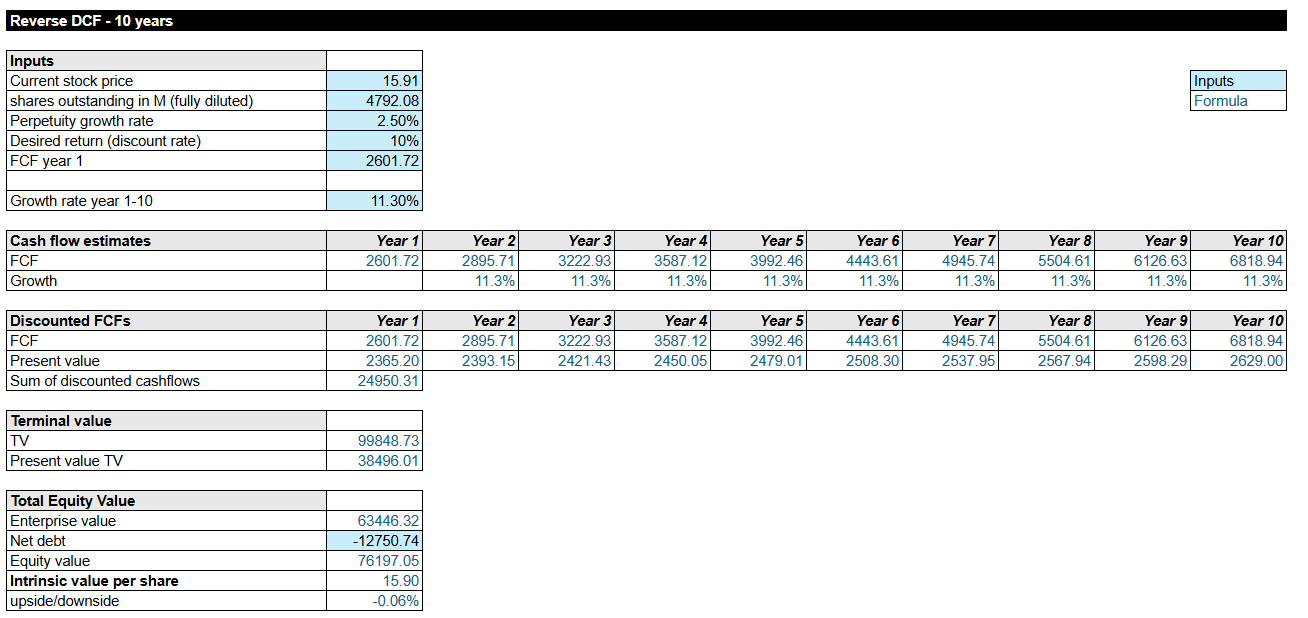
If you are interested in the forecast and valuation model in Google Sheets you can join our Discord app for free and get it. There will be more detailed information available in the app, also around other stocks.
DCF Model: What’s the Intrinsic Value?
Next, I will calculate NU Holding’s intrinsic value using a declining revenue growth but an increasing operating margin, as earlier explained. Here are my assumptions:
An adult market share of 75% for Brazil, 37% for Mexico and 39% for Colombia in year 10.
A maximum ARPAC of 25.49 dollar per month in year 10.
42% gross margin in 2025, declining towards 40% in 2029 and to be maintained at 40% for the years ahead.
24% EBIT margin in 2025, which will increase by 50 bps each year towards a 28% EBIT margin in year 10 due to operational leverage in efficiency ratio.
Increasing tax rate, from 28% in 2025 to 31% in year 10.
2.6 billion dollar net profit in 2025, increasing towards 9.5 billion dollar in year 10.
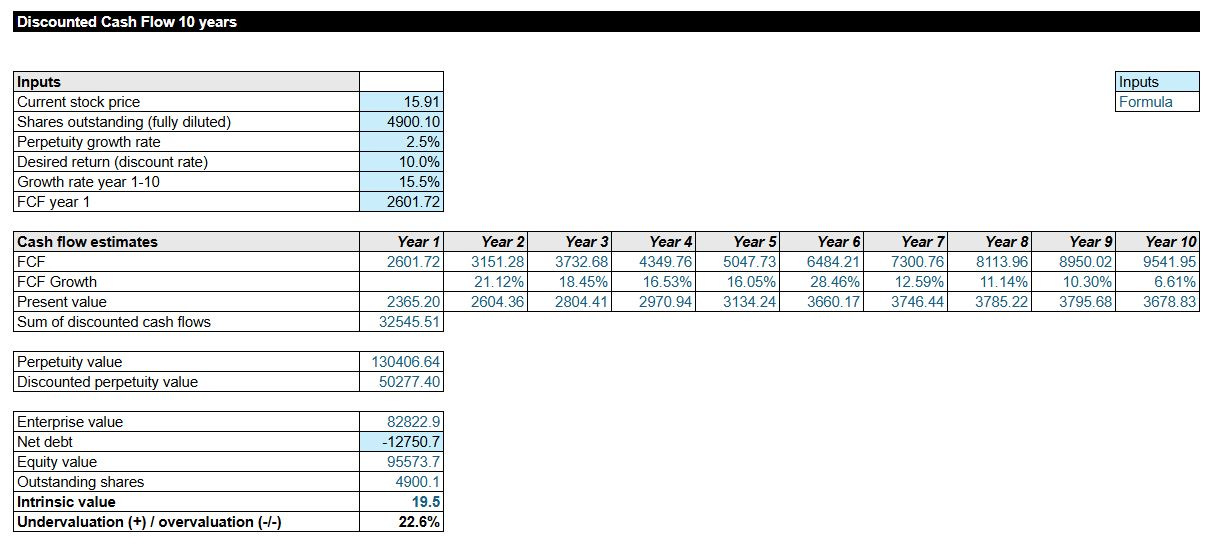
The DCF suggests NU Holdings is undervalued by 22.6%, yielding a 12.0% annual return over ten years. However, this is for the base case and without any margin of safety. Given the fierce competition and the LatAm risk premium (which I didn’t update my Desired return rate for) I would like to go with a margin of safety of 35% which results in my buy below price of $12.67 and an expected return annual return of 14.4% the next ten years.
Let’s also explore the optimistic and pessimistic scenarios:
The bull case at 20.0% earnings growth offers an intrinsic value of $24.40 and a 14.4% annual return based on today’s stock price of $15.91.
The bear case at 7.5% earnings growth drops the intrinsic value to $12.30 with a 7.5% annual return based on today’s stock price of $15.91.
Forward P/E
I have taken NU Holdings forward P/E as of 2023, as the years before 2023 NU Holdings didn’t make a profit yet. Its median over recent years sits at 25.3, and currently it is 23.8 showing it’s trending just below it’s average of last years.
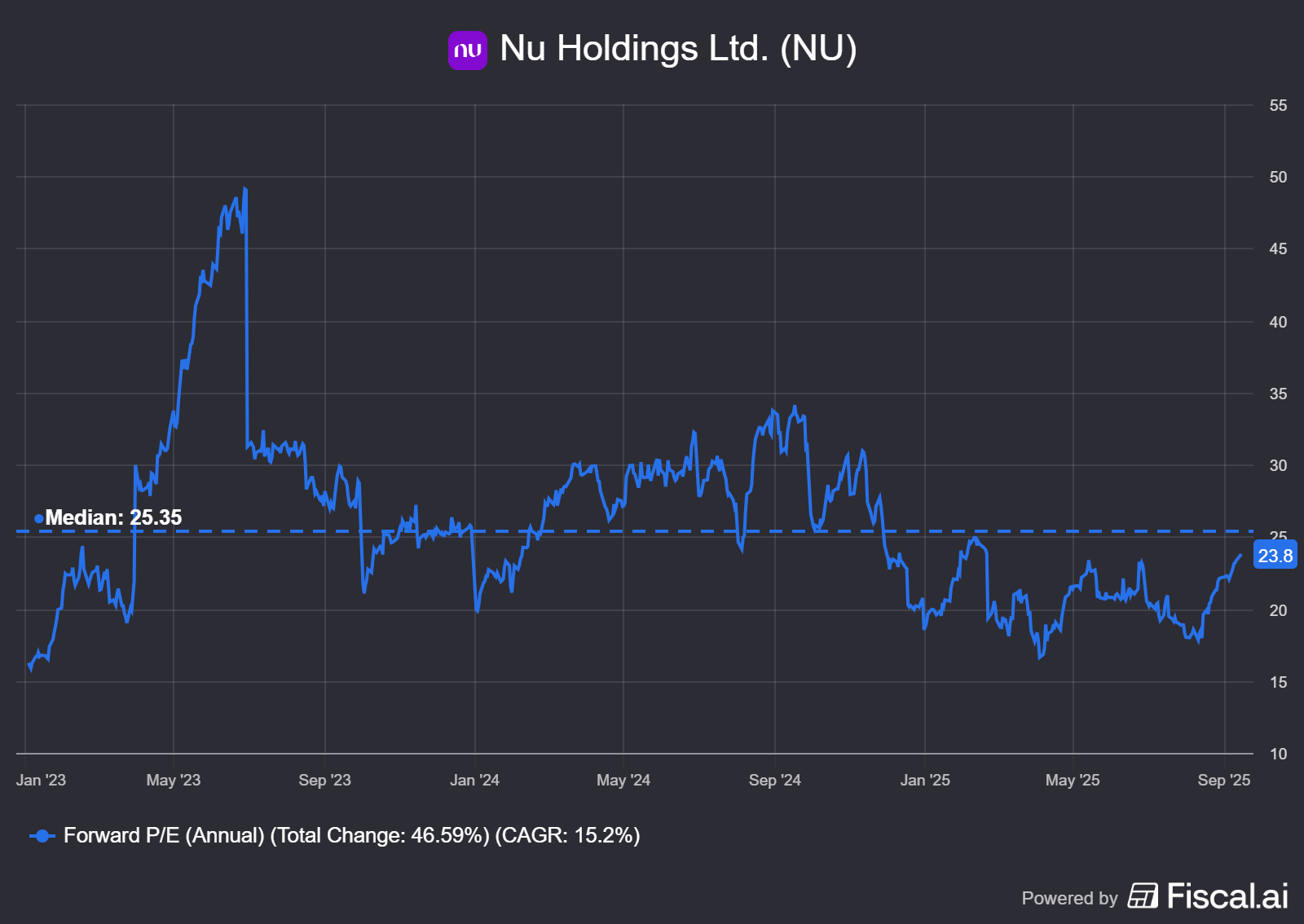
Facts Recap
Management
Positive – Nubank is founder led. Vélez is founder and still Nubank’s largest shareholder, mainly owning Class B shares with higher voting rights. This provides him 75% of voting rights and 19% of economic ownership and ensures a long-term strategy laid out by Vélez.
Positive – Nubank’s leadership is a blend of visionary founders, seasoned professionals from global finance, and top tech talents from Uber, Duggal ad Facebook. They are relatively young as a group, which brings energy and a long horizon. They mastered a balance between aggressive growth and prudent management, without major scandals or setbacks.
Positive – Nubank has a strong internal culture. It’s founding mission is to simplify financial services and empower individuals. Each team is expected to consider how their contributions advance financial inclusion and improve lives. Such values drive the company’s long-term perspective, placing enduring customer trust and broad financial inclusion ahead of short-term profit.
Financials
Positive – Nubank’s financial health appears solid – it is profitable, well-capitalized, and highly liquid, with credit risk largely under control through substantial provisioning and high risk-adjusted margins. The balance sheet is solid, the income generation is robust, and it generated an operational leverage due to their superior efficiency level around 28%. ROE around 28% during the last quarters.
Positive – Asset quality is managed actively: while NPL ratios rose in 2022 and 2023 amid economic stress, they have stabilized a bit around 6.6% for 90+ day NPL. Capitalization is strong with CET1 / Tier1 capital around 20%, providing a sizable cushion above regulatory requirements.
Operational
Positive – Nubank operates entirely through digital channels and created a full platform of financial products. Their proprietary platform allows rapid product launches, high reliability, and low operating costs. This technology-first principle ensures Nubank remains more agile, efficient, and innovative than incumbents tied to legacy systems.
Positive – Data is embedded in every function of Nubank. Nubank has a superior risk management and underwriting, underpinned by its proprietary NuX credit engine. Nubank’s data science teams continuously refine algorithms that analyze customer behavior and myriad alternative data points to make lending decisions. This dynamic, data-driven credit process allows Nubank to extend credit to users whom traditional banks might overlook, but without incurring outsized defaults.
Positive – The company devotes nearly 40% of its workforce to customer support, blending AI-driven self-service with human agents for more complex issues. Nubank’s processes enable 94% of customer calls to be answered within 45 seconds, and most inquiries are resolved on the first contact by well-trained in-house teams.
Market
Positive – Huge runway ahead in the core markets of Nubank. Currently 5% market share of gross profit pool in Brazil and 1% in Mexico. They reached majority of adults in Brazil, so upsell has to come from ARPAC increase. Mexico and Colombia still offer a decent customer runway, but I expect growth to be a bit slower compared to Brazil due to increasing competition.
Challenge – International expansion might not look as attractive as it appears front sight. A significant GDP is required to cover initial investments cost, since Nubank has to duplicate the underwriting model from scratch for every single country. In addition, every single country has its own regulation and governance that requires separate attention. Especially lower interest rates or even interest caps are worth paying attention to.
Challenge – Nubank is exposed to considerable credit and emerging market risks. It has a strong emphasis on lending, particularly in Brazil where default rates are elevated. The company’s increased focus on interest-driven revenue streams has made it more vulnerable to loan defaults. Operating in dynamic economies like Brazil, Mexico, and Colombia, Nubank faces additional challenges from economic volatility, rising borrowing costs, fluctuating currencies, and evolving regulatory frameworks - all factors that can significantly influence its profitability and operational resilience.
Competition
Positive – Nubank harvested the results of a first mover advantage in the past years. More fintech and neobanks showed up, but currently Nubank is market leader in the majority of segments in Brazil. Customers love Nubank, reflecting in high branding recognition.
Challenge – The increase of competition is definitely a metric to monitor. It is hard to grasp whether Nubank can maintain their competitive position towards these new fintech players. Technically they offer the same zero fee products and services and can offer the same integrated cloud-based platform full of products. Many consumers in Latin America hold accounts at more than one bank or fintech which allows them to decide over time which to use more. Mercado Pago is the main competitor, by matching product offering and underwriting and by benefiting from their platform advantage. At the other hand, the longer customers use Nubank, the more services they tend to bundle under its platform – which increases the hassle of leaving. As customers adopt multiple Nubank products, it entwines with their financial life.
Valuation
Positive – Valuation is a bit heavy, but only due to stock increase after recent earnings. Based on a conservative and modest revenue and earnings growth perspective I do see an interesting return over the coming 10 years of around 14.4% at a stock price of $12.7. The upside is quite significant; by means of a more aggressive ARPAC increase or higher customer volume due to international expansion. Both scenarios are quite reasonable – or even close to a base case since management will announce a new market introduction end of this year. My 10-year DCF provides a fair value of $19.50, but given the high competition I prefer a margin of safety, even with my conservative and modest revenue growth.
Final Conviction
It is difficult not to fall in love with Nubank. Customers fell amass for the company and from an investor perspective there is much to like as well. It is founder led by an impressive personality, maintaining a 75% voting share, ensuring the rollout of a long-term strategy. It built an amazing internal culture which is highly customer focused, all chasing one mission; to simplify financial services and empower individuals. They created an attractive data-driven platform full of zero fee products which opened up banking for many Latam individuals and disrupted the entire banking industry. It is highly profitable and created an operational leverage due to an increase of operational efficiency and scale. It generates high levels of ROE, while actively managing the asset quality which results in strong NPL ratios. The growth runway of both revenue and margin is long, aiming on customer expansion and product launches to increase ARPAC. So far so good.
But I do have 2 main concerns. First concern is a common mentioned risk; Latam’s macroeconomic situation makes investors nervous. And it makes sense. Inflation is an attention point, but Nubank seems to be able to adapt quickly due to monthly rates. I expect the Brazilian Real to decrease against USD, but the potential growth runway will mostly cover this. But a potential recession might shake up everything. Unemployment would increase and I expect NPL rates to explode in such a situation.
Second concern is increasing competition. Nubank had a first-mover advantage in the previous year, but has attracted several fintech or neobanks as competition. In addition, incumbents are picking up the pace as well by launching online platforms. Many consumers in Latin America hold accounts at more than one bank or fintech which allows them to decide over time which to use more. Special focus must go to Mercado Pago. It benefits from the power of the MercadoLibre’s ecosystem by acquiring and engage users at a scale Nubank cannot match outside of Brazil. It offers a product depth close to that of Nubank and is currently active in 18 countries. Therefore, 2 metrics are important to monitor; Active Customers and % of customers who are using Nubank as primary bank: Primary Banking Account ratio. Both are stable, but not increasing. Active Customers ratio is stable around 83% over a few quarters, while Primary Banking Account has been above 60% for a few years but decreased slightly towards 59% in 2024.
In my opinion, increased competition is a risk since financial products are not really distinctive. I do not expect this risk to materialize short term, but it can be quite dangerous long-term. All competitors will be able to offer the same zero fee products. Difference can be made in underlying loan or credit quality, but that will have an impact on profitability, rather than on product USP. Nubank could tackle this by achieving high product adoption by customers and to entwine them in their financial life.
Valuation provides an entry point of $12.7, while current stock price is close to $16. Therefore, I will not initiate a position yet and wait on the sidelines. Here is the final score, which is a result of the deep dive:
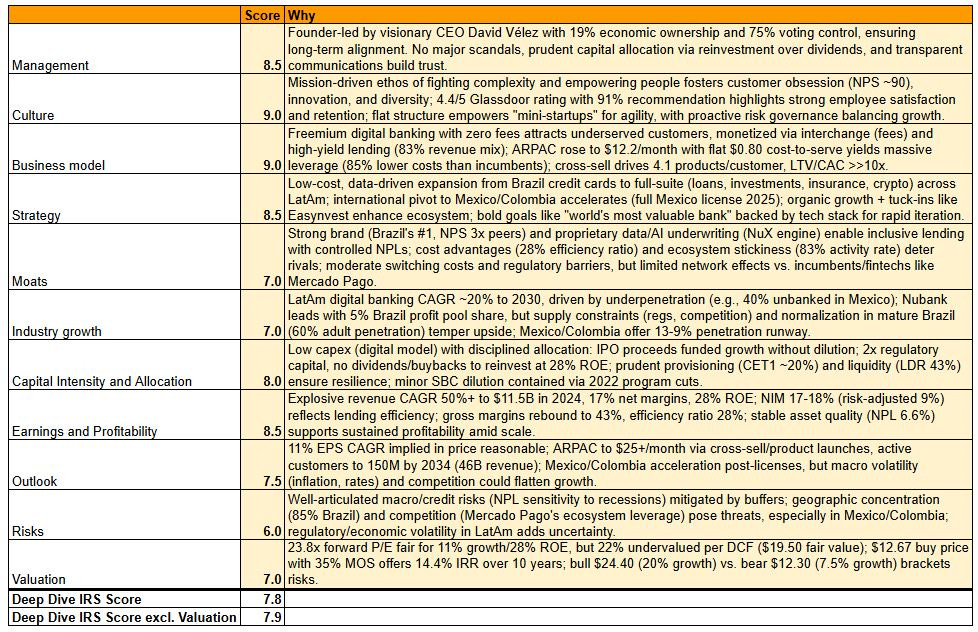
If you’d like to explore these rankings further or discuss Nu Holdings with fellow investors, join the Compound & Fire Discord community. We’re always ready to explore quality picks together!
Hopefully you have enjoyed this deep dive. Feel free to like the post and share it with friends!
Disclaimer
The information in this article is provided for informational and educational purposes only.
The information is not intended to be and does not constitute financial advice or any other advice, is general in nature, and is not specific to you. Before using this article’s information to make an investment decision, you should seek the advice of a qualified and registered securities professional and undertake your own due diligence.
None of the information in this article is intended as investment advice, as an offer or solicitation of an offer to buy or sell, or as a recommendation, endorsement, or sponsorship of any security, company, or fund. The author is not responsible for any investment decision made by you. You are responsible for your own investment research and investment decisions.
Excellent write up! I am really interested in Nu Holdings.
Fantastic write-up!