

Welcome to Compound & Fire, where I’m building wealth the smart way by investing in top-quality businesses that drive long-term shareholder value, paving the path to financial freedom. Join our Global Quality Investing Discord and Substack community to grow this journey together!
Introduction
After I had added Cogent Communications to my portfolio the share price sharply dropped and hence it is time to write an update. But Collective Fire Author Wayne, author of Dragon Field Investing (if you don’t follow him yet, I strongly adivce to do so!) was faster than I am. I read his article and I couldn’t have done it better and wouldn’t have done it differently. It shares my initial story and my current thoughts, so we are completely aligned!
My prior article on CCOI presented a compelling deep-value opportunity, with an underappreciated asset and catalysts for a significant rerating despite headline risks around debt and legacy telecom challenges. Cogent’s 180 data centers and 38 million IPv4 addresses are valued at $10.7 billion based on current market prices for legacy data centers and IPv4 addresses. After deducting the $2.4 billion net debt on the balance sheet, the net asset value (NAV) from just the two items is $8.3 billion, or 4.37x of the then $1.9 billion market cap. This is without consideration of Cogent’s ongoing and profitable business in internet access and transport services, which represent approximately 25% of all global internet traffic; a potential high-growth, valuable wavelength services network; and a monthly subsidy payment of ~$8.3 million from T-Mobile until October 2028. In other words, if we assign a zero value to Cogent’s ongoing business and its fiber network, Cogent was traded at a P/NAV of 0.23.
Well, that P/NAV of 0.23 was in the warm and cozy days of mid-September. As we enter the chilly days of late November, Cogent’s market cap has dropped to just $906 million, or a P/NAV of 0.11 if the asset valuation has not changed materially.
If Cogent was viewed as a misunderstood, “deep value with optionality” story in September, it is now being treated as a distressed asset play, but only by the equity investors. For example, CCOI’s June 2027 7%-coupon bonds are still trading at $100.4, indicating that bond investors don’t see a risk of Cogent failing to pay its interest on debt.

What had happened
Cogent reported its Q3 earnings before the market opened on November 6, and its stock took a swan dive, dropping 35% from the $38.3 closing price of the previous day to $24.95. In the following six trading sessions, it continued its daily decline to an intraday low of $15.96 on November 14, but staged a volatile intraday reversal and closed at $17.55. From the $38.3 pre-earnings closing to the intraday low of $15.96 on November 14, investors marked CCOI down by 58%. At the current price of $17.05 (November 21), CCOI is down 80% from its high of $85.18 about one year ago. What has spooked the investors and the Wall Street analysts?
Earnings Highlights and Misses
Q3 2025 service revenue came in at $241.9 million, down 1.7% sequentially and 5.9% year-over-year, missing consensus estimates.
Despite the revenue drop, on-net revenue rose 2.2% quarter over quarter, and wavelength revenue surged 92.5% year over year to $10.2 million, demonstrating progress in strategic growth areas.
Adjusted EBITDA increased marginally to $73.8 million (margin 30.5%). In comparison, GAAP EBITDA grew to $48.8 million (margin 20.2%), both up on a quarterly and annual basis due to a higher-margin service mix and disciplined cost controls, but still failed to offset the negative topline shock.
CCOI posted a GAAP net loss of $0.87 per share, reinforcing market skepticism about near-term earnings power and sparking concerns about dividend sustainability.
On the conference call, COOI stated that they have changed the IPv4 leasing structure. Currently, they have leased out only 13 million of the total 38 million addresses, and they are considering selling some of the idle addresses. However, due to the recent decline in quoted prices, they decided to allow the leasees to sublet their blocks. The company believes that this would result in a slightly lower unit price overall, but much higher utilization for the entire asset base. In Q3, revenue from IPv4 leasing was $17.5 million, implying an annual run rate of $70 million. Note that this is a 14.1% increase over Q2, and a 55.5% increase over the same quarter last year. Given the robust FCF generation capacity of these IPv4 assets and the potential for significant tax liability if they were sold (because they were carried on the books at zero cost), it makes no sense for CCOI to sell any of them.
Shortly before the Q3 report, CCOI revealed that it had signed a Letter of Intent (LOI) to sell two of the twenty-four converted Sprint data centers for $144 million, validating Compound & Fire’s investment case estimate.
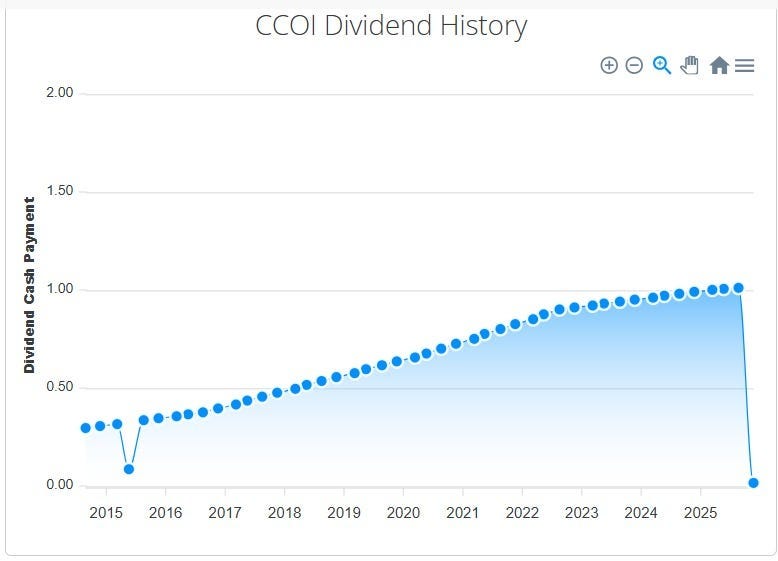
The company suspends its quarterly dividend from $1.02 to $0.02 per share until the Debt/EBITDA ratio is brought back from the current 5.3x to below 4x.
Why Did Investors and Analysts Hate Cogent’s Q3 Report Card?
Major brokerages, including JPMorgan, RBC, Citi, and Goldman Sachs, all cut price targets by ~20% (to $23 and $25), and the consensus target is now $25.71, as analysts flagged near-term underperformance, continued legacy business drag, and operational execution risk.
However, the actual reason for the relentless selling from November 6 to 14 was that dividend investors were bailing out. Due to its high and consistent dividend yield since 2013, CCOI is included in many income and high-yield funds and ETFs. When the dividend yield dropped from +10% to near zero following the cut, these funds had no choice but to close out all their positions. Obviously, many dividend investors, even some professional fund managers, are mistaking the “income” from dividends for the income from fixed-income securities like government or high-quality corporate bonds. Nevertheless, to most dividend investors, it’s an irreparable sin for a corporation to cut dividends. Their mantra is, “Cut my divvy, I will kill you.”
What’s the Way Forward?
Like a car involved in a head-on collision with an 18-wheeler on a highway, Cogent is now being crushed, towed, and dumped at a junkyard. Is there any hope that a professional dismantler would pay more than $0.11 to buy $1 of CCOI’s NAV to harvest the parts? If so, can he get $0.22 or $0.33 for each $1 NAV for the parts? Taking a more optimistic view, would a re-builder buy CCOI from the junkyard, clean it up, repair it, and then sell some or all of it for something like $0.77 or $ 0.88 per $1 of NAV? Ideally, for shareholders, the best outcome would be for Cogent’s legendary CEO, Dave Schaeffer, to execute his strategic plan to monetize non-core assets, lower leverage, accelerate growth in its core internet transport and emerging wavelength businesses, and restore the dividend and buybacks to return capital to shareholders. If so, buying CCOI at the current price is akin to spending $0.11 for a dollar bill or even $2. Plus if dividend back in place at $1 a quarter, that would mean 23% at current prices. Even if it’s half it’s very interesting.
If you are interested in CCOI, I encourage you to read my prior article. Another excellent resource for CCOI is Aaron Chan at Recurve Capital, who has written extensively about the company and conducted interviews with Cogent’s CEO. I don’t intend to write a deep dive into DCF modeling or COTP (sum-of-the-parts) analysis, because anything I produce would look superficial compared to theirs. However, I can offer to conduct an exercise to assess the marketability of their 24 non-core data centers with “For Sale” signs on. In my view, this is the most critical piece of the Cogent story. Suppose these data centers can be monetized over the next 1-2 years at a decent price. In that case, it will give Cogent many opportunities to unlock value from its other assets and develop its emerging wavelength business. If they can’t, Cogent would be in a bind, and the only options are a fire sale of other valuable core assets or issuing new shares, which would dilute existing shareholders.
7-Eleven for Edge AI
Unless you have been living in a cave in the Hamalaya Mountains meditating for the last three years, you are probably aware that an AI company with projected $13 billion revenue and $9 billion loss in 2025, has a plan to spend $1.3 trillion to build data centers by 2030. The company is not public yet, but the pre-IPO investors already valued it at north of $500 billion in the private market.
Of course, everybody knows that I am talking about OpenAI, the poster child of the ongoing raging AI revolution. Recently, there have been many doubts about where OpenAI will find the money to build the $1.3 trillion data centers, whether they can get the power to run them, and other concerns. But OpenAI says they must build these data centers to meet the customer demand. Upon hearing about the 24 Cogent “move-in ready” data centers for sale, you may think, “What are they waiting for?” Just make a deal between Cogent and OpenAI for a couple of billion dollars, which is less than pocket change for OpenAI, and problems at both companies will be solved. Cogent gets the money to lower its leverage, and OpenAI gets the mush of compute capacity it needs now.
AI Computing: Training vs Inference
Unfortunately, Cogent’s 24 for-sale data centers can’t handle any of OpenAI’s compute needs for the model training. For that task, it needs mega data centers with a power capacity of 40-120 kW (kilowatts) per rack, versus the 4-8kW per rack typical at the Cogent data centers. More importantly, running AI servers with the most advanced NVIDIA GPUs (H100/Blackwell) is like running a furnace. Without liquid cooling, you would melt the Cogent buildings in no time. All Cogent data centers are air-cooled, even after they spent over $100 million in the last two years renovating them. As shown in this table, there are many gaps in Cogent’s data centers if you want to run them as an “AI Factory” for model training.
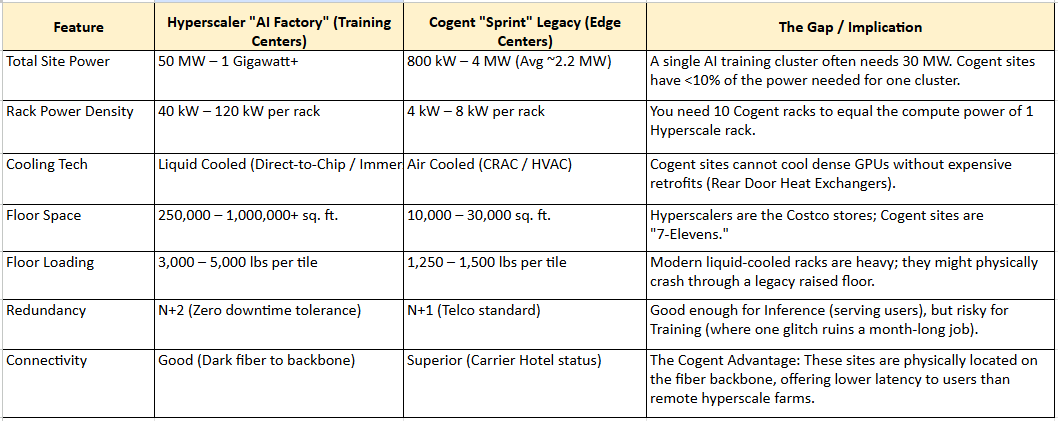
However, Cogent’s data centers can handle AI inference compute with only some creative design. One workaround is to put only one AI server in each rack instead of 10, so you stay under the 5 kW limit and don’t need to rebuild the cooling system. The downside is that you are wasting a lot of floor space, which is uneconomic if you have expensive real estate for the data centers.
Another workaround is to use less powerful inference chips, such as NVIDIA L40S or older A100s, which run cooler than the training chips. This way, you can fit 2-4 of these servers in a rack and achieve a power density of ~15 kW. For the cooling issue, you can install “Rear Door Heat Exchangers” (RDHx). These are special doors that fit on the back of the rack with a radiator coil inside. They capture the heat before it enters the room. This allows legacy buildings to handle AI workloads without ripping up the floor for a liquid-cooling system.
There are also lower-power alternatives to the NVIDIA GPU for AI inference. For example, the ARM Ampere Altra CPU requires only 190W, compared to 700W for the NVIDIA H100 and 350W for the L40S. They are already being deployed for inference computing for high-volume small AI models. The Qualcomm AI100 Edge Accelerator, which requires only 75W, is perfect for computer vision and Edge AI.
Let’s use transportation as an analogy to illustrate the difference between AI model training and inference. For those of you who have traveled on China’s high-speed rail (HSR), you know it is cheap, fast, comfortable, and has 95%+ on-time reliability. If you are one of the 1,200 people who want to travel the 750 miles from Shanghai to Beijing, you will spend about $80, and it will take about 4.5 hours. For the same 1,200 passengers, if you use Uber or DiDi taxis, you will need 400 cars and 400 drivers, and it will take 12 hours to drive the distance, plus time to stop for meals, fuel, and biobreaks. AI training is like taking the HSR. China has invested heavily in building the rails and other infrastructure, and spends a significant amount each year operating them. But once built, the system’s capacity and unit economics are simply excellent. Of course, you need to make sure there is sufficient demand for the capacity; otherwise, you will lose a lot of money very quickly, as your revenue can’t cover OpEx and asset depreciation. The large AI training data centers work the same way: Very high upfront CapEx and long building cycles, significant on-going OpEx, but excellent unit economics if you have a high enough utilization.
Now imagine the 1,200 passengers are spread across different cities and villages in China, each with very distinct transportation needs. Some want to travel to remote provinces or even to foreign countries. Some want to visit a nearby city, within 50 to 150 miles. Still, some others only want to make a trip across the town, or 2 miles down the street to a grocery store. In this case, the 1,200 passengers will need many different modes of transportation, or combinations of them. Some will take the HSR, some will fly, some will drive a personal vehicle, or call an Uber. Some may choose to ride a bicycle or walk. This is not unlike AI inference computing. As AI is applied to more and more use cases, it will require a range of approaches to designing and building systems that achieve the best results at the lowest possible cost. This is where you don’t want the hyperscalers’ GW data centers. Instead, you want Cogent’s cheap, convenient data centers that are close to you and also offer the flexibility to design your customer AI inference computing systems.
Using another physical-world analogy, the large data centers of the hyperscalers are the big Costco warehouses that let hundreds of customers zoom around; the Cogent data centers are the small 7-Eleven stores that serve only small neighborhoods but are much quicker and more convenient for small purchases.
Hybrid Edge AI Economics
We can run an exercise to build a distributed grid (Edge AI for inference) that respects the limits of Cogent’s legacy assets, to assess the unit economics of this hybrid approach. The primary constraints are the 5kW-8kW rack limits and air-cooling, but we also need to deliver a high-value inference architecture for ad tech, recommendation engines, and voice agents. We can design this system using a two-tier architecture. The first tier is an “always-on” CPU using the 128-core ARM Ampere architecture to run lighter models (such as Llama-3-8B or Mistral) or vector database lookups. The target customers for this tier include high-volume, low-cost users, such as customer support bots and search indexing, to generate a low-margin but steady revenue stream.
For the second tier, we will install an NVIDIA L4 GPU on the same server as the “burst accelerator”, but it only kicks in for complex image-generation requests and for analyzing large PDF files, so it does not waste power when it’s not needed. Many customers would be willing to pay a premium for low latency, giving Cogent data centers a competitive advantage due to their proximity to customers and their excellent connectivity. This work can generate higher margin revenue for the operators.
One possible server configuration and its likely cost:
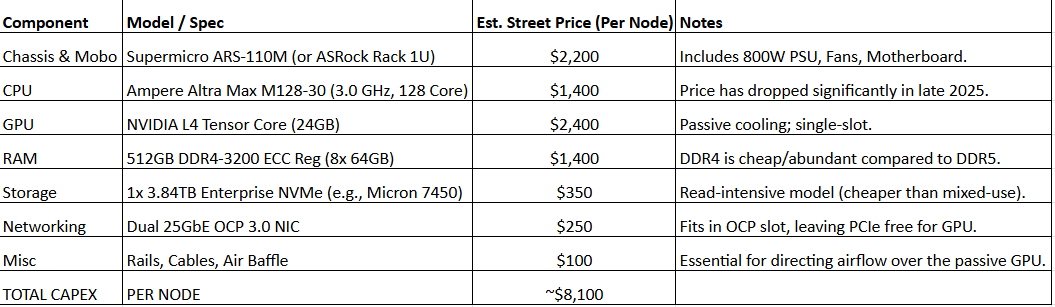
Assuming a per-rack power limit of 5 kW for the Cogent facilities and 14 servers per cabinet, the total cost for the servers is $113,400. Add $6,000 for the network switch and $2,500 for cabling and power distribution unit, and we can build a rack in a Cogent facility for about $122K, which is about one-third of the ~$350K for a typical single NVIDIA DGX H100 rack.
With this design, can do some “napkin math” to estimate the ROI and payback period for this system. For each of the 14 servers on the rack, we have two revenue streams:
Revenue Stream 1: The CPU Workhorse
Use case: Rent out the 128-core ARM CPU as a high-performance web server or redistribution cache for content streamers
Revenue: $6,048 per month (at $0.6/hour rate)
Revenue Stream 2: The GPU Burst Accelerator
Use case: Llama-3 requests via APIs at $0.0002 per 1k tokens
Utilization: 20% (4.8 hours/day of constant inference)
Revenue: $8,400 per month (varies wildly based on demand)
Monthly Revenue & OpEx:
Revenue: $14,448
OpEx: $3,500 ($250 per server for colo overhead, power, and internet)
Net Profit: $10,948
Payback Period
$122,000 / $10,948 = 11 months
As you can see, if we use a single NVIDIA DGX H100 rack for this application, even if it can do the job as well as our hybrid cluster, and generate the same revenue, it will take almost 3 years to recover the CapEx.
This simple exercise is really my sanity check of Cogent’s decision to spend about $100 million in CapEx in the last two years to renovate the 45 Sprint legacy teleco data centers. This confirmed to me that Dave Schaeffer is not crazy when he stated in the Q3 conference, “Remaining facilities suited for lower density computing for inference.” In fact, the signed LOI for two of the 24 renovated data centers, valued at $144 million, is proof of the attractiveness of these assets.
What About the “AI Bubble”?
There have been a lot of debates recently about whether we are having an “AI Bubble” and whether it has burst. I have been listening to both sides of the discussion with great interest, but I don’t think I am qualified to give an opinion on this subject. One question I had about the CCOI investing case is, if we do have an AI bubble and when and if it bursts, how would it impact CCOI? After some digging and contemplating, my conclusion is that it might be a positive for Cogent, and here is my thought process:
The most ambitious AI lab, OpenAI, plans to build up to 250 gigawatts of computing capacity by 2033, a significant increase from the 10 to 17 gigawatt range set in early this year. Given the many industrial constraints, it is unlikely they will achieve this goal by 2033.
Even if they can build all these mega data centers for AI, I doubt they can get the electricity to power them. We already have evidence that even recently completed data centers can’t get the power they need, as illustrated by Amazon’s complaint to the Public Utility Commission of Oregon against Berkshire Hathaway-owned PacifiCorp for failing to provide adequate power for four new data centers in Oregon.
It is already ancient history that a small, unknown AI lab in China called DeepSeek dropped a bombshell in January, revealing that they had trained a pretty good AI model using a fraction of the computing power. Their ongoing inference costs are also very low, allowing them to charge significantly lower prices for their APIs. Since it was an open-source model, DeepSeek has inspired many other economic models with good enough performance. While the Western AI labs continue to add compute power, the Chinese continue to focus on more innovative architecture. Does this remind you of the different approaches taken by Japanese and South Korean automakers vs. the Detroit “Big Three” over the last 50 years? I think there is no debate which approach has won in the end. Why do we believe AI is any different?
In early October at the Italian Tech Week 2025, former Amazon CEO Jeff Bezos commented that “investors don’t usually give a team of six people a couple of billion dollars with no product, and that’s happening today.” You see, when the times are good, driving around in a Lambo is excellent, but in tough times, you also know perfectly well that the Toyota Prius can also get you from Point A to Point B. What do you think an AI startup CEO would do if he could only get $6 million in VC money for the next 12 months, instead of $2 billion? Would he try something like the “Hybrid Edge AI” as I discussed above?
In my view, if AI becomes truly revolutionary, as tech visionaries have predicted, demand for Cogent’s data center will increase. If AI is a bubble that will burst, even the existing mega AI data centers will be at a disadvantage in competing with Cogent. Remember my analogy of HSR vs Uber? It’s much easier to run a small UBER fleet with 22 Priuses versus a 750-mile rail line with 20 16-carriage trains.
A Market Validation
On the Cogent Q3 earnings call, one analyst asked about the specs of the two data centers with an LOI for $144 million. Dave Schaeffer cited competitive reasons for not revealing any of the information, as doing so might negatively impact negotiations for future sales. Schaeffer also stated that he hopes the other data centers would fetch a similar or even a better price.
If Cogent can obtain a similar price for the remaining 22 data centers as for the two with signed LOIs, Cogent would get $1.728 billion from the 24 for-sale assets ($72M x 24). It is probably too much to expect all of Cogent’s 180 data centers (core and non-core) to be sold for $72 million each. In my latest estimate of the NAV for all Cogent data centers, the $1.1-1.9 billion represents $6.1-10.6 million per facility, which is only 8.5-14.7% of the average price for these two assets. Therefore, I conclude that my NAV estimate from September is very reasonable and probably errs on the conservative side.
It is probably not unreasonable to assume that Cogent can sell the 24 facilities for something like $1.2 billion ($50 million each). If so, this action alone would cut Cogent’s net debt by half, thereby lowering the Net Debt to EBITDA ratio from the current 5.3x to 2.7x.
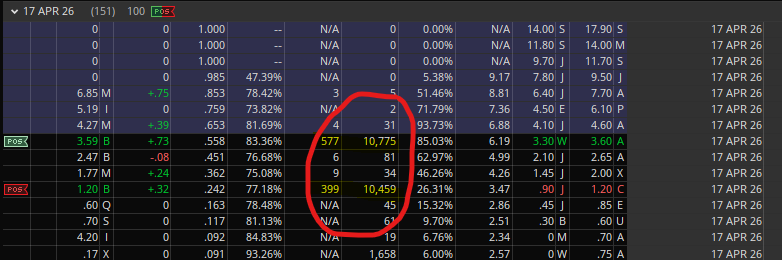
Another market validation, whether you believe it or not, is from the stock market. On Friday, November 14, after Cogent’s stock dropped 58% from the $38.3 pre-earnings to the intraday low of $15.96, a big money trader/investor paid $1.95 million premium to buy 10,000 contracts of CCOI April 17, 2026 $20/30 call spreads, betting CCOI price would rally nearly 40% to reach at least $21.95 in six months by contract expiration to break even. If the price goes to $30 or above, this trader/investor will make a net profit of $8.05 million. Obviously, someone with a very deep pocket also believes that CCOI stock has an asymmetrical risk/reward ratio and is willing to bet $1.95 million to make a kill.
Key Takeaways
CCOI stock was severely punished, down ~60%, for missing analysts’ revenue and EPS targets and for its tardiness in signing the promised 1,000 wavelength contracts. But more likely, it was punished for committing an irreparable sin: cutting its generous, reliable quarterly dividend from $1 to 2 cents. Dividend investors were mad as hell and hit the sell button with all ten figures. As a result, the highly compensated Wall Street analysts all cut their price targets in unison, from whatever their previous targets were to about ±$2 of the then-current trading price.
At the same time, Cogent’s internet access and transport services continue to generate an adjusted EBITDA of $74 million (at a margin of 30.5%), or $49 million GAAP EBITDA (at a margin of 20%).
Fourteen million of its 38 million IPv4 addresses on leasing generated a quarterly revenue of $17.5 million, an increase of 14% from Q2 and 55.5% from the same quarter in 2024. The company decided to change the lease terms, which is likely to increase asset utilization and, in turn, total revenue. It’s unclear whether investors realize that the net margin for this revenue stream is close to 100%, and that the book value of these assets was a big zero before their auditor forced an upward adjustment to reflect their more accurate economic value.
While the equity investors were in full panic mode, the bond investors seemed to be in a state of total equanimity, continuing to buy and sell the CCO, the 7%-coupon, June 2027 expiring bonds, at 100 cents on the dollar. One might wonder whether these bond investors even had internet access or read the news.
The signed $144 million LOI for two of the 24 for-sale data centers provided strong validation that their renovated data centers are indeed valuable assets. I wouldn’t be surprised if the NAV for the 180 data centers is significantly higher than Compound & Fire’s estimate.
Some BIG Money trader/investor spent $1.95 million and bought something that would be worthless if COOI’s stock does not trade above $21.95 by Friday, April 17, 2026. It’s unclear to me whether this person has profound insights into CCOI or is simply a crazy gambler.
Whether AI is or is not a bubble, whether it will burst or not, or whether OpenAI can build its 250 gigawatts of data center by 2033 or not, as long as people are using AI to create 80-page Substack articles and I use AI to produce a short summary, and my kids are posting and watching TikTok videos, Cogent’s legacy centers will have more demand.
When dividend is back on the table, probably it will mean some data centers are sold. It also means that dividend doesn’t have to be lower versus the prior quarterly dividend of $1, which is a dividend yield north of 20%.
The last and least important: my napkin math confirmed that the ROI of Cogent Edge AI servers can be 3x that of the most powerful NVIDIA GPU for particular lightweight, low-latency AI inference applications.
Disclaimer
The information in this article is provided for informational and educational purposes only.
The information is not intended to be and does not constitute financial advice or any other advice, is general in nature, and is not specific to you. Before using this article’s information to make an investment decision, you should seek the advice of a qualified and registered securities professional and undertake your own due diligence.
None of the information in this article is intended as investment advice, as an offer or solicitation of an offer to buy or sell, or as a recommendation, endorsement, or sponsorship of any security, company, or fund. The author is not responsible for any mistakes or investment decision made by you. You are responsible for your own investment research and investment decisions.