

Welcome to Compound & Fire, where we’re on a mission to build wealth the smart way. Hunting for top-quality businesses that grow shareholder value over the long haul, paving the road to financial freedom and early retirement.
This community is free, but if you’re enjoying the deep dives and want to fuel more, you can treat me to a coffee on Buy Me a Coffee . Every bit helps keep the fire burning, and I’m truly grateful for your support!
Let’s grow this journey together. Join the conversation on our Global Quality Investing Discord App and subscribe to my Substack for free if you haven’t yet!
Hello, fellow quality investors!
In the fast-evolving realm of health technology, where regulatory scrutiny and digital transformation pressures challenge even the most innovative platforms, two SaaS providers stand out for their focus on cloud-based solutions in the healthcare ecosystem: Veeva Systems Inc. (VEEV) and Vitalhub Corp. (TSX:VHI). Both empower efficiency and compliance in health-related operations. Veeva through specialized tools for life sciences like pharma CRM and clinical data management, Vitalhub via software for providers including EHR and patient flow optimization. But they diverge sharply in scale, margins, and growth trajectories. As AI integration accelerates in healthcare and global digital health spending surpasses $500 billion annually, I am pitting these names head-to-head using my proprietary Quick Scan framework. Which one flags as a candidate for in-depth quality analysis? Let’s dive in.
Quick Scan Overview: Investment Readiness Scores
Before I declare a winner, let's recap our Investment Readiness Score (IRS) methodology. This proprietary framework assesses companies across three key areas: Financial Health & Performance (e.g., debt levels, margins, ROIC), Shareholder Value & Suitability (e.g., management ownership, stock-based compensation), and Growth Metrics (e.g., revenue CAGR). Scores are normalized out of 100 per metric, with an overall IRS above 80 signaling a strong candidate for further due diligence. I use data from the latest available annual reports.
Veeva: Quick Scan
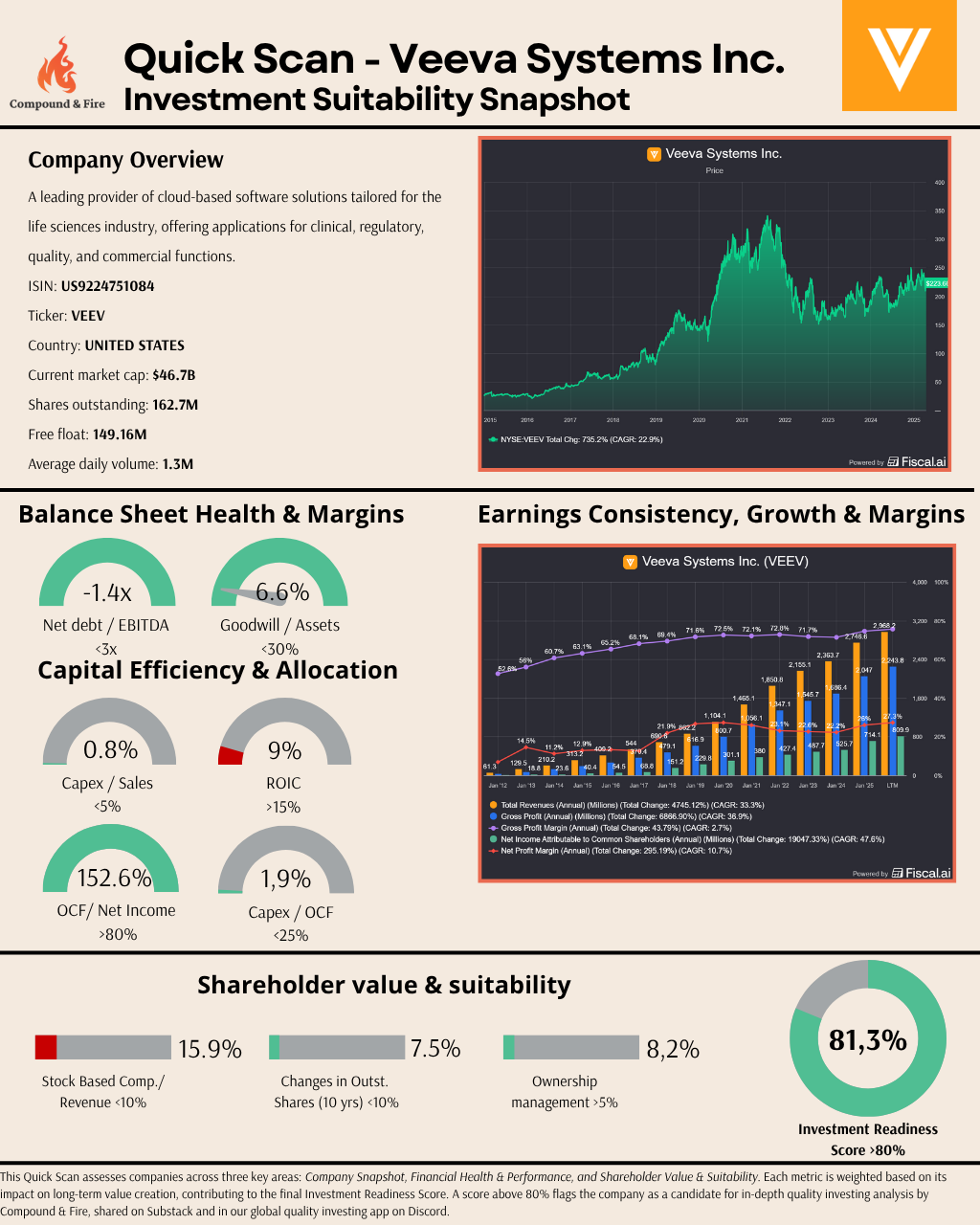
For a better picture of the Quick Scan click here. The calculation of the IRS score is available in our Discord app
Summary and Highlights: Veeva Systems Inc. is a leading provider of cloud-based software solutions tailored for the life sciences industry, offering applications for clinical, regulatory, quality, and commercial functions. It operates as the dominant platform for pharma, biotech, and medtech companies, powering everything from CRM and content management to clinical trial data analytics and AI-driven compliance tools. Headquartered in Pleasanton, California, Veeva serves over 1,000 customers globally from its U.S.-based operations. Its Investment Readiness Score (IRS) of 81.3 reflects excellent margins, high revenue growth, and very good return on invested capital. Since its 2013 IPO, VEEV stock has appreciated 1,090%, delivering a total return of 23% CAGR for its shareholders.
Net Debt / EBITDA: -1.4x (100/100) – Pristine balance sheet with net cash position, providing exceptional financial flexibility.
Intangibles / Assets: 6.6% (95.6/100) – Low ratio reflects asset-light SaaS model with minimal reliance on acquisitions.
Capex / Sales: 0.8% (97.0/100) – Extremely capital light for a software business, with negligible reinvestment needs.
Return on Invested Capital: 9.0% (48.1/100) – Looks like a low ROIC for a high-growth SaaS leader, but quite sure when making adjustment for acquisitions and / or R&D that the real ROIC will be higher. That’s a next step within the deep dive.
OCF / Net Income: 152.6% (98.2/100) – Outstanding cash conversion, far exceeding earnings due to efficient operations.
Gross Margin: 74.5% (91.5/100) – Elite margins typical of premium life sciences SaaS.
Net Profit Margin: 26.0% (84.4/100) – Exceptional profitability driven by subscription recurring revenue and pricing power.
Revenue 10YR CAGR: 21.3% (90.9/100) – Consistent high growth over a full decade, fueled by life sciences digital transformation.
SBC / Revenue: 15.9% (21.9/100) – Elevated stock-based compensation reflects tech talent retention costs.
Changes in Outstanding Shares: 7.5% (85.0/100) – Moderate share dilution over 10 years, aligned with growth incentives.
Ownership Management: 8.2% (81.3/100) – Meaningful insider alignment, with founder-CEO Peter Gassner holding significant stake.
Vitalhub Corp.: Quick Scan
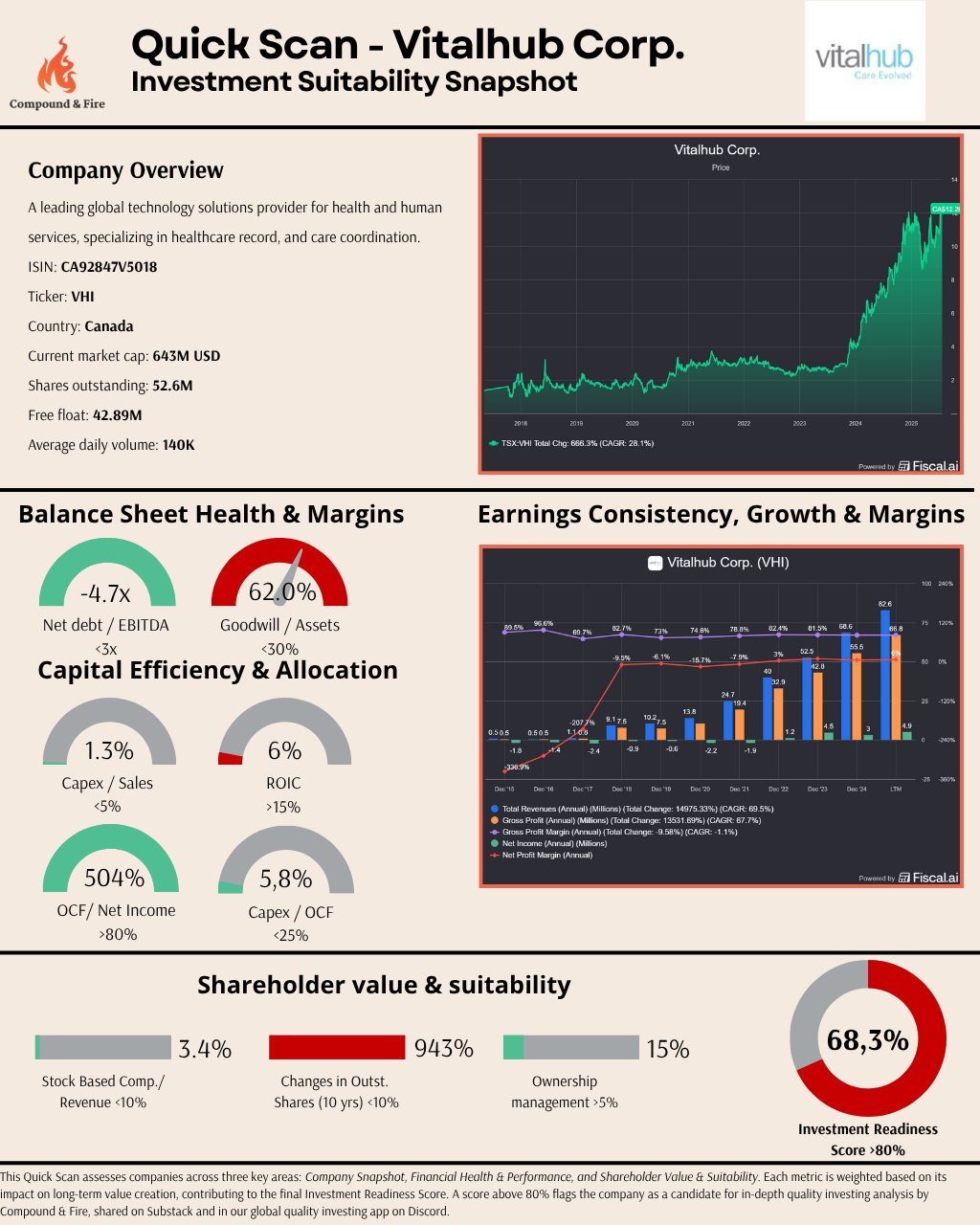
For a better picture of the Quick Scan click here. The calculation of the IRS score is available in our Discord app
Summary and Highlights: Vitalhub Corp. is a leading global technology solutions provider for health and human services, specializing in healthcare records and care coordination. It operates as an acquisition-driven SaaS platform, consolidating fragmented markets with solutions like electronic health records (EHR), patient flow optimization, case management, and workforce automation tools for hospitals, long-term care, mental health, and community services. Headquartered in Toronto, Canada, Vitalhub supports customers worldwide across North America, the UK, Australia, and beyond. Vitalhub Corp. trades on the TSX under the ticker VHI, and graduated from the TSXV to the main exchange. Its Investment Readiness Score (IRS) of 68.3 is a mixed bag of phenomenal revenue growth, outstanding gross margins, and exceptional cash conversion, offset by a low ROIC, acquisition-related dilution and intangibles. Since its July 2015 IPO, Vitalhub stock has appreciated 690%, delivering a total return of 28% CAGR for its shareholders.
Net Debt / EBITDA: -4.7 (100/100) – Pristine balance sheet with significant net cash position, offering ample flexibility for growth and acquisitions.
Intangibles / Assets: 62.0% (37.3/100) – High ratio reflects aggressive M&A strategy to consolidate the highly fragmented healthcare software niche.
Capex / Sales: 1.3% (94.8/100) – Highly capital light for a SaaS business with minimal reinvestment needs.
Return on Invested Capital: 6.0% (32.1/100) – Modest ROIC due to ongoing integrations from acquisitions, with upside as synergies materialize.
OCF / Net Income: 504% (100/100) – Extraordinary cash conversion, well above earnings, driven by recurring revenue and efficient working capital management.
Gross Margin: 80.9% (93.6/100) – Superior margins for a specialized healthcare SaaS provider.
Net Profit Margin: 4.4% (23.3/100) – Lower profitability impacted by acquisition expenses, but trending upward with scale.
Revenue 10 YR CAGR: 40.0% (100/100) – Explosive growth over the decade, fueled by strategic acquisitions and organic demand for digital health solutions.
SBC / Revenue: 3.4% (86.3/100) – Modest stock-based compensationfor a company in the tech sector.
Changes in Outstanding Shares: 943% (0/150) – Substantial dilution over 10 years from equity-financed acquisitions and raises, a key risk for shareholders.
Ownership Management: 15.0% (84/100) – Respectable insider ownership, signaling alignment with long-term value creation.
The Big Picture: Investment Readiness Check
Head-to-head, Veeva pulls ahead in profitability, capital efficiency, and stability, leveraging its dominant life sciences platform for sticky, high-margin subscription revenue amid pharma’s digital transformation. A tailwind as AI and data cloud adoption accelerates globally. Vitalhub’s acquisition-fueled growth delivers explosive revenue velocity, but its fragmented integrations dilute ROIC and trigger massive share dilution, yielding a higher-risk “growth-at-any-cost” profile despite pristine cash positions. Both exhibit SaaS discipline (ultra-low capex, exceptional OCF conversion), but Veeva’s 9% ROIC (potentially higher) vs. Vitalhub’s 6% underscores superior allocation in a mature niche. Shareholder alignment favors Veeva with moderate dilution, while Vitalhub’s 943% share explosion over 10 years raises red flags. At current levels, Veeva’s 81% readiness score flags it for quality screens, while Vitalhub’s 68% suits aggressive growth bets in healthcare digitization.
What’s the Verdict?
For quality investors, Veeva’s margin moat and proven compounding engine make it the health tech pick of the two, poised for steady upside as life sciences digitization deepens. Vitalhub offers explosive growth potential but carries integration risks and dilution headwinds that temper long-term appeal. Both warrant watches, but Veeva earns the deeper dive for its elite stability and alignment.
Winner: Veeva Systems
But is the market telling a different story? Let’s explore.
Market Reality Check: FCF Yield
To ground this in valuations, let’s examine Free Cash Flow (FCF) yields as of October 2025, incorporating the latest charts from Fiscal.ai for a visual and quantitative perspective. These charts illustrate the annual FCF yield trends, highlighting volatility, medians, and cumulative growth, which is key for assessing if these health tech compounders are priced attractively amid market fluctuations. For context, the 10-year US Treasury bond yield stands at ~4.2%.For Veeva Systems, the FCF yield chart shows a stable path between 1-4% over the past decade, with a median of 2.2% and a current yield of 2.89%.
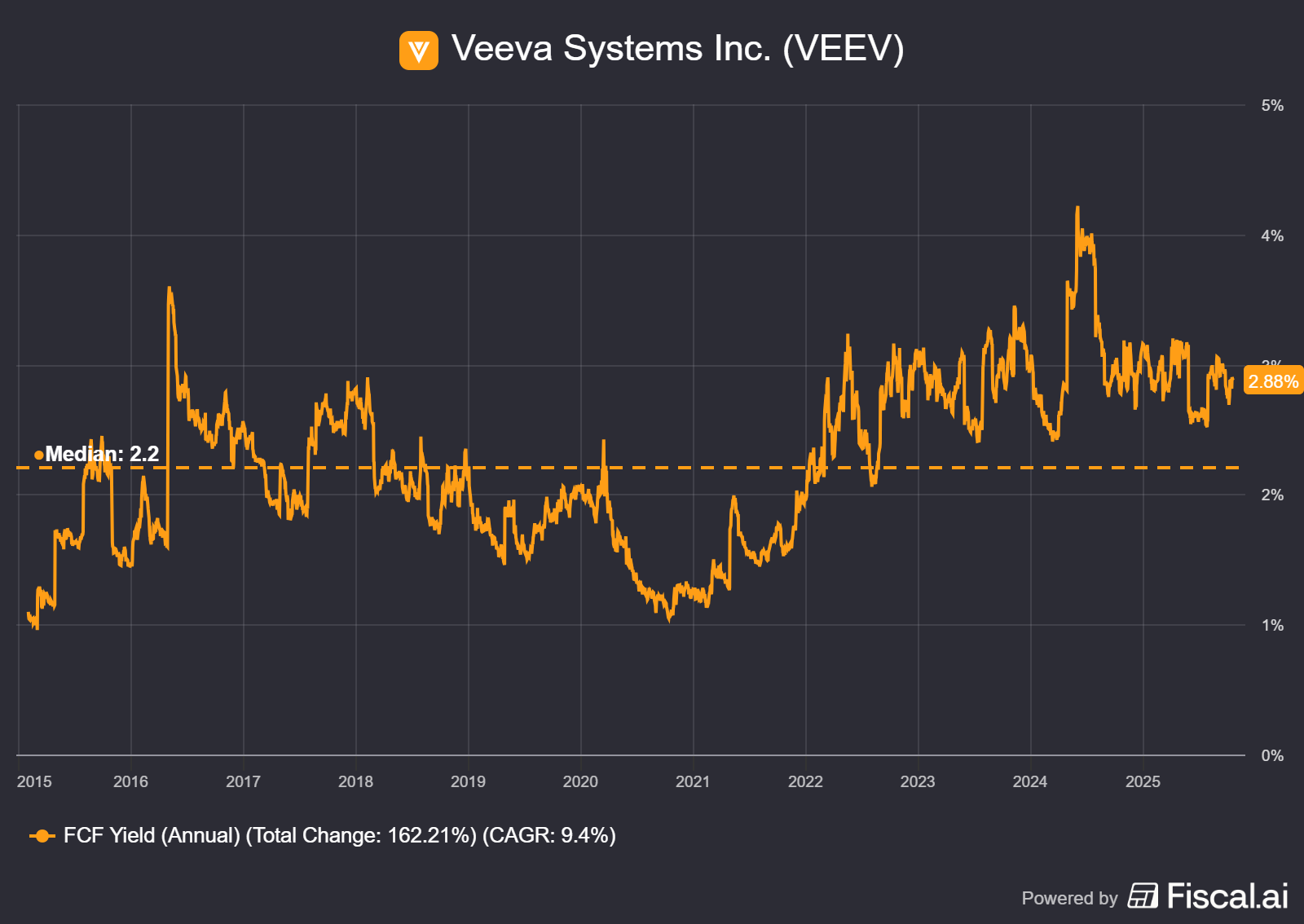
This reflects consistent cash generation from its mature subscription model, with total FCF growth of 162% (9.4% CAGR), however the yield is below the US treasury bond, indicating the stock is priced quite rich.
For Vitalhub, the chart depicts higher volatility between -20% and +15% due to acquisition timing, with a median of 0.36% and a current yield of 1.92%. Recent stabilization around 2% highlights improving cash flows post-integrations.
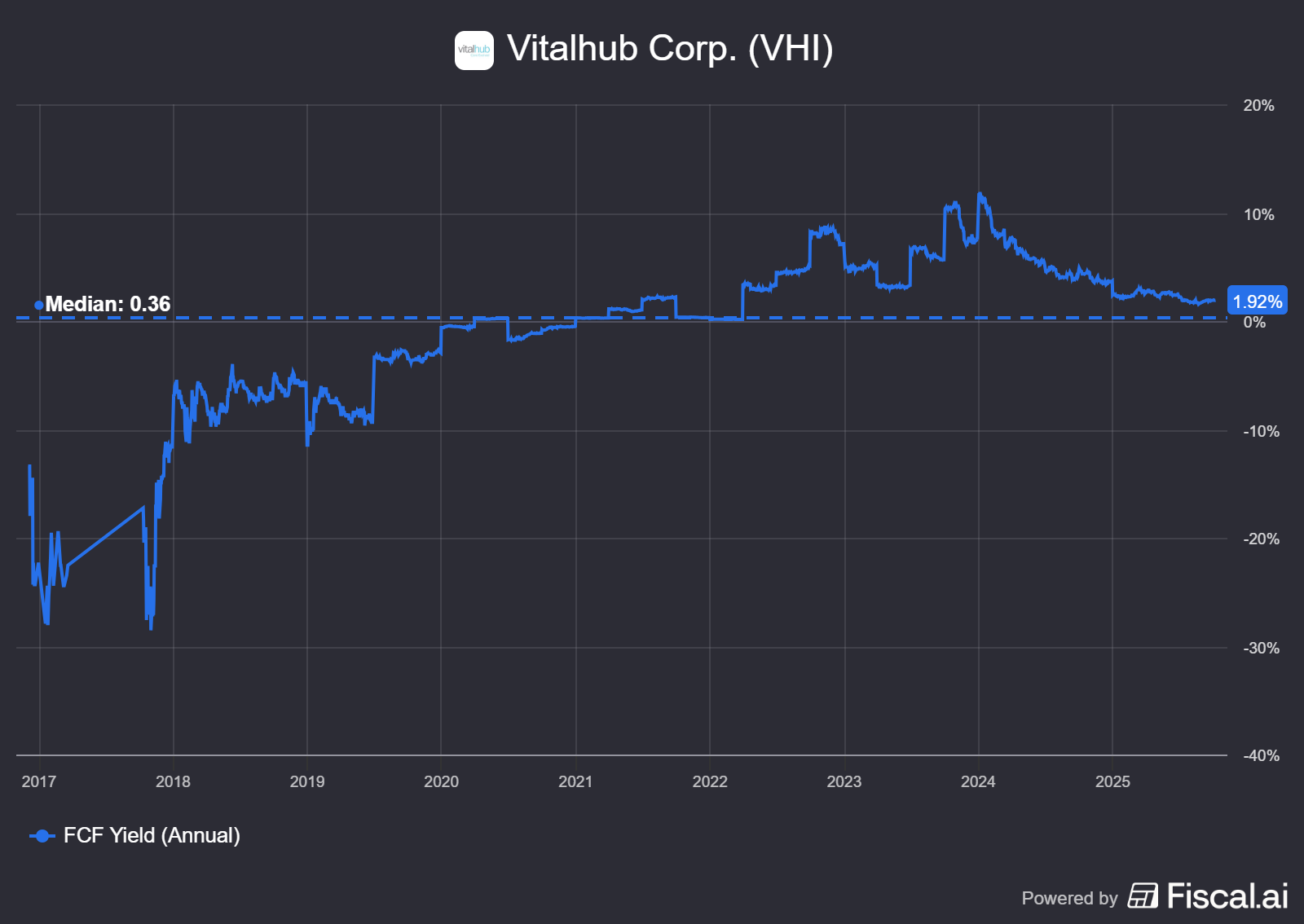
Vitalhub 1.9% is also below the 10-year Treasury, implying it’s valued quite high at the moment. From a Quick Scan perspective Veeva Systems is the most interesting company of the two as it has a lower risk profile, but from a valuation perspective both look expensive. It will be interesting to see whether a deep dive on Veeva Systems will change my mind. Expect this deep dive published soon!
Hopefully you have enjoyed this quick scan battle. Share your thoughts in the comments below or join the debate on my Global Quality Investing Discord.
Join the Quality Edge!
Stay tuned for adetailed report on Substack and my Global Quality Investing Discord. The fintech space offers rich opportunities, and Wise stands out as a leader worth watching. Until next time, keep compounding!
Share this article
If you enjoyed reading my article, feel free to share it with friends:
Disclaimer
The information in this article is provided for informational and educational purposes only.
The information is not intended to be and does not constitute financial advice or any other advice, is general in nature, and is not specific to you. Before using this article’s information to make an investment decision, you should seek the advice of a qualified and registered securities professional and undertake your own due diligence.
None of the information in this article is intended as investment advice, as an offer or solicitation of an offer to buy or sell, or as a recommendation, endorsement, or sponsorship of any security, company, or fund. The author is not responsible for any investment decision made by you. You are responsible for your own investment research and investment decisions.
Fascinating. Your analysis really makes you think about the power of quality software in healthcare. The potential of AI integration in this sector is something I truely find compelling.
How might the rapid adoption of AI in healthcare and the surge in digital health spending reshape the competitive dynamics between Veeva and Vitalhub, and which company is better positioned to leverage these trends?